Harnessing the Solar Wind: Inside the Science of Space Weather Forecasting
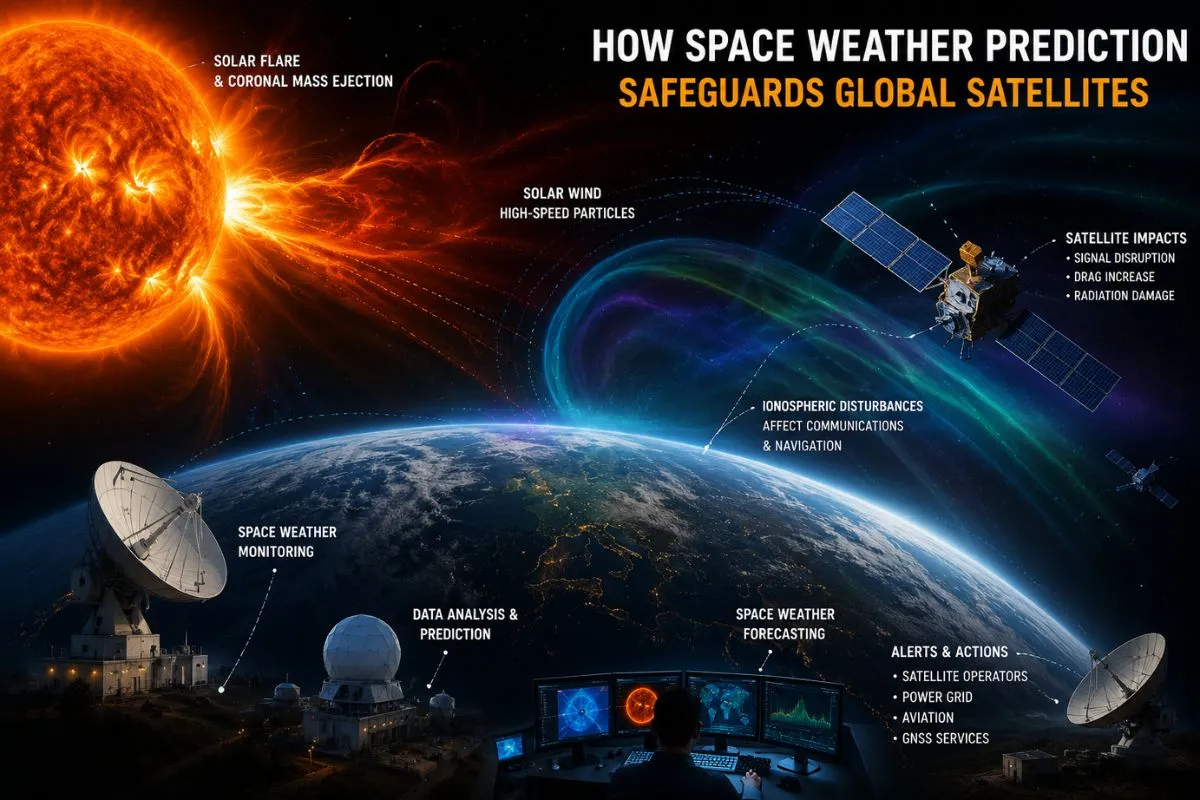
Space is far from an empty void. Beneath the quiet vastness lies a dynamic environment shaped by continuous streams of charged particles, intense magnetic fields, and unpredictable bursts of radiation emitted by the Sun. As human civilization becomes increasingly reliant on satellite infrastructure for communication, navigation, and defense, space weather forecasting has transformed from a niche scientific pursuit into a critical operational necessity.
Understanding the Mechanics of Space Weather
Just as terrestrial weather is driven by atmospheric pressure and temperature shifts, space weather is dictated by solar activity. The primary driver is the solar wind—a constant outflow of plasma consisting mainly of electrons and protons originating from the Sun’s corona.
- Coronal Mass Ejections (CMEs):Massive clouds of solar plasma and embedded magnetic fields hurled into space at high velocities. When oriented toward Earth, CMEs spark powerful geomagnetic storms.
- Solar Flares:High-energy bursts of radiation across the electromagnetic spectrum. These flares reach Earth’s atmosphere within minutes, ionization causing radio blackouts across high-frequency bands.
- Geomagnetic Distortions:The interaction between solar plasma and Earth’s magnetosphere induces electric currents in the upper atmosphere, causing orbital drag on Low Earth Orbit (LEO) satellites and inducing power surges in ground-based electrical grids.
How Space Operations Safeguard Orbital Assets
When space weather sensors detect an incoming solar storm, satellite operators activate specialized protocols to protect sensitive hardware.
- Entering Safe Mode:Spacecraft reorient their solar arrays parallel to incoming particle streams to minimize radiation exposure, temporarily powering down non-essential sensors.
- Orbital Drag Adjustments:Heating of the upper atmosphere expands air density at higher altitudes. Predictive drag models allow flight controllers to schedule automated orbit-raising maneuvers before a satellite loses altitude.
- Hardened Electronics and Shielding:Modern satellites employ fault-tolerant electronics and heavy radiation shielding around crucial microprocessors to prevent single-event upsets caused by high-energy cosmic rays.
The Future of Space Weather Telemetry
Next-generation space weather observatories positioning sensors at Lagrangian points—gravitationally stable spots between the Earth and the Sun—provide up to an hour of early warning before geomagnetic disturbances strike Earth’s magnetosphere. Combining real-time telemetry from space-based sensors with machine-learning predictive algorithms enables space agencies to forecast solar weather with higher precision, ensuring the safety of satellite constellations and future crewed deep-space missions.