
An Indian Army Wife’s Heartfelt Reflections on Operation Sindoor
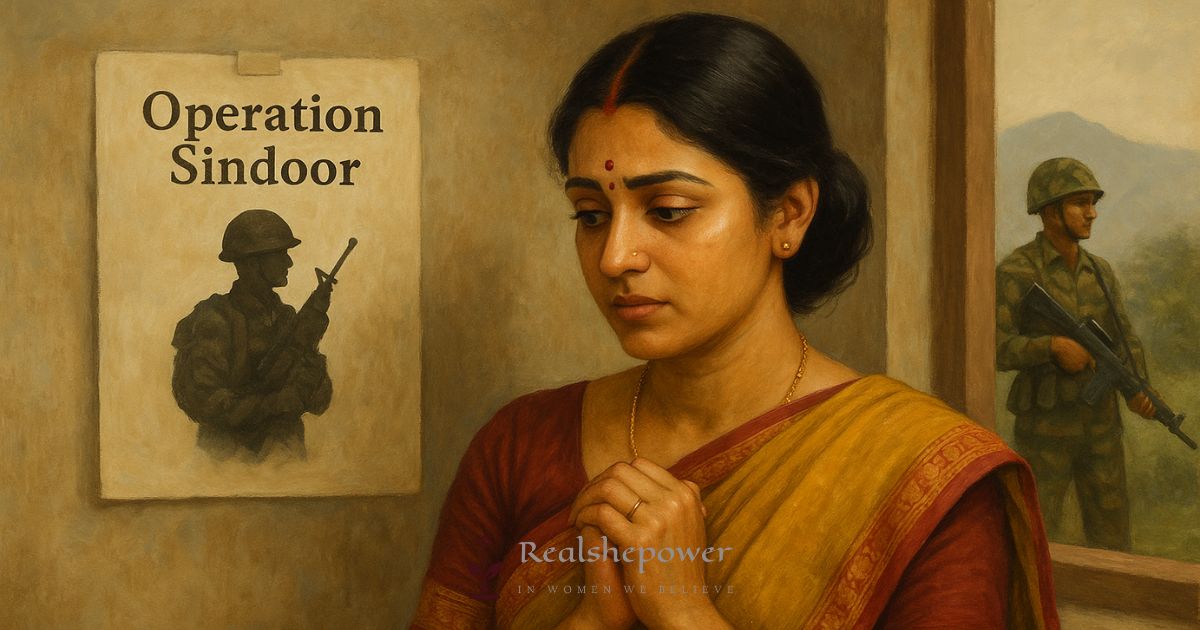
Indian Army Wife’s Heartfelt Reflections
I sit here, pen trembling in my hand, the weight of the last few weeks pressing against my chest. My husband, an officer in the Indian Army, is out there—somewhere along the Line of Control (LoC), where the air is thick with tension and the echoes of Operation Sindoor still linger. I am one of countless Indian women, wives, mothers, sisters, and daughters, who carry the silent burden of war in our hearts. We are the unseen warriors, bound by love, fortified by fear, and united by an unspoken promise to stand strong. This is my story, raw and unfiltered, woven with the threads of every woman who has ever waited for a soldier to come home.
When I heard the name Operation Sindoor, my breath caught in my throat. Sindoor—the scarlet vermillion that adorns the parting of a married Hindu woman’s hair, a symbol of love, commitment, and the sacred bond of marriage. It’s the same sindoor I apply each morning, a ritual that feels like a prayer for my husband’s safety.
The name, chosen by Prime Minister Narendra Modi to honor the widows of the Pahalgam terror attack on April 22, 2025, struck a chord deep within me. It wasn’t just a military operation; it was a tribute to us—the women who live with the constant ache of absence, who wear our sindoor as both a badge of love and a shield against fear.
The Pahalgam massacre, where 26 lives were brutally taken, including 25 Indian men singled out for their faith, shattered families. I saw Aishanya Dwivedi’s photograph on the news, a new bride in her wedding bangles, sitting beside her husband Shubham’s lifeless body. Her sindoor, still fresh, told a story of love cut short. My heart broke for her, for I know that pain too well—not of loss, thank God, but of the ever-present fear of it. “It connected with us on a personal level,” Aishanya said, tears streaming down her face as she spoke of Operation Sindoor. Her words echoed in my soul, a reminder of the shared grief that binds us army wives.
I remember the night my husband left for his posting, just days before the Pahalgam attack. We stood in our small apartment, the air heavy with unspoken words. I pressed my sindoor into my hair, my fingers lingering a moment longer, as if the act could protect him. “Don’t worry,” he said, his smile both brave and brittle. “I’ll be back before you know it.” But as the door closed behind him, I sank to the floor, clutching his uniform’s badge, the one he’d left on the dresser. That badge, with its regimental crest, became my talisman, a piece of him I could hold onto while he was out there, fighting battles I could only imagine.
Operation Sindoor was India’s response—a fierce, precise strike on nine terror camps in Pakistan and Pakistan-occupied Jammu and Kashmir (PoJK) on May 7, 2025. But for me, and for women like me, it was more than a military triumph. It was a cry of justice for the husbands we pray for, the fathers our children miss, and the futures we hold onto with trembling hope.
As an army wife, my role during this war has been one of quiet endurance. I don’t fire missiles or plan strategies, but I fight my own battles—against fear, loneliness, and the relentless ticking of the clock. Each morning, I wake to the news, my heart racing as I scan headlines for updates on the LoC. The blackouts in Jammu and Kashmir, Punjab, and Rajasthan, imposed after Pakistan’s ceasefire violations, feel like a metaphor for the darkness we navigate.
I light a diya each evening, its flame a silent vow to keep hope alive. I call my mother-in-law, another army wife from a generation past, and we share stories of waiting, of letters that arrived weeks late, of nights spent staring at the ceiling, imagining the worst.
One memory haunts me. A few years ago, during a posting in Jammu and Kashmir, my husband was caught in a crossfire incident. He came home unharmed, but the call I received from his commanding officer still echoes in my ears: “He’s fine, but it was close.” That night, I held him tighter than ever, my sindoor smudging against his shoulder as I wept. “You’re my warrior,” he whispered, but I knew the truth—I was his warrior too, fighting to keep our family whole, to keep our love unbroken. Operation Sindoor brought that memory rushing back, a reminder of how fragile our lives are, how every mission could be the one that changes everything.
I think of Pragati Jagdale, another widow of the Pahalgam attack, who called Operation Sindoor a “befitting reply.” Her words, filled with both grief and resolve, mirror my own feelings. “On hearing the name of this operation, I got tears in my eyes,” she said. I understand those tears. They are not just of sorrow but of pride, of knowing that our pain, our sacrifices, are seen and honored. The operation’s name feels like a nod to us, the women who stand behind the soldiers, our sindoor a silent testament to our strength.
Yet, the fear remains. Pakistan’s violations—drones shot down in Jammu and Kashmir, shelling that killed civilians in Poonch—keep me awake at night. I think of Munni, the widow from the Kargil War, whose story I read years ago. Her husband Hardeo’s body, brought home wrapped in the tricolor, was blackened, perhaps by poison, she said. Munni’s pain, her bare parting without sindoor, haunts me. I pray I never know that loss, but I carry her strength, her quiet dignity, in my heart.
As an army wife, I’ve learned to find solace in small acts. I volunteer at the local Army Wives Welfare Association, helping families navigate the challenges of deployment. We share meals, stories, and sometimes tears, building a sisterhood that sustains us. I write letters to my husband, though I know they may take weeks to reach him. In one, I wrote, “Your courage inspires me, but my love keeps you safe.” I don’t know if he’s read it yet, but it’s my way of fighting alongside him, of reminding him that I’m here, waiting, always.
Operation Sindoor is more than a military victory; it’s a testament to the women who hold the home front. We are the ones who kiss our husbands goodbye, who teach our children to be brave, who wipe away tears and replace them with hope. Our sindoor is not just a mark of marriage but a symbol of sacrifice, of a love that endures through war and uncertainty. To Aishanya, Pragati, Sangita, and every woman who has lost or waits, I say: You are not alone. Our pain is shared, our strength collective, our prayers a chorus that reaches the heavens.
I close my eyes and see my husband’s face, his smile that promises he’ll come home. Until then, I’ll wear my sindoor, light my diya, and carry on, a silent warrior in a war that tests us all. Operation Sindoor is our story too—a story of love, loss, and the unbreakable spirit of Indian women.
Share your thoughts or stories of resilience in the comments. Subscribe for more heartfelt reflections on India’s military families.