The Forgotten Rishikas of the Vedas: Voices of Divine Insight and Eternal Wisdom
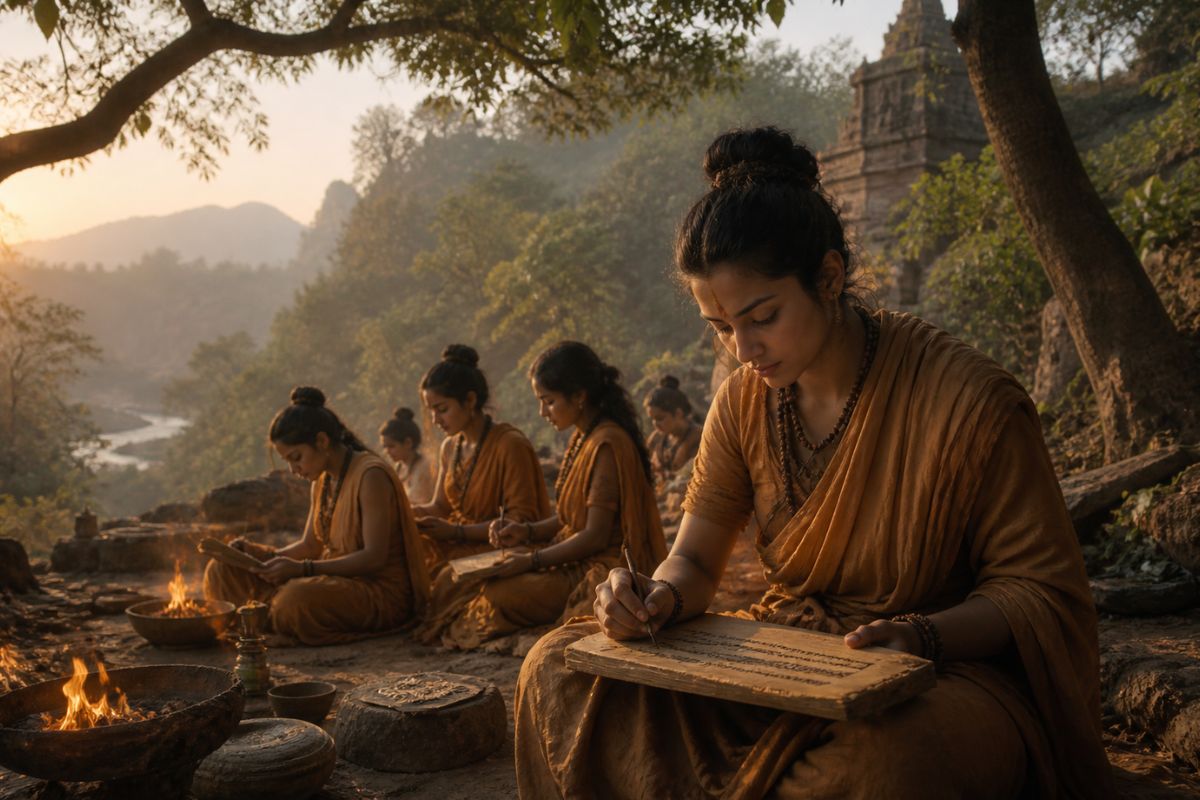
The Veda are among the oldest sacred texts known to humanity. They are not merely compositions of men. They are revelations (śruti), “heard” by seers whose consciousness touched the eternal. Among these seers were women—ṛṣikās—whose spiritual authority was neither secondary nor symbolic, but direct, luminous, and sovereign.
Their presence challenges modern assumptions and restores an ancient truth:
in the earliest layers of Sanātana Dharma, spiritual realization knew no gender.
Lopamudra: The Voice of Sacred Union

One of the most revered ṛṣikās is Lopamudra, whose hymn appears in the Rigveda (1.179). She was the wife of sage Agastya, yet her identity is not defined by him.
In her hymn, Lopamudra speaks openly of desire not as something to suppress, but as a sacred force to be understood and integrated. Her words reveal a nuanced Vedic worldview where spiritual life and worldly life are not opposites, but complementary paths.
Her voice is not submissive, it is assertive, wise, and deeply aware.
Ghosha: The Seeker of Healing and Grace
Ghosha, another ṛṣikā of the Rigveda (10.39–40), composed hymns to the divine twin physicians, the Ashvins. Afflicted by illness and social isolation, she did not retreat into silence—she sang her truth into the cosmos.
Her hymns are prayers, but also declarations of faith. They reflect a deeply personal relationship with the divine, where vulnerability becomes strength and devotion becomes transformation.
Apala: The Courage to Be Seen

The story of Apala (Rigveda 8.91) is one of raw humanity and divine encounter. Suffering from a skin condition, she invokes Indra not for superficial beauty, but for restoration, dignity, and acceptance.
Her hymn is deeply symbolic. The transformation she seeks is not merely physical—it is existential. She stands as a testament to the Vedic idea that the divine does not reject the imperfect; it transforms it.
Vak Ambhrini: The Voice That Declared “I Am the Cosmos”

If your reference to “Ambrani” comes from somewhere, it may be closest to Vak Ambhrini, the seer of the Devi Sukta (Rigveda 10.125).
This hymn is one of the most extraordinary declarations in all spiritual literature. Speaking as the embodiment of Vāk (cosmic speech), she proclaims:
“I move among the gods… I uphold the universe… I am the Queen, the gatherer of treasures.”
This is not poetry—it is realization.
Vak Ambhrini does not worship the divine as separate from herself. She speaks as the divine. Her voice dissolves the boundary between seeker and sought, revealing a truth later echoed in the Upanishadic mahāvākyas.
The Truth Behind the Names
The Vedic tradition is vast, and over millennia, names have been misremembered, merged, or altered in oral and written transmission. But what remains undeniable is this:
- Women were not absent in the Vedas.
- They were not silent.
- They were not secondary.
They were seers, composers, philosophers, and realizers of truth.
A Reverent Closing
To speak of the ṛṣikās is not to romanticize the past, it is to restore a forgotten balance. These women did not seek validation. They did not argue for equality. They simply realized truth and spoke it.
And in doing so, they left behind not just hymns, but living echoes of consciousness that continue to inspire, awaken, and elevate.