Vak Ambhrini: The Vedic Woman Sage Who Spoke as the Universe Itself
When a Woman Became the Voice of the Cosmos
There are moments in human history so profound that they seem to stand outside time, moments where the human voice becomes something more than human, where it transforms into a channel for the infinite, where identity dissolves and truth speaks for itself and among those rare, luminous moments stands the voice of Vak Ambhrini, a woman sage of the Rigveda, whose revelation in the Devi Sukta (10.125) remains one of the most extraordinary declarations in all of spiritual literature not because it praises the divine, but because it becomes it, not because it seeks truth, but because it speaks as truth itself.
At a time often misunderstood as patriarchal in its spiritual authorship, the Vedas quietly preserve a reality far more expansive that realization was never the privilege of gender, but the attainment of consciousness and Vak Ambhrini stands not as an exception, but as undeniable evidence that the highest spiritual insight in ancient India was accessible to those who transcended limitation, regardless of whether they were called man or woman.
Who Was Vak Ambhrini? The Mystery Beyond Biography
Unlike historical figures defined by timelines, events, and personal narratives, Vedic seers exist in a different dimension of remembrance, they are known not for what they did, but for what they realized and in this sense, the absence of detailed biography about Vak Ambhrini is not a limitation, but a reflection of the Vedic worldview itself where the individual dissolves into the universal.
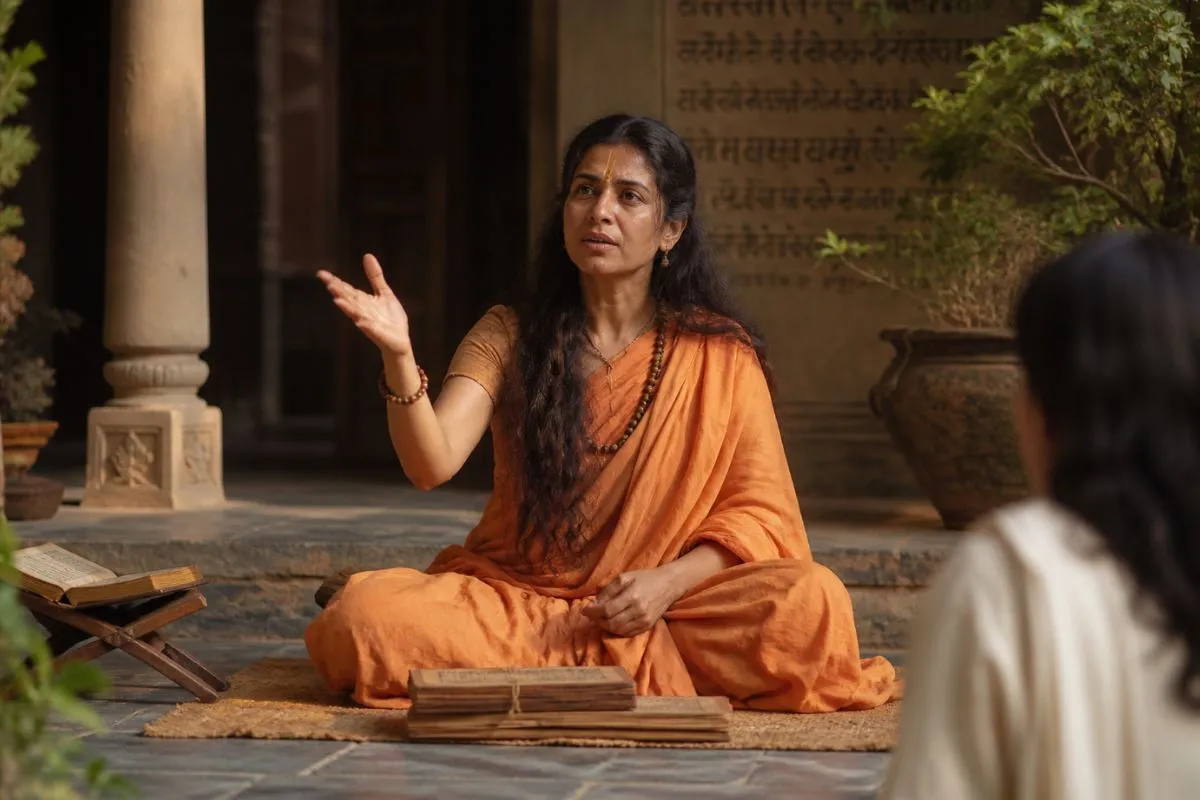
Vak Ambhrini is identified as a ṛṣikā, a female seer, whose revelation forms the Devi Sukta — a hymn not composed in the ordinary sense, but heard in a state of heightened awareness — a direct experience of the cosmic principle known as Vāk, the primordial speech, the creative vibration that gives rise to existence.
Her name, “Ambhrini,” connects her to a lineage, yet the power of her voice transcends lineage entirely because what she expresses is not inherited knowledge, but self-realized truth.
The Devi Sukta: A Declaration Unlike Any Other
The Devi Sukta is not a prayer, not a plea, not an act of devotion in the conventional sense it is a revelation of identity, a moment where the boundary between the individual self and the cosmic self dissolves completely and what emerges is a voice that does not describe the divine, but is the divine.
Vak Ambhrini proclaims that she moves among the gods, that she sustains the universe, that she is the source of power behind all forces and these statements are not symbolic exaggerations, nor philosophical abstractions they are expressions of a state of consciousness where the seer recognizes herself as inseparable from the totality of existence.
In the Vedic framework, this is not blasphemy — it is the highest realization — the recognition that the essence within is not different from the essence that pervades the cosmos.
Vāk: The Cosmic Feminine Power
To understand Vak Ambhrini is to understand Vāk, the principle she embodies — Vāk is not merely speech as we know it — it is the creative intelligence of the universe, the force through which the unmanifest becomes manifest, the vibration through which existence expresses itself.
In later traditions, this principle evolves into the concept of Shakti, the divine feminine energy that animates all creation but in the Devi Sukta, we encounter it in one of its earliest and most direct expressions not as a distant goddess, but as an experienced reality.
Vak Ambhrini does not worship Vāk — she is Vāk — and in doing so, she reveals a truth that continues to resonate across centuries that the divine feminine is not external, not symbolic, not confined to mythology it is the very fabric of existence itself.
A Radical Vision of Spiritual Equality
One of the most striking aspects of Vak Ambhrini’s revelation is what it implies about the nature of spiritual authority in Vedic India in a text that forms the foundation of one of the world’s oldest spiritual traditions, a woman does not merely participate, she speaks with the highest authority possible.
This challenges modern assumptions and forces a re-examination of history because the presence of Vak Ambhrini, along with other women seers, demonstrates that the earliest layers of Indian spirituality were not defined by exclusion, but by inclusivity grounded in realization.
She does not ask for recognition, she does not argue for equality, she simply exists as proof of it.
Beyond Devotion: The Philosophy of Identity
The Devi Sukta anticipates ideas that would later be articulated in the Upanishads — the concept that the individual self (Atman) is not separate from the ultimate reality (Brahman) but what makes Vak Ambhrini’s expression unique is that it is not presented as philosophical doctrine — it is lived experience.
Her words dissolve duality — there is no longer a seeker and a sought, a devotee and a deity — there is only being.
And in that being, there is no fragmentation, no division, no hierarchy only a seamless unity that encompasses all existence.
Why Vak Ambhrini Matters Today
In a world still grappling with questions of identity, equality, and empowerment, the voice of Vak Ambhrini emerges not as a relic of the past, but as a living force of relevance because her realization transcends social constructs and speaks directly to the core of human existence.
She reminds us that power does not come from external validation, that identity is not confined to labels, and that the deepest form of empowerment is not granted, it is realized.
For women, her voice is not merely inspirational, it is transformational because it shifts the narrative from seeking space to embodying presence.
Conclusion: The Voice That Still Echoes
Vak Ambhrini’s words have traveled across millennia, not because they were preserved, but because they are timeless they do not belong to an era, a culture, or a gender they belong to the realm of truth itself.
She did not leave behind a biography, a dynasty, or a movement — she left behind something far more enduring — a moment of pure realization captured in sound — a voice that declared, without hesitation and without division, the unity of all existence.
And perhaps that is why her presence feels so powerful even today because in a world full of noise, her voice does not ask to be heard, it simply is.
And in that being, it continues to awaken those who are ready to listen, not to her, but to the same truth within themselves.
FAQs
Who was Vak Ambhrini?
Vak Ambhrini was a female Vedic sage (ṛṣikā) credited with the Devi Sukta (Rigveda 10.125), one of the most profound hymns declaring unity with the cosmos.
What is the Devi Sukta?
The Devi Sukta is a hymn in the Rigveda where Vak Ambhrini expresses her identity with the universal divine force, representing Vāk, the cosmic speech.
Were there women sages in the Vedas?
Yes, the Vedas include several women seers whose hymns are preserved, proving that spiritual realization was not limited by gender.
Why is Vak Ambhrini important?
She represents one of the earliest recorded expressions of non-dual realization and stands as a powerful example of women’s spiritual authority in ancient India.