15 of the World’s Most Bizarre Festivals, and They’re All Real
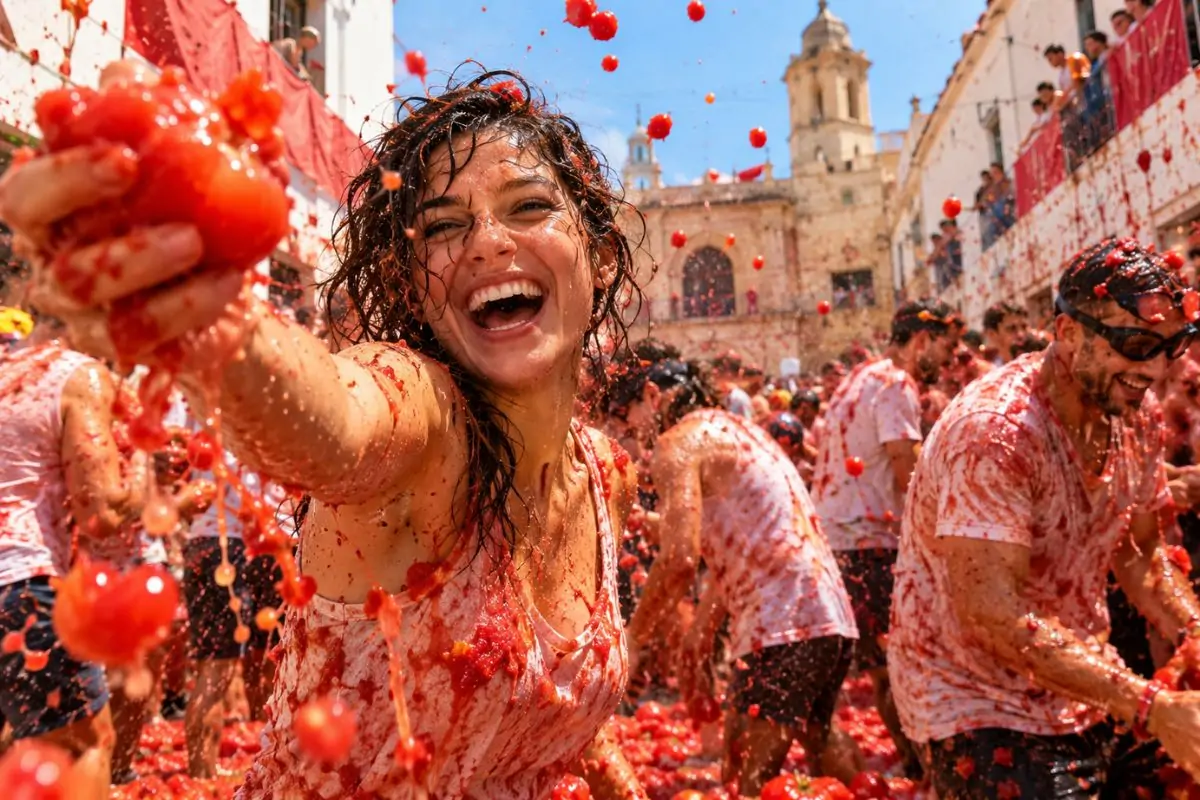
Every culture has its version of a big celebration, but some countries took “festival” and ran somewhere completely unexpected with it. Tomato fights, baby jumping, crying competitions, frozen hair contests. Here are fifteen genuinely real festivals happening around the world right now, verified and still running.
Related read:if quirky, under-the-radar global customs are your thing, you’ll also enjoy our piece on10 bizarre laws that are completely real and still enforced today.
1. La Tomatina, Spain
What happens:Every August, the small town of Buñol turns its streets into a battlefield of overripe tomatoes, with tens of thousands of participants throwing an estimated 150,000 kilograms of fruit at each other over the course of a single hour.
Highlight:It started in 1945 as a spontaneous street brawl among young locals and somehow became one of the most famous festivals in the world, drawing international visitors purely to get pelted with tomatoes on purpose.
2. Boryeong Mud Festival, South Korea
What happens:Held every July on Daecheon Beach, the festival turns mineral-rich local mud into the centrepiece of wrestling matches, mud slides, and mud pools, originally launched to promote a regional cosmetics line made from the same mud.
Highlight:What began as a marketing idea now draws millions of visitors over its two-week run, making it one of the most commercially successful “bizarre” festivals on this entire list.
3. Cheese Rolling, Cooper’s Hill, England
What happens:Competitors chase a wheel of double Gloucester cheese down a steep, uneven hill in Gloucestershire, with the winner being whoever reaches the bottom first, cheese or no cheese.
Highlight:The hill is steep enough that most participants simply tumble the entire way down rather than run, and injuries are common enough that ambulances are a standard part of the event setup every year.
4. Wife Carrying World Championships, Finland
What happens:Husbands race along a 253.5 metre obstacle course in Sonkajärvi while literally carrying their wives, including through an icy water pool along the way.
Highlight:The sport takes itself seriously enough to have an official guide titled “How to Become a Master in Wife Carrying,” and the winning husband traditionally receives his wife’s weight in beer as the prize.
5. World Toe Wrestling Championships, England
What happens:Competitors lock bare toes in Ashbourne and attempt to pin their opponent’s foot down, essentially arm wrestling with feet instead of hands.
Highlight:Despite how small-scale it sounds, the event has run for decades and donates its proceeds to charity every year.
6. Air Guitar World Championships, Finland
What happens:Contestants mime elaborate, theatrical guitar performances with no actual instrument, judged on technical skill, stage presence, and what organisers call “airness.”
Highlight:It’s judged with the same seriousness as a real musical competition, which is exactly what makes watching grown adults air guitar for a championship title so entertaining.
7. Noche de Rábanos (Night of the Radishes), Oaxaca, Mexico
What happens:Every December 23rd, local sculptors carve oversized radishes into elaborate scenes depicting historical and religious moments, competing for cash prizes judged on artistry alone.
Highlight:The radishes are grown specifically oversized for this one night, and the carved sculptures rarely survive past the following morning, making it one of the most short-lived art forms in the world.
8. El Colacho (Baby Jumping Festival), Castrillo de Murcia, Spain
What happens:Men dressed as devils leap over rows of babies born within the past year, laid out on mattresses in the street, as part of a tradition believed to cleanse the infants of original sin.
Highlight:It’s considered one of the more unusual baptism-adjacent rituals in the Western world, and remarkably, serious injuries are rare despite how the premise sounds.
9. Nakizumo (Crying Sumo), Japan
What happens:Sumo wrestlers hold babies and attempt to make them cry first, based on an old belief that a baby’s loud crying wards off evil spirits and brings good health.
Highlight:The tradition is roughly 400 years old, and officials sometimes wear frightening masks specifically to speed up the crying, making it one of the gentler entries on this list despite the chaos it looks like on camera.
10. Hadaka Matsuri (Naked Man Festival), Saidaiji, Japan
What happens:Around 10,000 men, dressed only in traditional loincloths, pack into near-freezing temperatures near Saidaiji Temple competing to grab a pair of lucky sticks thrown into the crowd by a priest.
Highlight:Despite the visual chaos, it’s rooted in a centuries-old purification ritual meant to bring the person who catches the sticks a year of good fortune.
11. Hokkai Heso Matsuri (Belly Button Festival), Furano, Japan
What happens:Held in Furano City, which sits at roughly the geographic centre of Hokkaido, the festival has participants paint faces on their bare stomachs and dance through the streets, treating their belly buttons as the literal “centre” the town is named for.
Highlight:The festival’s entire concept is built on a single geographic pun, the town’s location at the island’s centre inspiring a festival built around the human body’s own centre point.
12. Takhini Hot Springs Hair Freezing Contest, Yukon, Canada
What happens:Bathers dunk their hair in the Takhini Hot Pools during temperatures as low as minus 20 degrees Celsius, then style it into frozen sculptures before it can thaw, competing for the most creative frozen hairstyle.
Highlight:The contrast of soaking in hot mineral water while your own hair freezes solid above the surface makes this one of the most photogenic entries on this entire list.
13. Monkey Buffet Festival, Lopburi, Thailand
What happens:Locals lay out an enormous buffet of fruits and vegetables specifically for the thousands of wild monkeys that live throughout the town, as a gesture of gratitude for the tourism the animals bring in.
Highlight:It directly breaks the usual rule you’ll hear at almost every other animal sanctuary in the world, don’t feed the wildlife, turning that exact instinct into the entire point of the celebration.
14. Fiesta de Santa Marta de Ribarteme, Spain
What happens:In the village of Las Nieves, people who survived a serious illness or near-death experience in the past year are carried through the streets lying inside open coffins, as a public act of gratitude for surviving.
Highlight:Once the procession ends, the “almost-dead” climb out of their coffins and join the rest of the village in dancing and celebrating, turning what sounds like a funeral procession into one of the more life-affirming traditions on this list.
15. Up Helly Aa, Shetland, Scotland
What happens:Held every January in Lerwick, hundreds of torch-bearing participants dressed as Vikings march through the streets before ceremonially burning a full-sized replica Viking longship.
Highlight:The festival is a relatively modern invention, dating back only to the 1880s, despite looking and feeling like it belongs to an ancient Norse ritual passed down for a thousand years.
FAQ
Are these festivals safe to attend as a tourist?
Most are, though a few, especially Cheese Rolling and La Tomatina, involve real physical risk and injuries are common. Checking each event’s official safety guidance before attending is worth doing.
Do any of these festivals have deep historical or religious roots?
Several do. El Colacho, Nakizumo, and Hadaka Matsuri all trace back centuries to specific religious or spiritual beliefs, while others, like Up Helly Aa and the Belly Button Festival, are more modern inventions built around local identity.
Which of these festivals is the most tourist-friendly?
Boryeong Mud Festival and La Tomatina are both specifically structured around large international crowds, with organised entry points, timed sessions, and clear participation rules, making them the easiest for first-time visitors to join.
Can you participate in these festivals or only watch?
Nearly all of them are built for active participation rather than spectating, which is a big part of what makes them famous in the first place.
Why do so many of these bizarre festivals come from Japan and Spain specifically?
Both countries have exceptionally deep, localised festival traditions tied to individual towns and shrines, many centuries old, which naturally produced a wide variety of hyper-specific, unusual customs over time.