Jokamiehenoikeus: The Finnish Law That Lets You Camp on Anyone’s Land
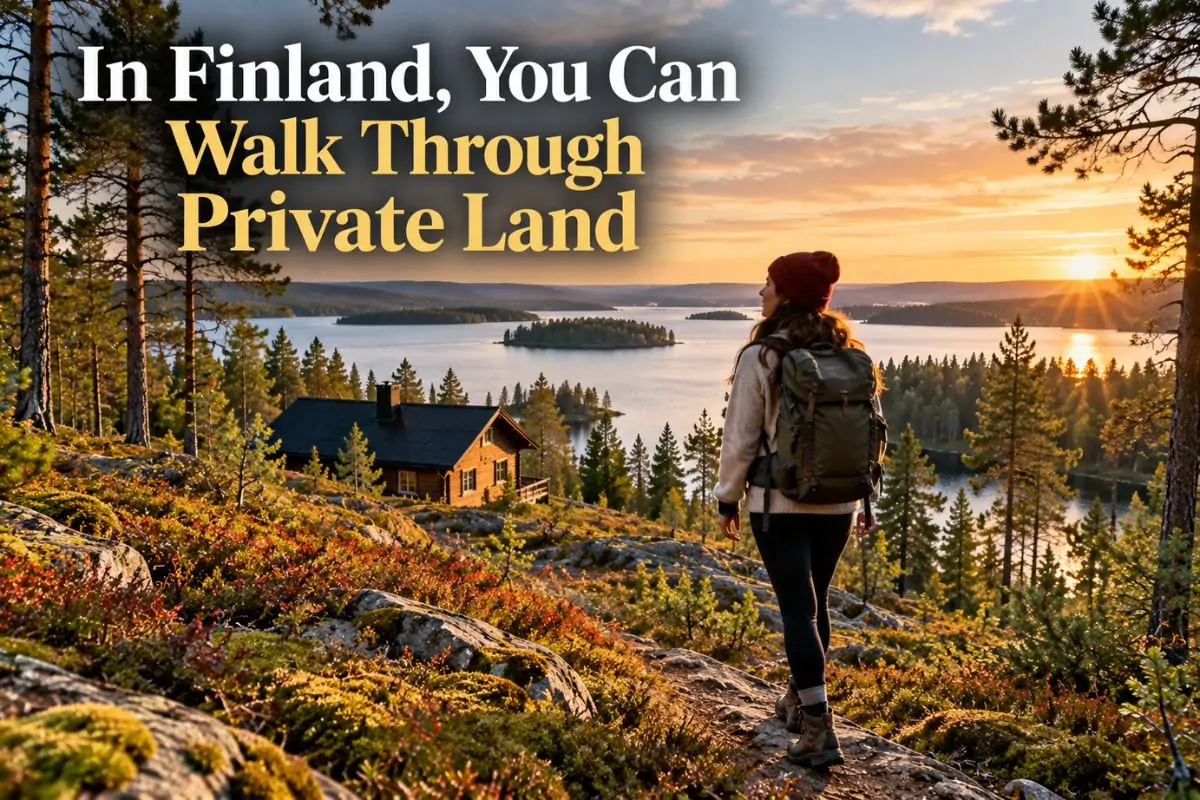
Imagine walking into a forest in your own country, pitching a tent for the night, picking a basket of wild berries, and swimming in a lake, all without owning a single square metre of the land you’re standing on, and without breaking any law. In most of the world, that’s trespassing. In Finland, it’s a centuries-old legal right available to absolutely everyone, citizen or tourist, and it has a name most people outside the Nordics have never heard: jokamiehenoikeus, Everyman’s Right.
- Finland’s “Everyman’s Right” lets anyone camp, forage, fish, and roam on almost any land, regardless of ownership
- Basic etiquette applies: stay about 150 metres from homes, get permission for fires, and leave no trace
- The right has never been written into one specific law, surviving instead as an old customary right
- Similar, slightly less expansive versions exist across Norway, Sweden, Estonia, Iceland and Scotland
- The custom is tied to Finland’s harsh winters and the deeply communal relationship Finns have with their landscape
- Rising travel costs are driving fresh global interest in the right as a free, low-impact way to see a country
What the Law Actually Allows
The right grants anyone living in or visiting Finland the freedom to roam the countryside, forage for food, fish with a line and rod, and make general recreational use of natural areas, largely regardless of who legally owns that land. It applies to privately owned forests, lakes, and open countryside alike, with only the government able to exempt specific areas from it, and even that isn’t straightforward to arrange.
In practice, this means a visitor can set up a tent in a stranger’s forest for the night, pick as many wild blueberries, lingonberries, or mushrooms as they can carry, and swim in virtually any lake they come across, all without asking anyone’s permission first.
“Finland’s beautiful nature is open to everyone to explore and enjoy.”
Freedom With Fine Print
The right isn’t a free-for-all, and Finns are fairly particular about the etiquette surrounding it. Campers are generally expected to stay roughly 150 metres away from the nearest inhabited house or cottage, well out of sight and earshot of whoever actually lives there. Lighting an open fire requires either permission from the landowner or a designated, officially marked spot, and is banned outright whenever forest fire warnings are active. Motorised vehicles are excluded from the right entirely, and anything resembling large-scale commercial foraging, rather than personal use, falls outside its protection too.
One expert who spends her time explaining these rules to curious audiences across the country, Anne Rautiainen of the Outdoor Association of Finland, has pointed out that most violations aren’t deliberate at all, usually coming down to visitors simply not knowing the specifics rather than willfully ignoring them.
Older Than the Finnish State Itself
What makes jokamiehenoikeus especially unusual as a legal concept is that it was never actually written into a single specific law. It exists instead as an old, unwritten customary right, inherited from centuries of rural Nordic life long before modern property law as we know it existed, when land was vast, communities were sparse, and the idea of fencing off a forest from your neighbours would have seemed almost absurd.
Finland isn’t alone in this tradition. Norway has its own version called allemannsretten, Sweden enshrined allemansrätt directly into its constitution in 1994, and similar rights exist, in varying strengths, across Estonia, Iceland, Scotland, and a handful of other European countries. But most travel writers who’ve compared them agree Finland’s version remains the most expansive and least restricted version of the right still practiced anywhere in Europe today.
A Law Shaped by Darkness
There’s a quieter, more human story behind why a country would build this kind of radical openness into its culture. Finland experiences genuinely extreme seasonal darkness, with the far north living through what’s locally called kaamos, a stretch of near-continuous winter night. One Finnish writer reflecting on her own country’s character described this directly, framing the long, dark winters as something that shaped the famously resilient Finnish spirit known as sisu, while also fostering the kind of quiet, generous hospitality visitors to Finland often remark on.
“In Finland, the silence isn’t empty, it’s full of answers.”
That quote captures something close to the philosophy underneath jokamiehenoikeus itself. Nature isn’t treated as a possession to be fenced off and protected from others, it’s treated as a shared, almost spiritual resource, one that every single person living through those long winters has an equal claim to.
Why It’s Catching Attention Again Now
With the rising cost of travel and accommodation worldwide, this kind of free, legally protected access to nature has started getting renewed international attention. Writers covering the trend have specifically framed it around the cost of living crisis, pointing out that a Nordic right first designed for rural subsistence now doubles as one of the cheapest, lowest-impact ways to actually experience a country’s landscape without paying for a single campsite or guided tour.
For travellers used to needing a permit, a booking, or a landowner’s blessing just to pitch a tent for the night, Finland’s approach can feel almost disorienting at first. Then, usually around the second or third night falling asleep beside a lake nobody owns, it starts to feel like exactly how it should have worked all along.
Highlights
- Jokamiehenoikeus lets anyone in Finland roam, forage, fish, and camp on almost any land, public or private
- Campers must generally stay about 150 metres from the nearest house and need permission for open fires
- The right has no single codifying law, it survives as an old, unwritten customary right predating modern property law
- Similar rights exist in Norway, Sweden, Estonia, Iceland, and Scotland, but Finland’s version is considered the most expansive
- Sweden enshrined its own version, allemansrätt, directly into its constitution in 1994
- Rising travel costs have renewed global interest in the right as a nearly free way to experience nature