
GenAI Hits 39% of the World’s Population in Just One Year
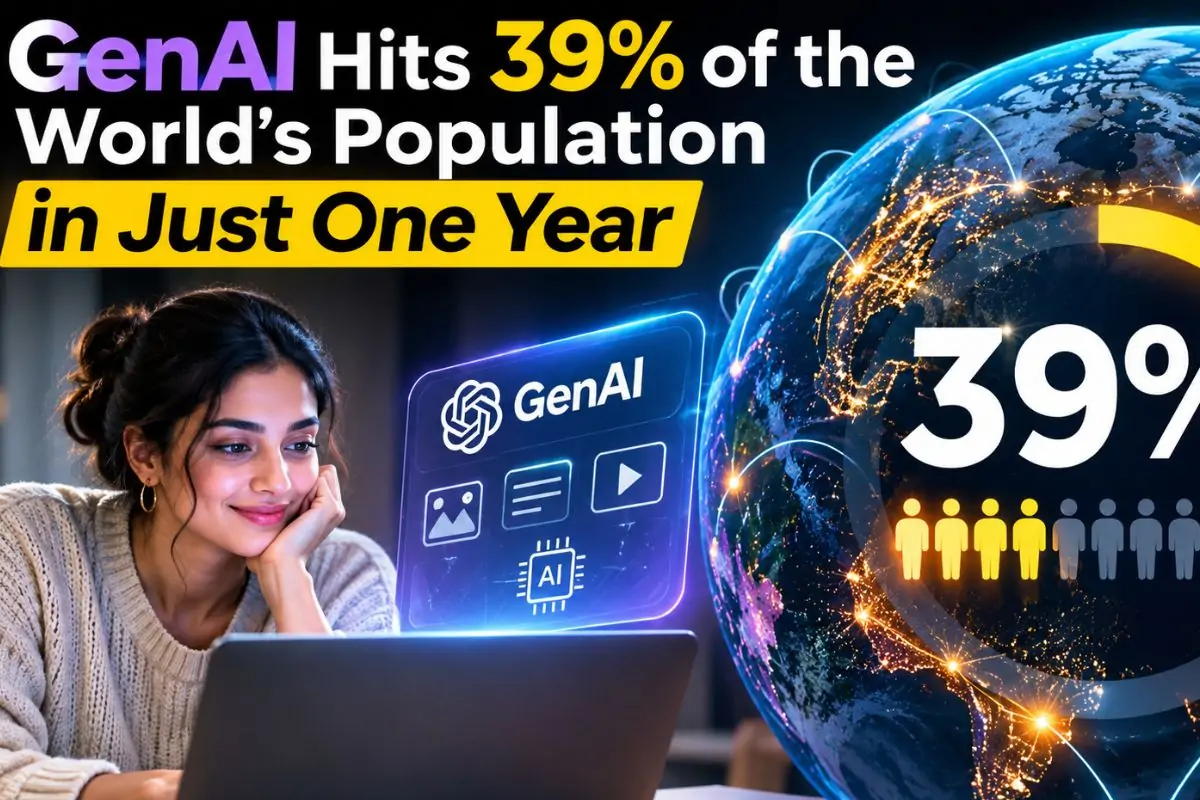
Generative AI has reached a major milestone. According to the Digital 2027 Global Overview Report from We Are Social and Meltwater, around 3.24 billion people now use generative AI tools each month. That figure equals 38.9 percent of the global population, or nearly 39 percent when rounded.
In the 12 months from October 2025 to October 2026, active GenAI users grew by 57.2 percent. The platforms added 1.2 billion new users in a single year. More than one in three people worldwide now engage with tools powered by large language models every month.
This rapid rise marks one of the fastest technology adoption rates in recent history. It outpaces the early growth of many earlier digital platforms and shows how quickly generative AI has moved from niche experiment to everyday utility.
What the Numbers Really Mean
The 3.24 billion figure comes from analysis of leading large language model platforms, including ChatGPT, Google Gemini, Anthropic’s Claude, and others. Analysts estimate monthly active users across these services.
Important context matters here. The total may include some duplication. One person can use multiple AI tools or maintain separate accounts for personal and work purposes. Even with that caveat, the scale remains striking. Generative AI now sits alongside social media and internet access as a core part of global digital behavior.
For comparison, global internet users stood at about 6.15 billion in early October 2026, or 73.9 percent of the world’s population. Social media user identities reached 5.81 billion. Generative AI has closed a large part of that gap in a short time.
ChatGPT continues to lead the category by a clear margin, often attracting roughly twice as many monthly active users as its closest competitors. Google’s Gemini has seen especially strong growth. Its mobile app user base increased fourfold over the past year. Anthropic’s Claude has also expanded rapidly.
Why Generative AI Adoption Exploded
Several factors drove the 57 percent surge.
Access became far easier. Free tiers, mobile apps, and integration into existing products lowered the barrier for new users. People no longer needed technical knowledge to get useful results.
Practical value appeared quickly. Users turn to GenAI for information searches, advice on everyday problems, learning new skills, writing help, creative work, and productivity tasks. Surveys in the Digital 2027 report and related data show information seeking and problem solving as top reasons for use.
Competition among providers improved quality and features. Better models, multimodal capabilities, and specialized tools kept people engaged and attracted newcomers.
Regional growth added momentum. China alone added at least 150 million generative AI users in 12 months according to local data, pushing its total past 700 million. Many emerging markets showed strong uptake once tools became available in local languages and on affordable devices.
How People Are Using Generative AI
Current patterns reveal clear priorities. A large share of users rely on these tools to find information, often treating them as an alternative or complement to traditional search. Many seek practical advice or solutions to specific problems. Learning and skill development rank high as well.
Creative applications and work-related tasks also appear frequently. Students, professionals, and casual users all contribute to the totals. The technology has moved beyond early adopters into broader demographics, including older adults in some markets.
At the same time, traditional web traffic on major sites has shown declines in some measurements. Time spent on social platforms and video continues to rise. Generative AI is reshaping how people discover information and complete tasks online.
Challenges That Remain
High adoption numbers do not mean equal access. Internet connectivity still limits use in many regions. Roughly one-quarter of the global population remains offline. Among those already connected, differences in device quality, digital skills, and language support create uneven experiences.
Data privacy, accuracy of outputs, and the environmental cost of large models continue to draw scrutiny. Some users pay for premium versions while the majority rely on free access. The gap between casual experimentation and deep, productive use remains wide in many places.
Businesses face their own questions. While consumer adoption has soared, enterprise deployment and measurable return on investment vary widely by sector and company size.
What Comes Next for Generative AI
The next phase will likely focus on deeper integration. AI agents that handle multi-step tasks, stronger multimodal features, and tighter connections with everyday software could push usage even higher. Competition will keep pressure on quality, speed, and cost.
Regulators and platforms will shape the environment through rules on data, safety, and transparency. Education systems and workplaces will adapt as more people treat these tools as standard resources.
The 39 percent milestone shows generative AI has entered the mainstream faster than many expected. The speed of the past year suggests further growth is likely, though the exact pace will depend on access, trust, and continued usefulness.
The Digital 2027 data provides a clear snapshot of where things stand in late 2026. Generative AI is no longer emerging technology for most of the connected world. It has become a regular part of how billions of people find answers, create content, and get work done.