AI Can Make You Beautiful. What Happens When You Start Believing the AI Version?
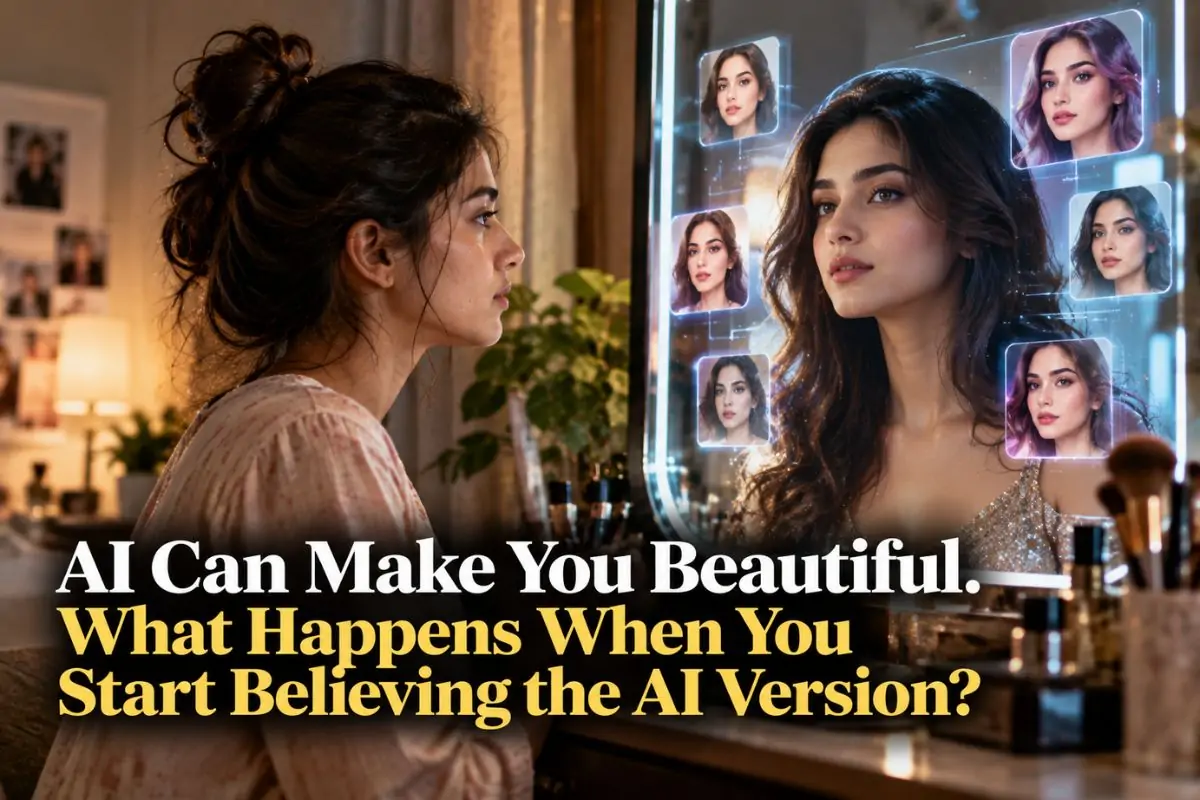
There was a time when looking at a photograph of yourself meant accepting whatever the camera happened to capture. Maybe the lighting was terrible, your hair was behaving badly, or you simply didn’t like the way your face looked from that particular angle. You could delete the photograph, take another one, or blame the camera and move on.
AI has changed that relationship completely. Today, a woman can upload an ordinary photograph of herself and ask an AI tool to make her look more polished, more glamorous, younger, slimmer, clearer-skinned or simply more conventionally beautiful. Within seconds, she can be looking at a version of herself with smoother skin, sharper features, perfectly arranged hair and lighting that seems almost impossible to reproduce in real life.
At first, it can feel harmless and even fun. Then something much more complicated can happen. You look at the AI version, look back at your actual face and suddenly the face you have lived with for years seems slightly less attractive than it did five minutes earlier. The technology hasn’t changed your face. It has changed your reference point.
1. The New Beauty Filter Doesn’t Just Improve You, It Reinvents You
Traditional beauty filters generally worked by modifying an existing photograph. They could smooth your skin, brighten your eyes, reshape your face or add makeup, but there was still usually a recognizable connection between the photograph and reality. Generative AI is different because it can reconstruct parts of an image rather than simply applying a cosmetic effect.
That means an AI system can create a version of you that never actually existed. It can give you a different hairstyle, different facial proportions, different skin texture, different lighting and sometimes an entirely different aesthetic. The result may still look recognisably like you, but it can also look significantly more polished than anything your real face can reproduce on an ordinary morning.
That distinction matters because the comparison is no longer between you and a celebrity, model or influencer. You are comparing yourself with yourself. And psychologically, that can be a much more intimate comparison.
2. Suddenly, Your Real Face Can Start Looking Like the “Before” Picture
Imagine repeatedly seeing an AI version of yourself with perfectly even skin, symmetrical features, defined cheekbones and hair that always seems to fall exactly where it should. You know the image is artificial. You know the software changed it. You may even find the whole thing amusing.
But after enough exposure, you may begin noticing what the AI version removed.
Your real skin has texture. Your face is slightly asymmetrical. Your hair doesn’t naturally sit that way. Your eyes may not be perfectly identical. Your body changes depending on sleep, hormones, stress, lighting and a hundred other ordinary factors.
None of those things are unusual. They are simply part of being human. Yet once an artificially perfected version of your own face becomes familiar, those ordinary characteristics can suddenly feel like imperfections.
This is where AI beauty becomes psychologically interesting. The problem isn’t necessarily that someone believes the generated image is real. The problem can be that the image becomes an internal benchmark.
3. Your Brain Learns Beauty Through Repetition
Human beings don’t develop ideas about attractiveness in isolation. Our perception of beauty is influenced by the faces we repeatedly see around us, the people represented in media, cultural preferences, fashion and social expectations. What seems exceptionally beautiful in one environment may not have the same meaning in another.
This is one reason researchers have spent years studying the relationship between idealised media images and body dissatisfaction. Repeated exposure to highly edited or idealised appearances can influence how people evaluate their own bodies and faces, particularly when they begin comparing themselves with those images.
AI adds an unusual twist because it can personalise the ideal. Instead of showing you an impossibly beautiful stranger, it can show you an impossibly polished version of yourself. The message becomes much harder to mentally distance yourself from because the face staring back at you is still, recognisably, yours.
You aren’t simply thinking, “She is beautiful.” You may begin thinking, “Apparently, this is what I could look like.”
4. Knowing It’s Fake Doesn’t Automatically Make It Harmless
One of the easiest arguments against worrying about AI beauty images is that people know they’re fake. And that’s true. Most people are perfectly capable of understanding that a generated photograph has been altered.
But conscious knowledge doesn’t necessarily prevent emotional comparison. We already know that magazine covers are edited, celebrities use professional lighting and social media photographs are carefully selected. Yet people can still feel inadequate after looking at them.
A person doesn’t necessarily have to believe an image is documentary evidence for it to influence her expectations. Repeated exposure can still make certain appearances feel normal, desirable or attainable.
This is particularly relevant with AI because the technology can produce a personalised ideal rather than a generic one. Instead of seeing someone else’s perfect skin, you can see your own face with perfect skin. Instead of looking at a celebrity’s features, you can see those features incorporated into your own face.
The psychological distance becomes much smaller.
5. The Most Dangerous Part May Be How Ordinary It Feels
There is rarely a dramatic moment when someone becomes dissatisfied with an AI version of themselves. It can happen through tiny repetitions.
You edit one photograph because the lighting is bad. Then you smooth your skin in another. You experiment with a hairstyle. You try a different makeup look. You make your jawline slightly sharper. You generate a glamorous portrait just to see what it looks like.
Each individual action can feel completely harmless.
But if the same alterations appear repeatedly, they can quietly communicate a message: this is the version of you that looks better. The natural version is the one that needs improvement.
That is a very different psychological relationship with technology from simply experimenting with makeup or clothes. The software is no longer just helping you explore an aesthetic. It may gradually teach you to evaluate your actual appearance through the lens of what the machine can generate.
6. AI Can Turn “I Like This” Into “I Wish I Looked Like This”
There is nothing inherently wrong with enjoying an AI-generated portrait. People have always experimented with fantasy versions of themselves. Makeup, wigs, fashion, photography, hairstyles and even costumes allow people to explore different identities and appearances.
The distinction becomes important when experimentation turns into dissatisfaction.
There is a significant difference between looking at an AI image and thinking, “That’s fun,” and looking at it and thinking, “Why don’t I actually look like that?”
The first is imagination.
The second can become comparison.
And comparison is where beauty technology can become complicated. Once you have seen an extraordinarily flattering version of yourself, ordinary photographs may suddenly seem disappointing. You may start deleting pictures that you would previously have considered perfectly normal, simply because they don’t match the new standard you have created.
7. What Happens When the AI Keeps Removing the Same “Flaws”?
Pay attention to what you ask AI to change repeatedly.
If you consistently ask it to remove the same lines around your eyes, alter your nose, narrow your face, enlarge your eyes or change your body shape, something interesting is happening. The technology is learning your preferences, but you are also reinforcing them in your own mind.
The feature begins to acquire psychological importance because you keep identifying it as something that should be corrected.
But many characteristics that people attempt to remove are not defects. Skin has pores. Faces are asymmetrical. Bodies have folds, scars and marks. Hair has flyaways. Eyes are not perfectly identical. Smiles can be uneven. These aren’t failures of the human body. They are ordinary variations.
AI can make the process of removing those variations so effortless that we may forget they were never problems that needed solving in the first place.
8. There Is a Good Side to AI Beauty Too
It would be simplistic to suggest that every use of AI beauty technology is damaging. There are genuinely creative and useful applications. Someone considering a completely different hairstyle can experiment visually before making a change. Someone exploring fashion can see how different styles might look. A person interested in makeup can use generated images to explore colours and aesthetics.
For some people, these tools may even provide confidence and creative freedom.
The issue therefore isn’t that AI should never be used to alter appearance. The more useful question is what role the generated image is playing. Is it a creative experiment, a fantasy, a styling reference or entertainment? Or has it quietly become the standard against which your real face is judged?
The same image can be harmless in one context and psychologically unhelpful in another.
9. The Beauty Industry Has Never Had This Much Power Over Your Imagination
For decades, the beauty industry sold products by showing people an ideal and then offering a pathway towards it. A cream promised clearer skin. Makeup promised larger-looking eyes. Hair products promised glossy hair. Fashion promised a certain silhouette.
AI changes the equation because it can show you the result instantly.
You don’t have to imagine what you might look like with a different hairstyle. The machine can show you. You don’t have to wonder what you would look like with flawless skin. It can generate it. You don’t even have to imagine yourself with an entirely different aesthetic.
That can be wonderfully creative, but it also creates a new kind of dissatisfaction. Instead of vaguely thinking, “I wish I looked better,” someone can now identify exactly how they want to look because the technology has already generated the fantasy.
The distance betweenwanting to look differentandseeing the desired version of yourselfhas almost disappeared.
10. The Question We Should Really Be Asking
Perhaps the most useful question after creating an AI beauty image isn’t, “Does this look better?”
It is, “Do I actually want to look like this?”
Those questions sound similar, but they aren’t.
The first assumes that the AI version is an improvement. The second allows you to examine what you actually like about it. Maybe you love the hairstyle but not the altered facial proportions. Maybe you like the lighting but prefer your natural skin. Maybe you like the outfit but realise that the face doesn’t feel like you at all.
That distinction gives you something important back: choice.
Because an AI image is not an objective measurement of your attractiveness. It is a generated interpretation based on prompts, patterns, datasets and aesthetic assumptions. The beauty standards embedded in those systems come from somewhere, and they can reproduce the same preferences that have dominated beauty culture for years.
The fact that the image has your face on it doesn’t mean the beauty standard underneath it belongs to you.
The Real Risk Isn’t That AI Will Make Everyone Look Fake
The more interesting possibility is that AI could eventually make ordinary human faces feel inadequate.
A wrinkle becomes something to remove. A pore becomes something to smooth. A little asymmetry becomes something to correct. A photograph where your face looks tired becomes a photograph you cannot tolerate. Gradually, perfectly generated faces can make perfectly normal human faces seem unfinished.
And there is something deeply strange about that.
For most of human history, people had to live with their faces as they were. Mirrors showed an imperfect reflection. Paintings idealised people, but they remained recognisably interpretations. Photographs captured a particular moment, and although people could retouch them, the process required time and skill.
AI has removed much of that friction.
You can now create the version of yourself you wish existed almost instantly.
That is an extraordinary technological achievement.
But it also means we may need to become much better at recognising the difference betweenimagining a more beautiful version of yourselfandbelieving that the imaginary version is the one you should have been all along.
AI can make you beautiful in a photograph.
The real challenge may be making sure you don’t start believing that the woman in the photograph is more deserving of admiration than the woman looking back at you from the mirror.