How Slowly We All Lose Ourselves: The Quiet Tragedy of Becoming Everyone’s Everything
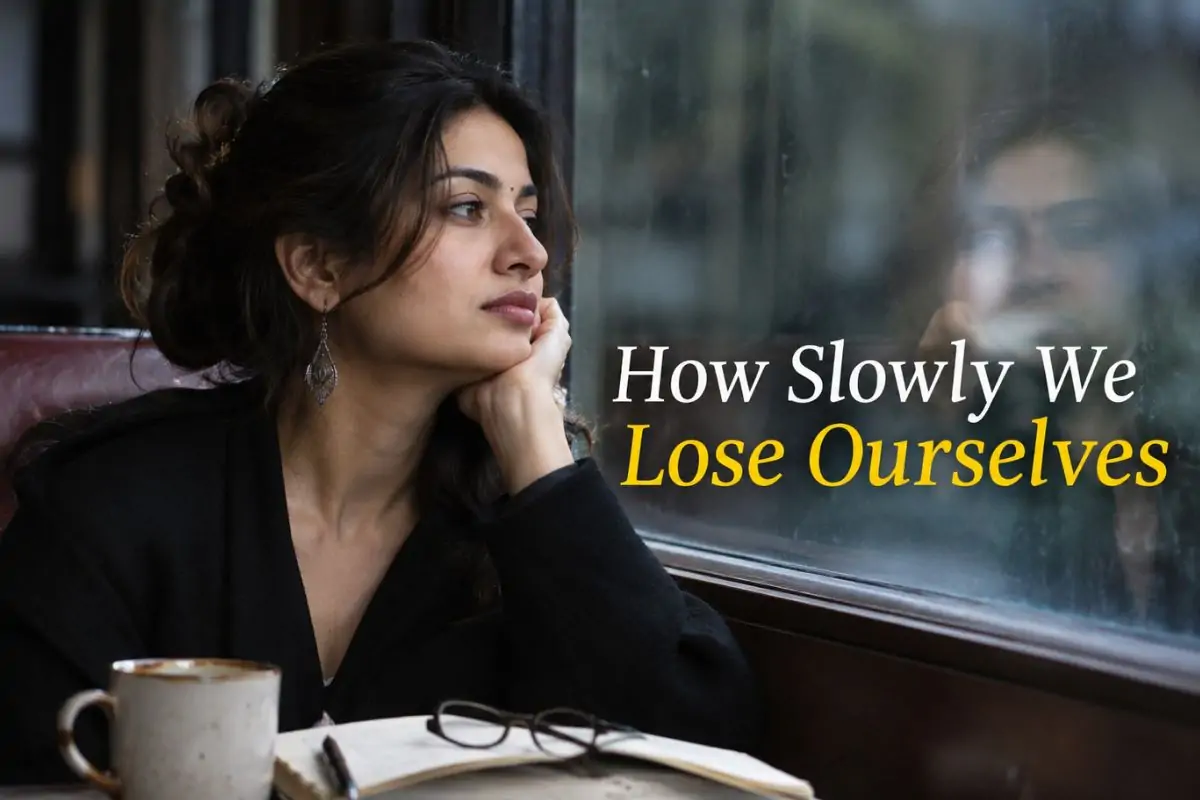
It rarely happens all at once. We do not wake up one morning and decide to abandon ourselves. It happens quietly, through compromises, unspoken disappointments, postponed dreams and the thousand little moments when we choose not to upset someone else. Until one day, we look at our lives and wonder when we stopped feeling like ourselves.
Nobody really warns you about this.
Nobody tells you that growing up might involve slowly becoming a stranger to yourself.
It begins innocently enough. You learn to adjust. You learn that not every opinion needs to be expressed, not every disagreement needs to become an argument and not every desire deserves to take priority.
You learn to be understanding.
You learn to be patient.
You learn to be the bigger person.
You learn to say, “It’s okay,” when it isn’t. You smile when you would rather cry. You agree when something inside you is quietly protesting.
And because these things seem small, you do not notice what they are costing you.
Until one day, perhaps while sitting alone in your room, driving home after a long day or looking at an old photograph, you experience a strange feeling.
You miss someone.
But the person you miss is yourself.
1. It Begins With the Little Things We Give Up
Think about how many times you have changed your mind because someone else would not approve.
The dress you did not wear because someone might find it inappropriate. The holiday you postponed because there were more important responsibilities. The career opportunity you declined because the timing was inconvenient for everyone else.
Perhaps you stopped listening to certain music because your surroundings changed. Perhaps you stopped meeting an old friend because explaining your absence became easier than making an effort.
One compromise becomes another.
You tell yourself that it is temporary. That you will return to those interests when life becomes less complicated.
But life rarely becomes less complicated.
There is always another responsibility, another deadline, another family expectation, another person who needs something from you.
And slowly, the things that once made you feel alive become things you used to do.
2. We Become Experts at Being What Other People Need
There is a particular kind of exhaustion that comes from constantly adjusting yourself to different people.
At work, you are professional and composed.
At home, you are responsible and accommodating.
With friends, you are cheerful and available.
In relationships, you try to be understanding.
With family, you may become the person who keeps everyone together, absorbs disagreements and makes sure nobody feels uncomfortable.
You develop an extraordinary ability to read rooms.
You know when to speak, when to remain silent, when to change the subject and when to pretend that something did not hurt.
People may even praise you for it.
They call you mature, sensible, dependable and emotionally strong.
But sometimes, what everyone calls strength is simply a person becoming very good at hiding their own needs.
And the difficult question is this:
Who are you when nobody needs anything from you?
3. We Confuse Being Loved With Being Convenient
Many of us grow up believing that being a good person means being agreeable.
Do not disappoint people.
Do not create unnecessary conflict.
Do not be difficult.
Do not ask for too much.
Do not make someone feel bad.
There is nothing wrong with kindness or compromise. Relationships require both.
But there is a difference between being considerate and constantly making yourself smaller to remain acceptable.
When your boundaries are repeatedly ignored, you may begin to question whether you are asking for too much.
When someone becomes upset because you express a need, you may decide it is easier not to express it again.
Eventually, you can find yourself maintaining relationships in which everyone knows what you are willing to give, but very few people know what you need.
That is a lonely place to arrive at.
Love should make room for your individuality. It should not require you to disappear.
4. The Dreams We Postpone Have a Way of Becoming Strangers
Remember the things you once wanted to do?
Perhaps you wanted to travel alone, start a business, become an artist, write a book, move to another city or simply live differently.
Maybe you had a hobby that made you lose track of time.
You might have imagined a version of yourself who was adventurous, creative, independent or wonderfully unconventional.
Then adulthood arrived with its practical questions.
Can you afford it?
Is this the right time?
What will people think?
What about your responsibilities?
Isn’t it too late?
Some dreams genuinely change. We discover that what we wanted at 20 is not necessarily what we want at 35 or 45.
That is perfectly natural.
But sometimes we do not outgrow our dreams. We simply become too busy, too frightened or too conditioned to pursue them.
And one day, we realise that we have spent years preparing to live rather than actually living.
5. We Become So Busy Surviving That We Forget to Experience Life
There is a peculiar rhythm to modern adulthood.
Wake up. Check messages. Get ready. Work. Answer calls. Complete tasks. Handle responsibilities. Eat something. Check messages again. Sleep.
Repeat.
Days become weeks. Weeks become months.
We keep waiting for the weekend, the holiday, the promotion, the financial breakthrough or the moment when everything finally settles down.
But what if that moment never arrives?
What if life is not waiting for us at the end of our responsibilities?
What if it is happening right now, in the middle of the unfinished work, the imperfect relationships and the ordinary afternoons?
We can become so focused on maintaining our lives that we forget to experience them.
And perhaps this is one of the quietest ways we lose ourselves: not through a dramatic tragedy, but through years of being physically present and emotionally elsewhere.
6. Sometimes We Lose Ourselves Trying to Keep Everyone Happy
Trying to make everyone happy is an impossible assignment.
Different people want different things from us.
One person wants us to be ambitious. Another wants us to be available.
One expects independence. Another expects obedience.
One wants us to change. Another prefers the version of us that never questioned anything.
We spend enormous emotional energy trying to reconcile these conflicting expectations.
And when someone is disappointed, we immediately wonder what we did wrong.
But other people’s disappointment is not always evidence of our failure.
Sometimes it is simply the consequence of no longer behaving according to their expectations.
You are allowed to make decisions that someone else does not understand.
You are allowed to have preferences that are inconvenient.
You are allowed to change your mind.
You are allowed to become someone your younger self could not have imagined.
7. We Sometimes Stay in Places Where We Have Outgrown Ourselves
Not every form of losing yourself happens through sacrifice.
Sometimes it happens through familiarity.
We remain in jobs that no longer challenge us. We maintain friendships built around an earlier version of ourselves. We stay attached to environments where our opinions, ambitions and interests are no longer welcomed.
Familiarity can feel safe, even when it is slowly making us unhappy.
We know how things work. We know what is expected. We know which version of ourselves people recognise.
Changing that arrangement requires courage.
It may mean having uncomfortable conversations, accepting uncertainty or admitting that something once important no longer belongs in our future.
But growth often requires us to acknowledge that we have changed.
We do not owe every past version of ourselves a permanent place in our present.
8. We Stop Knowing What We Actually Want
Ask someone what they want for dinner, and they may answer, “Anything is fine.”
Ask them where they want to travel, and they may say, “Wherever everyone wants to go.”
Ask them what they want from life, and the answer may become surprisingly difficult.
This is not necessarily because they have no desires.
Sometimes they have spent so long prioritising circumstances and other people that their own preferences have become unfamiliar.
They know what needs to be done. They know what is expected. They know what would make sense financially or socially.
But they struggle to answer a simpler question:
What would make me happy?
Reconnecting with yourself can begin with very ordinary choices.
What music do you want to listen to?
What would you like to eat?
Where would you like to spend an afternoon?
What kind of people make you feel comfortable?
What would you do if you did not have to explain your decision to anyone?
These questions may seem small, but they help you recognise your own voice again.
9. We Become Afraid of Disappointing the People We Love
One of the most complicated parts of reclaiming yourself is that it may affect people you genuinely care about.
You may need to say no.
You may need to change a long-standing arrangement.
You may need to stop accepting behaviour that you previously tolerated.
You may need to make a decision that disappoints someone.
This can produce guilt, especially if you have built your identity around being dependable and accommodating.
But there is an important distinction between hurting someone deliberately and allowing someone to feel disappointed because you have made a reasonable decision for yourself.
You can love people and disagree with them.
You can care about your family and still choose a different path.
You can be a good partner without abandoning your individuality.
You can be generous without becoming endlessly available.
Healthy relationships leave room for two complete people.
10. The Most Dangerous Sentence Is “Maybe Someday”
Maybe someday I will travel.
Maybe someday I will start writing again.
Maybe someday I will learn to dance.
Maybe someday I will wear what I actually like.
Maybe someday I will stop worrying about what everyone thinks.
Maybe someday I will finally make time for myself.
There is nothing wrong with waiting when circumstances genuinely require it.
But sometimes “someday” becomes a comfortable hiding place.
We postpone the things that make us feel alive because they seem less urgent than everything else.
Then years pass.
The answer is not to make dramatic decisions or abandon responsibilities. It is to stop treating your own life as something that can always be postponed.
Start small.
Book the class. Call the friend. Take the walk. Buy the book. Plan the trip. Return to the hobby.
You do not need to transform your entire existence to begin feeling like yourself again.
11. Reclaiming Yourself Does Not Mean Becoming Selfish
There is a strange misconception that choosing yourself means becoming inconsiderate.
It does not.
You can be compassionate and have boundaries.
You can be generous and protect your time.
You can be a responsible family member and maintain personal ambitions.
You can be in love and retain your independence.
You can change your priorities without rejecting everyone who mattered to you before.
Reclaiming yourself is not about becoming indifferent to other people.
It is about including yourself in the circle of people whose happiness and well-being matter.
That distinction changes everything.
12. Perhaps You Do Not Need a New Life. Perhaps You Need Yourself Back.
We often imagine that finding ourselves again requires a dramatic escape.
A new city. A new relationship. A different career. A complete transformation.
Sometimes those changes are necessary. Often, they are not.
Sometimes what we need is to reconnect with the small things we abandoned.
The books we stopped reading.
The friendships we neglected.
The music we loved.
The clothes we enjoyed wearing.
The opinions we became afraid to express.
The dreams we stopped discussing because nobody seemed interested.
Perhaps you need an afternoon without obligations.
Perhaps you need to take a decision without asking ten people for approval.
Perhaps you need to remember that you existed as a whole person before becoming someone’s employee, partner, parent, daughter, son, caretaker or problem-solver.
Those roles can be meaningful. They can be beautiful.
But they are not the entirety of who you are.
7 Questions Worth Asking Yourself
Take a little time with these questions. You do not need to answer them perfectly.
- When was the last time I did something purely because I wanted to?
- Which parts of my personality have I hidden to avoid disagreement?
- Am I living according to my values or primarily according to other people’s expectations?
- Which friendships, hobbies or interests do I genuinely miss?
- Do the people closest to me know what I need, or only what I can provide?
- What have I been postponing for years?
- If I could make one small change without seeking anyone’s approval, what would it be?
Sometimes the answers are uncomfortable.
That does not mean you have failed. It may simply mean you are beginning to pay attention.
The Real SHEE Power Takeaway
Perhaps we do not lose ourselves in one terrible moment.
Perhaps we lose ourselves in the thousand little moments when we decide that our feelings can wait, our dreams can wait, our happiness can wait and our needs are not quite as important.
We become dependable. We become sensible. We become accommodating. We become everything the world seems to need.
And somewhere along the way, we forget to ask what we need from the world.
If any part of this feels familiar, do not turn it into another reason to blame yourself.
You were doing the best you could with the circumstances, expectations and understanding you had at the time.
But you are allowed to change.
You are allowed to rediscover old interests, develop new ambitions, question familiar arrangements and make room for a life that feels like your own.
You do not have to disappear to be loved.
You do not have to be endlessly useful to be valued.
And you do not have to wait until everyone else is happy before you give yourself permission to live.
You have spent enough time becoming everything for everyone. It may be time to become someone for yourself again.
Editorial note: This piece is written as a reflective essay, not a clinical description of depression or any mental health condition. Its central theme is the gradual loss of personal identity through chronic self-neglect and people-pleasing.