
Who Will Feed Them? The Indian Woman’s Compulsion to Cook and What It Costs Her
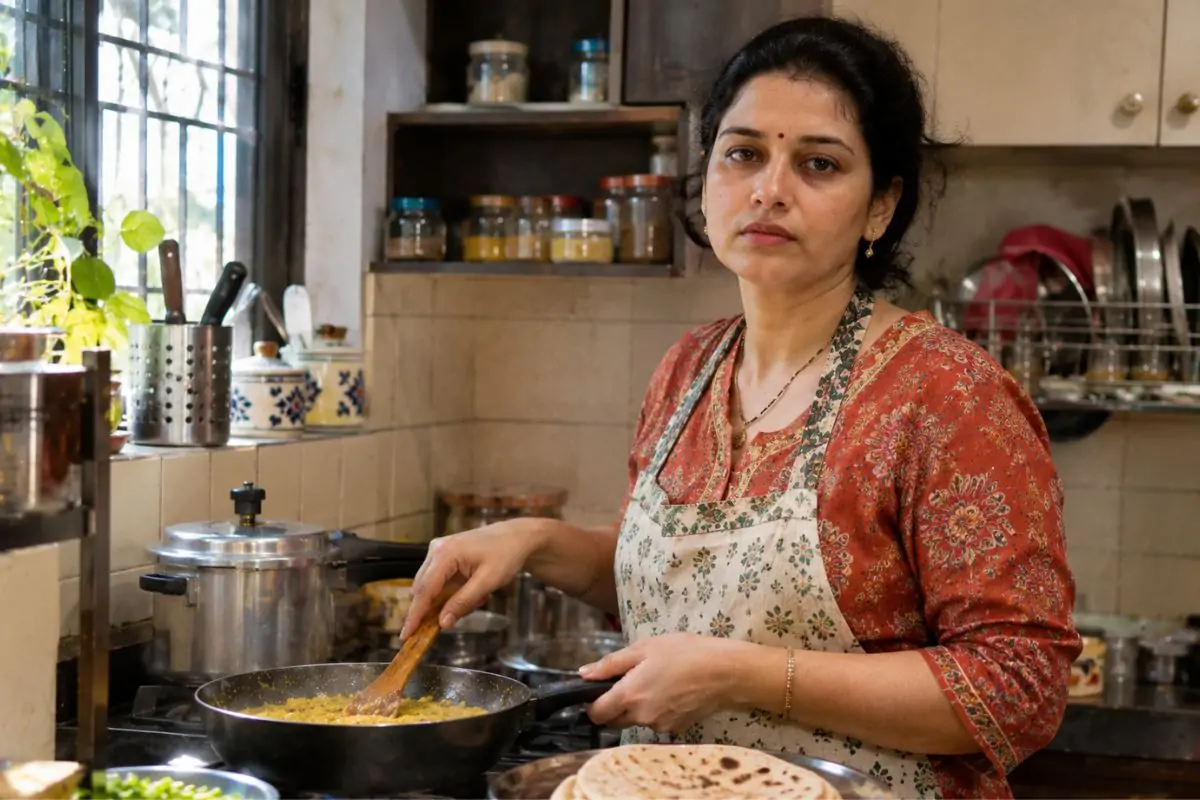
Let me describe a scene you already know.
A woman is about to leave for a wedding, a work trip, a hospital stay, anything. The bag is not packed, but the fridge is. There are three kinds of sabzi in labelled boxes, dough kneaded and covered, rotis counted by day, and a handwritten instruction on the door:heat for two minutes, not five.Somewhere on the journey, her phone rings.Kya khaya? Khana khaya na?She’s calling to ask whether the people she left behind, who are adults, who own phones, who have access to a delivery app, haveeaten.
If you’re an Indian woman, you probably didn’t need me to describe it. If you’re not, it may sound absurd. And if you’re a man in an Indian household, you may be reading this with a growing feeling of recognition.
The question iswhy.Why does a woman feel, almost physically, that she is responsible for whether others are fed, even when she’s miles away, ill, exhausted or leaving for good? This piece is my attempt at an answer. For more on how women think, feel and navigate the world, bookmark the Women Psychology hub and the Real Talk section.
First, Let’s Be Fair to Food
Before I criticise anything, a defence. Cooking for people you love is one of the oldest and loveliest ways to sayI care about you.Many Indian women cook with real joy, skill and creativity. A good meal is craft, memory, chemistry and generosity in one bowl. Plenty of men cook with the same pleasure, and plenty of women hate it and are perfectly fine with takeaway.
So this isn’t an argument against feeding people. It’s an argument about compulsion : the difference betweenI want to cook for youandI cannot rest until I know you’ve been cooked for.One is love. The other is a leash that looks like love.
Reason 1: In Many Homes, FoodIsthe Language of Love
In many Indian families, affection isn’t often spoken. It’s served. “Have you eaten?” can meanI love you, I worry about you, I’m thinking of youall at once. “Maa ke haath ka khana” isn’t just a meal, it’s a national shorthand for safety.
When a culture teaches that love equals feeding, the woman who feeds is the one who “loves enough.” And the woman who doesn’t feed, even once, even when ill, risks being read as someone who doesn’t care. The stakes of a skipped meal are never really about the meal.
Reason 2: When Worth Is Tied to Service, the Meal Becomes Proof of Existence
Psychologists use the term contingent self-worthfor the idea that a person’s sense of value depends on meeting certain standards. For many women, the standard is performance in a role: good mother, good wife, good bahu. And the most visible, measurable proof of performing that role isthe meal on the table.
Think about how praise works. A woman who cooks well is called “annapurna.” A woman who doesn’t is “lazy” or “careless.” There’s no equivalent for the man who forgets to buy groceries. If your sense of being a good person depends on food appearing on schedule, then failing to provide it doesn’t feel like a missed chore. It feels like a failure ofself.
That, I’d argue, is why a woman might cook while feverish, cook before a funeral, cook before a hospital stay. It isn’t always about hunger. It’s about holding on to the one measure she’s been taught proves she’s worth something.
Reason 3: The Worry Is Not Entirely Irrational (and That’s the Problem)
Here’s the uncomfortable part: sometimes the anxiety makes sense. If one person has always done the cooking, the planning and the remembering, then her absence really does create a gap. The family may genuinely not know where the atta is.
And if the family eats badly while she’s away, who gets judged? Not the adults who didn’t cook.Shedoes. “What kind of mother leaves with nothing in the house?” Responsibility and blame travel together, and both land on her. I’ve written elsewhere about how easily the world reaches for a woman-shaped explanation (see ourWomen Psychology pieces), and the kitchen is where that reflex lives.
This is themental load: not just doing the cooking, butholding the entire system in your head: what’s in the fridge, who dislikes what, which child has a test, who’s on a diet, what’s about to expire. You can leave the house, but you can’t leave the spreadsheet. If this sounds familiar, read She’s Paying the Bills, and He’s Loving It: The Hidden Cost for Women and check 11 signs you are mentally exhausted, even when you look fine.
Reason 4: The Numbers Say It’s Not Just “Personality”
If the compulsion were purely individual, you’d expect it to vary randomly. It doesn’t. India’s own time-use data shows how the load is distributed.
According to the National Statistics Office’s 2024 Time Use Survey, women aged six and above spent 289 minutes a day on unpaid domestic services for household members, against 88 minutes for men, and 81.5 percent of women took part in such work compared with 27.1 percent of men. For caregiving, women spent 137 minutes a day against 75 minutes for men. Among those aged 15 to 59, 41 percent of women took part in caregiving against 21.4 percent of men.
Where does the time go? An analysis of the earlier 2019 survey found that cooking, cleaning and childcare occupy almost 85 percent of women’s time spent on unpaid work. In rural areas the load is heavier: rural women spend an average of 324 minutes a day on unpaid domestic services such as cooking, cleaning and fetching water.
And the work is not small. The government has estimated that women’s unpaid domestic work is worth 15 to 17 percent of India’s GDP. It simply isn’t paid.
There’s a small shift. Women’s unpaid domestic time fell from 315 minutes in 2019 to 305 minutes in 2024 for those aged 15 to 59, but ten minutes in five years is not a revolution. When one gender does most of an invisible job for generations, the feeling that “it’s mine to do” stops being a thought and becomes a reflex.
Reason 5: The Cruel Irony, Women Feed Everyone and Often Eat Last
Here’s the part that angers me most. The woman who can’t rest until everyone else has eaten is, in many households, thelastto eat, and often eats the least.
Researchers and nutrition commentators have described this pattern for years. One policy analysis notes that women often eat less, and only after the rest of the family has finished, because of gender norms around unequal food distribution. A foundation summary of NFHS-5 data reports that 57 percent of Indian women aged 15 to 49 are anaemic, up from 53 percent in NFHS-4, and cites research showing that in states like Bihar, Jharkhand and Maharashtra it is common for women to eat only after men have finished. It adds that women who habitually eat last tend to have worse physical and even mental well-being than those who eat earlier.
I want to be careful here. Anaemia has many causes, including iron intake, health access and menstrual blood loss, and eating order is only one factor among them. I’m not claiming that eating lastcausesanaemia in every household. I’m saying the pattern deserves attention, because it exposes a strange truth: the person most devoted to feeding others has often been taught that her own hunger comes second.
If that sounds familiar, our piece on 55 foods that fight inflammation, ranked by how easy they are to actually cook is a gentle place to start looking after yourself, and Women’s Health has more.
Reason 6: We Teach It Early, in Girls Who Never Asked
Watch what children are asked to do. A girl is handed the rolling pin, the dishcloth, the “help your mother” instruction. A boy is told to go study, to go play, to go relax. Nobody announces a rule. It’s simply the weather.
By adulthood, the girl who learned to anticipate others’ hunger has been trained for decades in a skill nobody calls training. “Seekh lo, sasural mein kaam aayega” (learn it, it’ll be useful in your in-laws’ house) is a line many of us heard before we could name what it meant. Our own culture teaches that a woman’s usefulness is her passport.
Then we act surprised when that training doesn’t switch off at a bus stop or in a hospital corridor.
Reason 7: The Kitchen Is One of the Few Places She’s Allowed to Rule
This one is more speculative, and I offer it as opinion, not data. In many households, a woman has limited say over money, property, travel or career. But the kitchen is hers. Within it, she has expertise, authority and recognition. Everyone defers to her recipe, her measurements, hertaste.
If that’s the only domain where her power is acknowledged, then leaving it, even for a day, can feel like abandoning her only throne. Handing over the kitchen to a husband or a child may feel less like help and more likedismissal.This is why some women, even when offered relief, quietly resist it. “No, no, I’ll do it, you won’t do it properly.”
I don’t think that’s weakness. I think it’s what happens when authority is so narrowly granted that you guard every inch.
Reason 8: If They Can Eat Without Me, What Am I For?
Underneath all of this sits the quietest fear:being unnecessary.If the family can feed itself, if the kids can microwave, if the husband can order in, then where does that leave a woman whose identity has been built on being needed?
For women whose lives have revolved around caregiving, being needed isn’t just pleasant. It can feel like the thing holding up their sense of purpose. That makes empty-nest years, retirement from work, illness or even a holiday unexpectedly frightening. The meal prepared in advance is a way of sayingI’m still here, I still matter.
The Counterarguments (They Deserve Airtime)
“Women just enjoy cooking.” Many do, and I celebrate that. The question isn’t whether women can enjoy it, but whether it’sfree choice.A useful test: if she stopped, would she be loved less? Would she be judged? If yes, the choice isn’t entirely free.
“This isn’t unique to India.” True. Women everywhere do more unpaid care work. But the specific forms (the pre-cooked meals before travel, the in-law kitchen politics, the eating-last norm, the “annapurna” ideal) carry an Indian shape, and that’s what I’m describing.
“Men are changing.” Some are, and the 2024 numbers hint at slow movement. But change is uneven, and it rarely starts without women asking.
“It’s just a cultural habit; you’re overthinking it.” Habits that everyone follows without noticing are exactly the ones worth examining. Nobody asks a fish about water.
What Would Healthier Look Like?
I don’t want to end with only diagnosis.
For women
- Practise leaving.Try going out for an afternoon without pre-cooking. Let the household cope. Survive the guilt. It fades.
- Separate love from labour.SayI love youwith words sometimes. Notice that love doesn’t vanish if dinner is takeaway.
- Name the load.Write down every invisible task you do in a week. Seeing it on paper is powerful.
- Eat first, or at least eat with them.Sit down. Your nourishment is not an afterthought.
- Ask for help without apologising.Our piece on 10 things emotionally mature women no longer explain to anyone has useful scripts, and 10 things women stop caring about when they finally become comfortable with themselves is a good reminder of what’s possible.
- Notice when it stops being love.If you feel resentment, exhaustion or emptiness around the work, listen to that. Browse Burnout ,Self-Care and Stress Management .
For families, husbands and sons
- Learn to cook,properly, not just “help.” Own the whole task, including the planning and the shopping.
- Ask “what doyouneed?”as often as “what’s for dinner?”
- Stop treating her absence as an emergency.Plan for it, in advance, as a normal thing.
- Don’t judge her for ordering in, resting or saying no.
- Share the mental load,not just the tasks.
- Notice who eats lastand change it.
For society
- Count the work.Time Use Surveys exist for a reason. What gets measured gets discussed.
- Retire the “annapurna” praisethat rewards self-erasure.
- Teach boys the kitchenthe way we teach girls.
- Stop glorifying women who “still cooked” while ill, grieving or dying.Those stories aren’t proof of love. They’re proof of how little rest women are allowed.
- Look at women’s mental health beyond productivity.A woman who functions isn’t necessarily a woman who’s well.
If This Is Close to Home
If you’re having thoughts of ending your life, or you’re worried about someone who is, please reach out to someone today: a trusted person, a doctor or a helpline. In India,112is the national emergency number, and the government’s Tele-MANAS mental health service is commonly listed at14416. Services and numbers change, so confirm the current ones locally. You deserve support, and you don’t have to carry this alone or finish everything first.
If you’re supporting someone, listening without judgement and helping her reach professional support matters more than solving everything. You can also write to Ask Shakti , share a story through Confessions , or get featured or write a guest post .
The Last Word
The compulsion to cook isn’t a quirk. It’s the visible edge of something much larger: a system in which women’s worth has been made to depend on how well they serve, and in which the people they serve have rarely been asked to notice.
So the next time a woman in your life is about to leave, resist the urge to be impressed by the stocked fridge. Instead, say something unusual:You don’t need to cook. We’ll manage. Go, and eat something yourself.
And if you are the woman standing in front of the stove at midnight, packing your absence into labelled boxes, I’d like to say this as plainly as I can. You are not a meal. You are not a service. You are a person, and the household will survive one badly reheated sabzi. You, on the other hand, deserve more than survival.
FAQ
Why do Indian women feel responsible for cooking?
Several factors overlap: food is a primary expression of love in many families, girls are socialised into household work early, a woman’s worth is often measured through caregiving roles, and blame falls on her when the household goes unfed. The unequal distribution of unpaid work, documented in India’s Time Use Survey, reinforces the habit.
How much more unpaid domestic work do Indian women do than men?
According to NSO’s 2024 Time Use Survey, women aged six and above spent 289 minutes a day on unpaid domestic services against 88 minutes for men, and 41 percent of women aged 15 to 59 took part in caregiving compared with 21.4 percent of men.
What is mental load?
It is the invisible work of planning, remembering and managing a household, such as knowing what’s in the fridge, who needs what and what’s coming up. Even when tasks are shared, one person often carries the “manager” role.
Do Indian women really eat last?
Studies and policy analyses describe a common pattern in which women eat after other family members, with variation by region and household. Experts caution that nutrition outcomes such as anaemia have multiple causes, so eating order is one factor among many.
Is housework linked to women’s suicides in India?
NCRB data shows housewives are the largest occupational group among women who die by suicide, but experts caution that the category reflects gendered roles and population share and cannot prove a causal link. Family problems are the leading recorded cause among women.
Where can I get help in India?
In an emergency, call 112. Tele-MANAS (14416) is commonly listed as the national mental health helpline. Verify current numbers locally, and speak to a doctor or counsellor if you’re struggling.
Sources
- NSO, Ministry of Statistics and Programme Implementation,Time Use Survey 2024, as summarised by Business Today, ORF (Sunaina Kumar, “Underlining the work that women do”), ThePrint and others
- ORF, “Why Women Face More Food Insecurity Than Men” (Shoba Suri)
- Dr. Reddy’s Foundation (Sashakt), “Malnutrition in India: A Gender Based Outlook,” summarising NFHS-5 (2019 to 21)
- Centre for Mental Health Law and Policy (CMHLP), “What the National Crime Records Bureau data reveals about women’s suicides”
- NCRB,Accidental Deaths and Suicides in India, as reported by ThePrint (2018 to 2022 housewife figures) and The Quint (2021 figures, including Dr. Rakhi Dandona’s comment)