The Saree Is Not “Traditional” (And That’s the Best Thing About It): History, Weaves, Weavers and How to Wear One Now
Here is a fun way to ruin a family function. Mention, while someone is lovingly adjusting a pleat, that the “traditional” saree blouse is younger than the telephone.
It’s more or less true, and the story behind it is better than most Netflix dramas: a Bengali woman, a Bombay club that wouldn’t let her in, a Parsi drape, a Victorian fashion rulebook and a very public decision to wear what she liked. We’ll get to her.
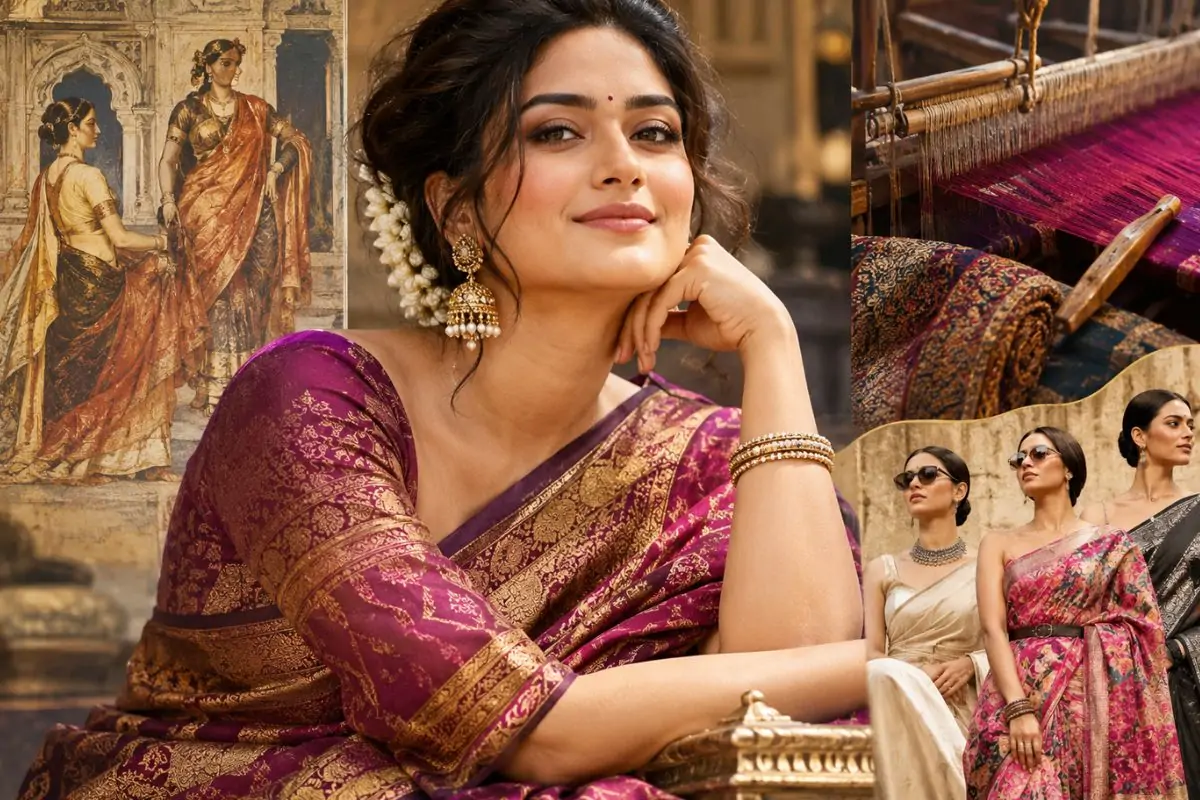
The saree has been called ancient, timeless, unchanging and sacred. Some of that is fair. But the most interesting thing about it is that it hasneverstopped changing. It’s an unstitched rectangle that adapted to every century, every region and every woman who wrapped it around herself and walked into a room.
This guide covers where it came from, the weaves worth knowing, the women who make them, how to tell real handloom from a convincing fake, and how to wear one without feeling like you’re in costume. For more on style, browseStyle ,Fashion and the full Lifestyle hub.
Table of Contents
The Saree at a Glance
| Question | Short answer |
|---|---|
| How old is it? | The garment is often traced to the Indus Valley Civilisation, though the evidence is indirect, and the modern way of wearing it is far newer |
| What does the word mean? | It comes from Sanskritsatiorsatika, a strip of cloth |
| Is it stitched? | No, it’s an unstitched length, usually worn with a stitched blouse and petticoat today |
| Most common drape? | The Nivi drape, associated with the 19th-century blouse-and-petticoat combination |
| How long is it? | The Nivi drape needs at least six yards, and the Maharashtrian nauvari uses nine |
| Who weaves them? | Across handloom overall, over 72 percent of workers are women |
Part 1: A Very Short, Very Honest History
Five thousand years, give or take (the “give or take” matters)
The saree is routinely traced to the Indus Valley Civilisation, almost five thousand years ago. The evidence is mostly indirect: figurines and sculpture showing draped figures. One often-cited example is a statue of an Indus Valley priest wearing a drape, although a priest’s drape is not quite a saree, and historians treat the “5,000-year-old saree” line as a charming simplification rather than a documented fact.
The word itself is more solid. It traces to the Sanskritsati, meaning a strip of cloth, and another account givessatikain Sanskrit andsadiin Pali, meaning an unstitched swathe of cloth. Draped garments appear on figurines across the first to sixth centuries and in classical literature, and the long literary record includes the ancient Sanskrit workKadambariand Tamil poetry such as theSilappadhikaram, which describe women in exquisite drapery.
Who actually invented the “Nivi” drape? (Historians disagree)
The Nivi drape, the one most of us picture when we hear “saree,” has two competing origin stories.
- The ancient theory:An eighth-century literary text, Haribhadra’sSamaraiccakaha, describes a woman dressing in a “nivi sari,” and the Ajanta cave frescoes show drapes with front pleats. Some scholars point to similarities with the South Indian veshti.
- The 19th-century theory:Other scholars credit the contemporary Nivi drape to Jnanadanandini Devi, wife of Satyendranath Tagore, elder brother of Rabindranath Tagore.
Both can be partly true: pleated, tucked drapes existed long before her, and she is credited with popularising a specific, blouse-and-petticoat version that spread across the country.
The woman, the club and the blouse
This is the good part. The saree was worn as a single garment, without a blouse or petticoat, until the third quarter of the 19th century, and textile historian Rta Kapur Chishti is cited as saying that Jnanadanandini Devi adopted the front-pleat style after seeing Parsi women in Bombay wear it with a petticoat and blouse.
She also reportedly popularised blouses, jackets and chemises after she was refused entry to clubs under the Raj in Bombay for wearing the saree over a bare chest. Think about that. A Victorian dress code produced the garment that millions of women now call “traditional.” Another account says she adapted the Parsi gara and the Gujarati draping style, added the blouse and petticoat and created a silhouette that was both contemporary and distinctly Indian.
According to one account, she advertised the style in newspapers and offered to teach it to anyone who was interested. In Kolkata it became known as the “Bombay dastur.”
A fair caveat: the idea that the blouse is “new” needs nuance. A bodice-like garment is much older. One summary notes that the termcholievolved from the ancientstanapatta,and that the tenth-centuryRajataranginirecords a choli from the Deccan being introduced in Kashmir. Whatisrecent is the specific package: the fitted, stitched blouse plus petticoat plus Nivi pleats that most of us now treat as the default. That package took hold from the 19th century.
From colonial rulebook to national symbol
The Nivi drape’s spread owes a lot to politics. As more women joined the independence movement and became visible in public life, the Nivi drape gained popularity across the country. Art played a part too: the painter Raja Ravi Varma styled most of his subjects, goddesses included, in the Nivi drape.
So the next time someone says the saree “never changes,” you can smile and say:it changed in the 1860s because a woman got turned away from a club.
Part 2: The Weaves Worth Knowing
India’s handloom landscape is huge. The Fourth Handloom Census notes important traditions including Banarasi, Jamdani, Chanderi, Maheshwari, Kota Doria, Kanjeevaram, Pochampally Ikat, Kuthampully and Khun weaving, and other well-known examples include Patan Patola of Gujarat, Baluchari sarees of West Bengal, Paithani of Maharashtra and Sambalpuri Ikat of Odisha. By August 2026, GI registrations covered 106 handloom products.
Here’s a starter guide. These descriptions are general, and individual pieces vary widely.
| Weave | Region | What it’s known for | Best for |
|---|---|---|---|
| Banarasi | Varanasi, Uttar Pradesh | Rich silk brocade with zari work | Weddings, festivals |
| Kanjeevaram (Kanchipuram) | Tamil Nadu | Heavy, durable silk with contrast borders and temple motifs | Weddings, heirlooms |
| Paithani | Maharashtra | Silk with peacock and floral motifs, often in vivid colours | Weddings, festive occasions |
| Chanderi | Madhya Pradesh | Light, sheer silk-cotton blends | Daytime events, summer weddings |
| Maheshwari | Madhya Pradesh | Lightweight cotton-silk with reversible borders | Work, festive days |
| Jamdani | West Bengal | Fine muslin with woven motifs | Elegant everyday, special occasions |
| Baluchari | West Bengal | Silk with narrative scenes woven into the pallu | Collectors, festive wear |
| Patan Patola | Gujarat | Double ikat silk, famously labour-intensive | Heirlooms, special occasions |
| Sambalpuri Ikat | Odisha | Ikat in cotton and silk | Everyday to festive |
| Pochampally Ikat | Telangana | Geometric ikat patterns | Work, casual, festive |
| Kota Doria | Rajasthan | Airy, check-patterned cotton-silk | Summer, daytime |
| Kuthampully | Kerala | Handwoven cotton with distinctive borders | Everyday, festivals like Onam |
For Kerala visitors, browse ourKeralatag and keep an eye out for handloom shops on your trip. If you love hand-embroidered pieces too, read our guide to authentic Lucknowi chikankari, which pairs beautifully with a plain handloom saree or kurta.
Part 3: The Women Behind the Weave
Here’s the part the fashion pages often leave out. The saree is a story about women’s clothingandwomen’s labour.
The latest handloom data tells us the following:
- The Fourth All India Handloom Census (2019 to 20) counts over 35 lakh handloom workers, made up of 26 lakh weavers and 8.5 lakh allied workers, of whom 72.3 percent are women and 89 percent live in rural households.
- About 6.83 lakh handloom households, around 22.9 percent, are engaged in weaving sarees.
- Women are frequently classified as helpers or allied workers despite doing essential tasks such as spinning, winding, dyeing and weaving.
- 67.1 percent of handloom-worker households earned less than ₹5,000 a month from all sources in 2019 to 20.
- Despite the craft’s prestige, handloom exports totalled only ₹1,330 crore in 2025 to 26, against ₹3.25 lakh crore for overall textile and apparel exports.
- India marked its 12th National Handloom Day on 7 August 2026.
A caution on the numbers.Counting weavers is genuinely hard. An NCAER-linked analysis notes that the Handloom Census counts weaver households with looms, while other surveys such as the Periodic Labour Force Survey report much lower numbers because of different methods, and that PLFS-based data shows only about 14.5 lakh weavers. So treat “35 lakh” as the census figure, not the final word.
My opinion.We love the saree as a symbol and underpay the people who make it. A garment that carries centuries of skill is often woven by women whose names never appear on the tag, in households where the loom is one of several jobs. If you’re buying handloom, pay fairly, buy directly where you can and resist the urge to haggle a weaver down to a price you’d never accept for your own work. For another story of women turning craft into a livelihood, read aboutPabiben Rabari, who turned a ban on embroidery into work for 300 women, and browseWomen Change Makers.
Part 4: How to Spot Real Handloom (and Avoid Being Fooled)
Machine-made imitations can look convincing in a photo. A few things help.
Check the marks
- The Handloom Mark:a stamp created by the Government of India for products made by hand, usually shown as a label or tag with a stylised hand holding yarn.
- The Silk Mark:issued by the Silk Mark Organisation of India, it certifies that the yarn is 100 percent pure silk. Note that the Silk Mark is aboutsilk content, not about whether the saree was woven by hand or by machine.
- The GI tag:a legal guarantee that a product comes from a specific region and was made using traditional methods. Look for the tagandthe seller’s authorised-user certificate.
- India Handloom Brand:brands registered under it, or sellers with GI tags, are more likely to provide authentic products.
Important caveat:not every genuine saree carries a label, though many reputable sellers include one as proof. A missing tag doesn’t prove a saree is fake, and a tag doesn’t replace judgement.
Check the fabric (rules of thumb, not guarantees)
- Look for small imperfections.Slight variations in thread spacing and tiny unevenness in the border are signs of hand weaving, while something that looks perfectly uniform may be machine-made.
- Turn it over.Handloom often shows floating threads or neat knots on the back, while powerloom is usually flat and tight.
- Feel it.Handloom tends to have a softer, more textured hand.
- Ask for photos of the labels on the specific piece you’re buying,especially online. Reputable sellers should be able to show the holographic sticker with its serial number, the Silk Mark and the weaver’s cooperative tag.
- Skip the burn test.It can damage the fabric and void returns, so rely on certifications and reputable sellers instead.
- Be sceptical of “too good to be true” prices.If a “pure Kanjeevaram” costs less than the silk alone would, something’s off. For a classic lesson in why, read aboutVictor Lustig, the con man who sold the Eiffel Tower, twice.
- Buy from sellers who can name the weaver, cluster or cooperative.
Bias alert:much of the available buying advice comes from sellers who benefit from your trust. Cross-check with official sources like the Development Commissioner (Handlooms) and Silk Mark Organisation, and when in doubt, visit a state handloom emporium or a weaver cooperative.
Part 5: Wearing It Now (Without Feeling Like Fancy Dress)
Here’s the sassy bit. The saree is not an obligation, a test or a costume. It’s a very versatile piece of clothing, and you’re allowed to wear it the way you like.
Pick a drape that suits your day
- Nivi:the default. Pleats at the front, pallu over the left shoulder. Needs a blouse, a petticoat and a saree of at least six yards.
- Seedha pallu (Gujarati style):the pallu comes forward over the right shoulder, which suits showing off a decorative pallu.
- Nauvari (Maharashtrian):a nine-yard saree worn in a dhoti-like style, brilliant for movement.
- Mundum neriyathum (Kerala):a two-piece set with a distinctive look, often in cream and gold.
- Atpoure and other Bengali drapes:wider, looser and gorgeous in cotton or tant.
- Kacche or Karnataka-style drapes:pleats tucked at the back for easy movement.
Modern styling ideas
- Belt it.A waist belt defines the silhouette and keeps pleats in place. It’s the quickest way to make a saree feel contemporary.
- Jacket or blazer over a saree.Instant office-ready, and brilliant for winter.
- Shirt, turtleneck or crop top as a blouse.The blouse is your canvas. Contrast it, clash it or go minimal.
- Pre-stitched and ready-to-wear sarees.Underrated if you’re short on time or nervous about draping, and a great way to try the look before committing.
- Sneakers or boots.Yes, really. A pair of white sneakers makes a cotton saree feel instantly casual.
- Statement jewellery, one piece at a time.The10 jewellery styling rules that instantly make an outfit look more expensiveapply perfectly.
- A bag that works.Avoid the10 handbag styling mistakes, especially a bag so heavy it ruins the pallu’s drape.
- Footwear you can actually walk in.For wedding season, see5 best bridal footwear ideas for winter wedding season.
Practical comfort tips
- Start with the petticoat.A well-fitted petticoat is the foundation. Some people prefer shapewear or a saree-specific underskirt for a smoother line.
- Safety pins are your friends.Use several: at the shoulder, the pleats and the pallu.
- Pre-pleat the night before.Pleats hold better if the saree has rested.
- Practise sitting, climbing stairs and getting into a carbefore the event.
- Match fabric to season.Cotton and linen for heat, silk and heavier weaves for winter, and chanderi or maheshwari for in-between.
- Mind the pallu.Pin it, drape it forward or tuck it into a belt if it gets in the way. No one will judge, and it’s better than dropping it into a plate.
For a wider wardrobe plan, readhow to build a comfortable ethnic wardrobe for women.
Seasonal pick: sarees for festive and wedding season
With Diwali around the corner and winter weddings starting, this is peak saree season. Silk and heavier handlooms suit cooler evenings, and a light shawl or jacket keeps you warm without hiding the drape. If you’re dressing for Diwali, ourDiwali 2026 lifestyle guidehas dates, outfit ideas and a budget framework.
Part 6: Care, Storage and the Art of Making It Last
A good handloom saree can last decades, and a few habits help.
- Dry-clean or hand-wash gentlyaccording to the fabric, and check with the seller.
- Air it after wearing,away from direct sun.
- Store in breathable cotton or muslin,not plastic.
- Refold along different lines every few months,since long-term creases can weaken silk and zari.
- Keep it away from perfume and hairspray,which can stain.
- Pass it down or restyle it.An inherited saree can become a dupatta, a jacket, a skirt or a new look entirely, and that’s the most sustainable fashion there is. Browsesustainable fashionfor more ways to make your wardrobe last.
Part 7: Myths Worth Retiring
“Sarees are impractical.”People have run, worked, farmed and climbed in them for generations. Comfort comes from fit, fabric and practice, not from the garment itself.
“Sarees are for older women (or for weddings only).”A cotton handloom with sneakers is a perfectly good Tuesday.
“The blouse has always been part of it.”Not in its current form, as we saw above.
“A saree must be nine yards.”Most modern Nivi sarees are around six yards, and the nine-yard style is a specific regional drape.
“Handloom is always better, and machine-made is always bad.”Not quite. Handloom carries craftsmanship and supports weavers, but quality varies, and many people can only afford powerloom. The point is to know what you’re buying and not pay handloom prices for a machine product.
“If it’s silk, it’s a heirloom.”Silk content and handloom craftsmanship are different things. Look at both.
“You need to know how to drape it perfectly.”Nobody does at first. Watch a tutorial, ask a relative, practise and use pins.
The Last Word
The saree has survived empires, dress codes, mills, mass production and fast fashion by doing one thing really well:adapting.It absorbed Parsi pleats, Victorian blouses, freedom-movement politics and Instagram.
That’s the opposite of “unchanging tradition.” It’s a living thing, shaped by women’s choices, and it will keep changing. Wear it your way. Pay the people who make it fairly. Check the label, ask the questions and don’t let anyone tell you there’s only one correct way to wear six yards of cloth.
And if someone does, tell them about the club in Bombay.
Want to share your own saree story, a family heirloom or a weaver you love?Get featuredorwrite a guest postfor Real Shee Power. Got style questions?Ask Shakti.
FAQ Block (for Featured Snippets / Schema)
Where does the word “saree” come from?
It comes from the Sanskritsatiorsatika, meaning a strip of cloth. In Pali, a related word issadi.
How old is the saree?
It’s often traced to the Indus Valley Civilisation, around five thousand years ago, though the evidence is indirect, and the modern way of wearing it is much more recent.
Who invented the saree blouse?
Jnanadanandini Devi, wife of Satyendranath Tagore, is widely credited with popularising the stitched blouse and petticoat combination with the Nivi drape in the 19th century, though historians note that bodice-like garments existed much earlier.
What is the Nivi drape?
It’s the most common saree style, with pleats tucked at the front and the pallu draped over the left shoulder. It requires a blouse, a petticoat and a saree of at least six yards.
How can I tell if a saree is handloom?
Look for the Handloom Mark, the GI tag and its authorised-user certificate, check for small natural irregularities and floating threads on the reverse, and ask the seller for photos of the labels and the weaver’s details. Remember that a missing label doesn’t prove a saree is fake.
What does the Silk Mark mean?
It certifies that the yarn is 100 percent pure natural silk. It doesn’t tell you whether the saree was woven by hand or machine.
Who makes handloom sarees?
According to the Fourth All India Handloom Census, over 35 lakh people work in handloom, and more than 72 percent are women, though women are often classified as helpers or allied workers.
Which saree is best for winter weddings?
Heavier silks such as Kanjeevaram or Banarasi suit cooler weather. Pair them with a shawl, jacket or full-sleeved blouse for warmth.
Sources
- Fourth All India Handloom Census (2019 to 20), as summarised in Drishti IAS, “Modernising India’s Handloom Sector” (7 August 2026) and related coverage
- NCAER / Fibre2Fashion, “Counting Handloom Weavers in India” (on census and PLFS discrepancies)
- HomeGrown, “How 18th Century French Fashion Changed the Way Indian Women Wear Sarees”
- Harper’s Bazaar India, “All about the saree” (citing textile historian Rta Kapur Chishti)
- MAP Academy, “Nivi Drape” (on competing origin theories)
- RmKV Silks, “Five events that shaped the modern-day saree”
- Reference summary of the saree’s literary history (Kadambari,Silappadhikaram,Rajatarangini)
- Authenticity guidance from Handloom Mark, Silk Mark Organisation of India and GI-related explainers. Check each against the issuing body’s own site before publishing