
Victor Lustig: The Con Man Who Sold the Eiffel Tower, Twice
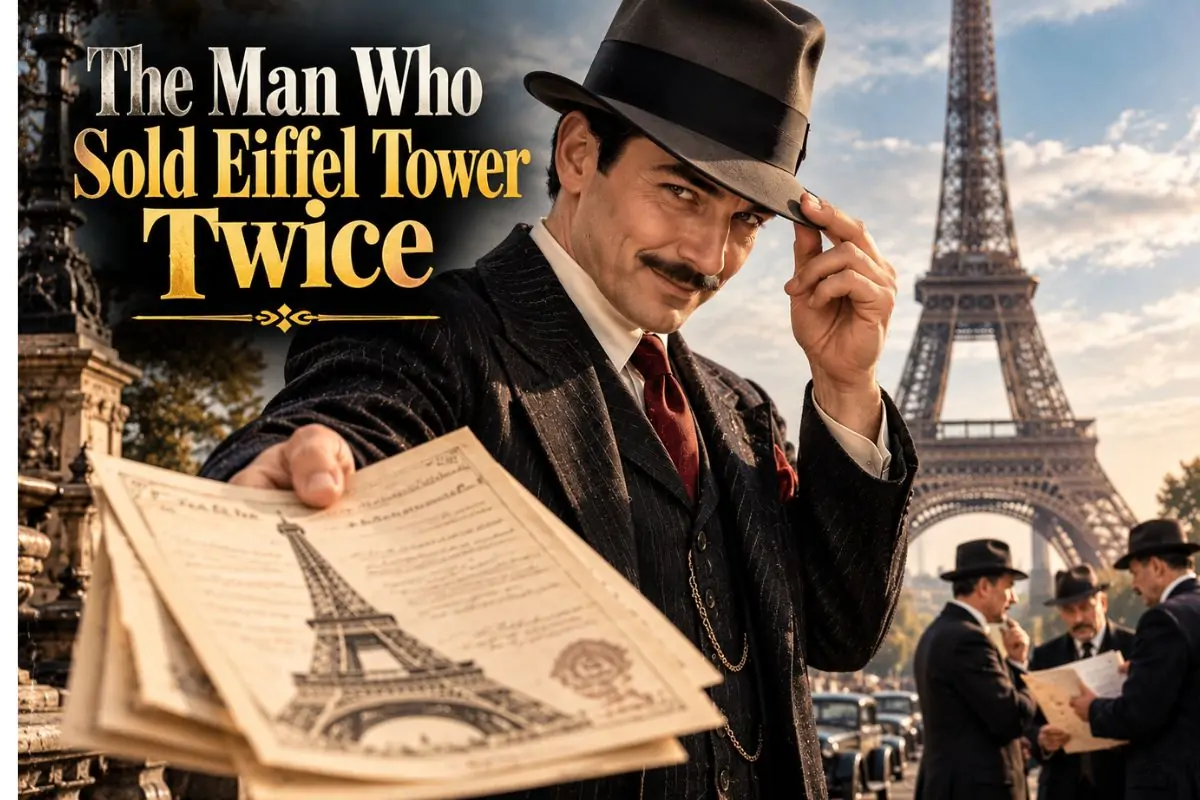
In May 1925, a small item buried in a Paris newspaper caught the eye of a Czech-born swindler with roughly two dozen aliases to his name. The article mentioned, almost in passing, that the Eiffel Tower had fallen into such disrepair that the French government was debating whether it might actually be cheaper to demolish it than keep repairing it. Most readers skimmed past that line. Victor Lustig read it and saw an entire con fall into place in his head.
A Government Minister Who Didn’t Exist
Lustig’s plan depended entirely on one thing: looking exactly like someone with the authority to sell France’s most famous landmark for scrap. Posing as a senior government official, he wrote to six of Paris’s leading scrap metal dealers, informing them discreetly that the tower was to be torn down and its roughly 7,000 tonnes of iron sold off to whichever dealer bid the highest.
He invited the men to a quiet meeting at the Hôtel de Crillon, one of Paris’s grandest addresses, and gave them a guided tour of the tower itself, playing the role of a weary bureaucrat burdened with an unglamorous demolition project. By the time bids started coming in, Lustig had already picked his real target: André Poisson, a provincial dealer described by those who studied the con as gullible and out of his depth among more seasoned Parisian businessmen.
“He Was Too Ashamed to Contact the Police”
Lustig accepted Poisson’s winning bid, collected the payment, and vanished to Austria before anyone realised anything was wrong. What happened next is the detail that turns this from a clever scam into something close to legendary. Poisson, once he understood he’d been conned out of a small fortune by a fake tower sale, never reported it to the authorities at all.
As one retrospective on the con put it plainly:
“The buyer was too ashamed to contact police.”
Lustig, watching the French papers for weeks afterward expecting a scandal, found nothing. No arrest, no public embarrassment, no story at all. Convinced his victim’s humiliation would keep him silent, Lustig did something almost nobody would dare attempt: he went back to Paris and ran the exact same con a second time, on an entirely different group of scrap dealers.
The Man Who Also Conned Al Capone
Lustig eventually fled Europe for the United States, where his talent for manipulation found an even more dangerous audience. He convinced Al Capone himself to invest $50,000 in one of his schemes. When the deal appeared to collapse, Lustig returned every dollar to Capone untouched, a move that seemed, on the surface, like an act of honesty.
It wasn’t. Capone, impressed that a man would hand back such a large sum rather than risk his wrath, rewarded Lustig with a $1,000 tip, precisely the outcome Lustig had engineered from the very beginning. He’d risked nothing and still walked away with a payday, simply by understanding exactly how Capone would react to being treated honestly by a stranger.
The Rulebook He Left Behind
Before his death, Lustig reportedly wrote down a list of principles for aspiring con men, guidance that reads less like criminal advice and more like a masterclass in reading people. The core idea running through nearly all of it: don’t talk, listen. Mirror the other person’s political and religious views back at them rather than offering your own. Never show boredom, never look desperate for information, and let your own importance come across quietly rather than through boasting.
One line from the list has been quoted more than any other, precisely because it captures something true well beyond the world of con artistry:
“It is this, not fast talking, that gets a con man his coups.”
Patience, in other words, not charisma, was Lustig’s real weapon.
Why a Century-Old Con Still Gets Taught Today
Financial writers revisiting the Eiffel Tower con decades later have pointed out something uncomfortable: Lustig’s playbook, manufactured urgency, a confident authority figure, a target too embarrassed to report the loss, still shows up in financial scams running right now. The tower itself was never real collateral. The entire con worked because Lustig understood exactly how shame silences victims far more reliably than any lock or disguise ever could.