
North Sentinel Island: Why Nobody Is Allowed to Visit This Island
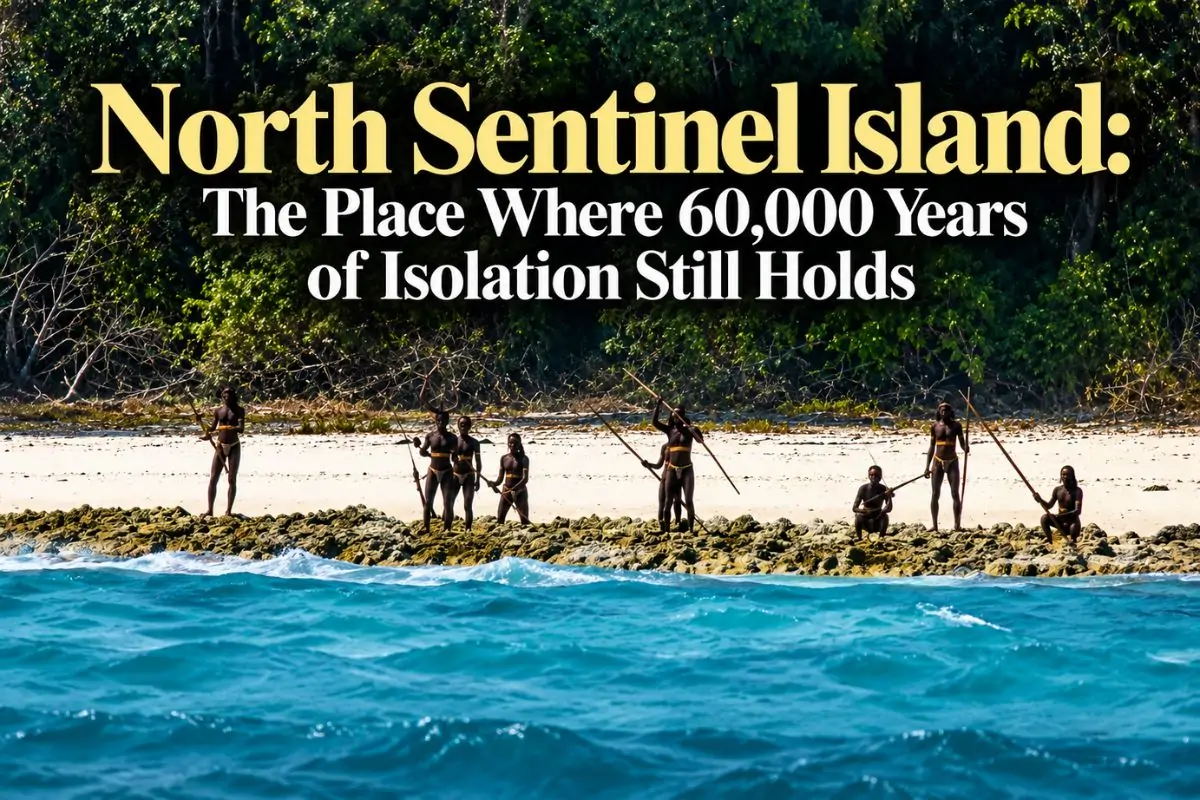
Just a short flight from the Andaman Islands sits a patch of forest roughly 20 square miles wide, ringed by coral reef, and legally off-limits to the rest of humanity. Inside it lives a tribe that has, by most accounts, resisted contact with the outside world for tens of thousands of years. No visitors. No photographs. No idea, even among the world’s leading anthropologists, what language they actually speak.
This is North Sentinel Island, home to the Sentinelese, widely described as the most isolated people on Earth.
“It’s Like an Era in History Gone”
Writer Adam Goodheart, describing the significance of the island in a widely cited 2000 essay, captured the strange weight of this place sitting at the edge of modern civilisation:
“A place encircled by the buzzing, thrumming web of a world still unknown to it, and by the mesh of a history that had forever been drawing closer.”
For most of recorded history, that mesh simply never closed. The first known Western reference to the island dates back to 1771, when a passing ship spotted lights onshore but never landed. For nearly another century afterward, the island was left completely alone.
The Anthropologist Who Tried for Twenty-Four Years
If one name is tied to this island more than any other, it’s Triloknath Pandit, the Indian anthropologist who spent over two decades attempting peaceful contact, starting in 1967. His early visits were almost comically one-sided. Government teams would drop off gifts, coconuts, bananas, pieces of iron, while the Sentinelese stayed hidden in the treeline, watching.
It wasn’t always peaceful. During a 1970s expedition, tensions flared when part of Pandit’s crew drifted away from shore in a small dinghy.
“Seeing this, one Sentinelese man drew a knife and threatened Pandit with it.”
The tribe apparently believed Pandit intended to stay behind on the island while his companions sailed off, something they weren’t willing to tolerate. It took until 1991, after exactly that kind of hostility defined decades of attempts, for the breakthrough Pandit had been chasing his entire career to finally happen. Describing the moment the Sentinelese walked toward his team unprompted, Pandit said simply:
“That they voluntarily came forward to meet us, it was unbelievable.”
Why the Hostility Runs So Deep
The tribe’s wariness isn’t random, and historians trace it back to a specific, well documented trauma. In the 19th century, a British colonial officer abducted several Sentinelese individuals and exposed them to diseases their bodies had no defence against, a betrayal that appears to have shaped generations of distrust that followed. As one retrospective on the island’s history put it:
“The tribe’s hostility is rooted in trauma.”
That history helps explain a tragedy decades later. In 2006, two fishermen, Sunder Raj and Pandit Tiwari, drifted too close to the island after their boat’s anchor failed. They were killed. In 2018, American missionary John Allen Chau paid local fishermen to illegally take him near the island, hoping to introduce the tribe to Christianity. He was killed as well, his body never recovered.
A Population That Can Be Counted on Two Hands
Perhaps the most sobering detail in the entire story is simply how few Sentinelese people are believed to remain. India’s 2011 Census estimated the population at just 15 people, 12 males and 3 females, though most researchers, including Pandit himself, consider the real number likely closer to somewhere between 50 and 100, given how difficult any accurate headcount is on an island nobody is permitted to properly enter.
Pandit, reflecting decades later on what the right path forward actually looks like, didn’t hedge at all:
“In my opinion, we should not be in a great hurry to make contact with the Sentinelese.”
He went further, dismissing persistent rumours that settlers or smugglers might have secretly established contact over the years:
“I refuse to believe that some mainlanders or settlers have established secret contacts with the Sentinelese. They have made it very sure since at least 1991 that outsiders are not welcome on their island.”
Protected by Law, Watched From the Sky
India formally declared North Sentinel Island a protected reserve in 1956, and today enforces a strict exclusion zone extending roughly 5 nautical miles around its coastline, with trespassing carrying real legal consequences. Beyond satellite monitoring and the occasional aerial check-in after major storms or earthquakes, mostly to confirm the tribe has survived, the island is deliberately left alone.
That isolation isn’t treated as an oversight. Advocacy groups working on indigenous rights, including Survival International, have been explicit that the single most important thing anyone can do for the Sentinelese is nothing at all, no visits, no contact attempts, no well-meaning interventions. Given that the tribe has no immunity to even common illnesses most of the world shrugs off, a single cold brought ashore by an outsider could, in theory, wipe out an entire people who have outlasted almost every other isolated culture on the planet.