One Cart, One City, One Legendary Plate: The Story of Sita Ram Diwan Chand in Paharganj
There are restaurants that become famous because of advertising, celebrity endorsements or fashionable interiors. And then there are places that become famous because generations of people keep coming back for the same plate of food.
In the crowded lanes of Paharganj, not far from New Delhi Railway Station, there is a food institution whose story begins with migration, uncertainty and a humble pushcart.
Its name is Sita Ram Diwan Chand.
Today, people visit for its chole bhature, but the more interesting story is how a family rebuilt its livelihood in a new country and gradually became part of Delhi’s culinary identity.
This is not a story about a luxurious restaurant or an ambitious food startup. It is about a dish, a neighbourhood and a family that kept going.
The story begins far from Paharganj
The history of Sita Ram Diwan Chand is closely connected to the upheaval of Partition.
According to historical reporting by ThePrint, Sita Ram Kohli migrated from Lahore to Delhi in 1947. Like countless other families arriving in the aftermath of Partition, he had to find a way to rebuild his life.
Paharganj offered an opportunity.
The neighbourhood was already busy with traders, residents, transporters and travellers. Its streets were full of commercial activity, making it a natural place for a small food business.
Sita Ram began selling chole bhature from a cart near a DAV school in the locality. The dish reflected the Punjabi food traditions he had brought with him.
The early business was modest, but the idea was straightforward: prepare familiar, satisfying food and serve the people who passed through the neighbourhood.
ThePrint’s account describes how the stall gradually attracted families and regular customers before the business moved towards the area around Imperial Cinema.
A small food cart became part of Paharganj’s identity
Imagine Paharganj in those earlier decades.
The neighbourhood was not the busy tourist and backpacker destination it is often associated with today. It was a working commercial area, with local residents, traders, small shops and the constant movement of people.
A food cart selling hot chole bhature fitted naturally into this environment.
People did not need an elaborate dining experience. They needed a filling meal, served quickly and at a price they could manage.
The family eventually established a permanent shop. Historical accounts place the move around 1970, although published sources differ on the precise early timeline. The family itself describes the business as beginning in the 1950s.
The important part is what happened next: customers kept returning.
Some came because they lived nearby. Others were traders and workers. Over time, former local customers who moved elsewhere continued visiting.
That is how a neighbourhood food business develops something more valuable than publicity: familiarity.
What makes the chole bhature distinctive?
Chole bhature is hardly an obscure dish. Across Delhi and northern India, countless eateries serve their own versions.
But Sita Ram Diwan Chand has a particular identity associated with its preparation.
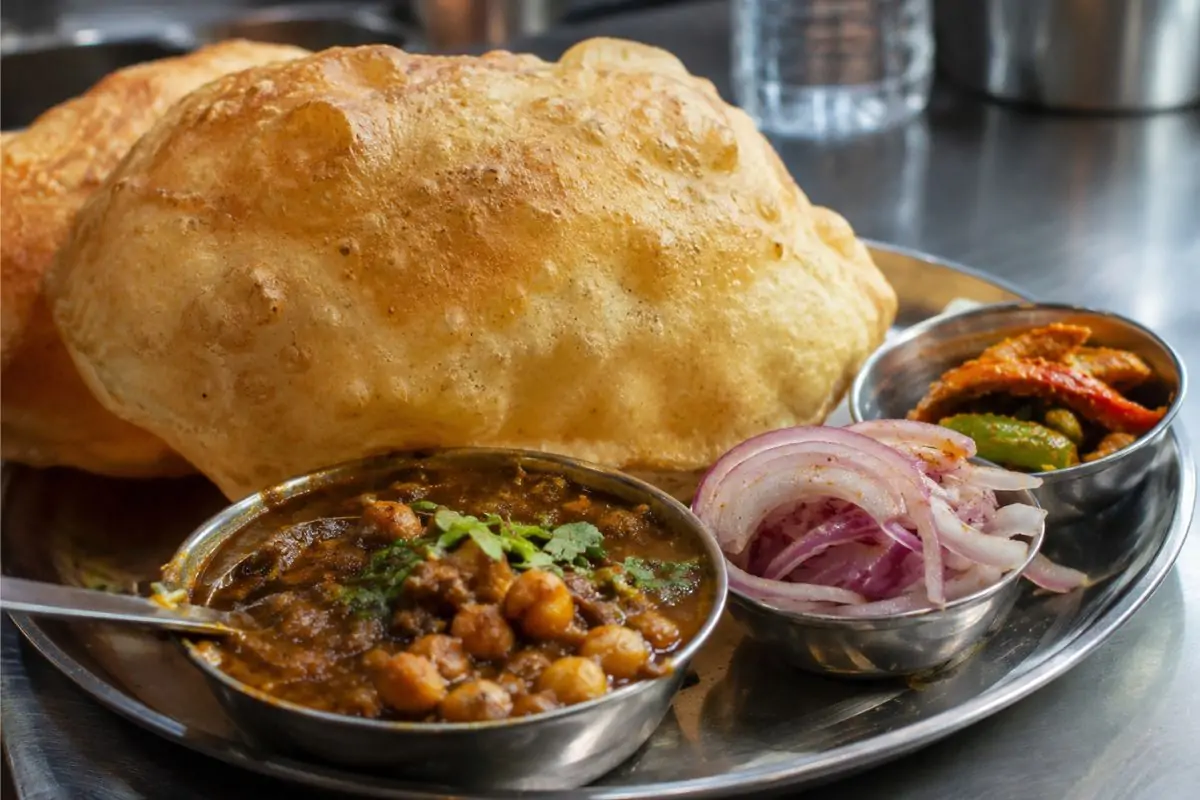
Its bhature are known for being stuffed with paneer and aromatic spices. The chickpea curry is prepared with a substantial blend of spices, while chutneys and pickles add contrasting sweet, sour and tangy flavours.
A 2023 feature in ThePrint describes the family’s use of whole spices, which are cleaned, ground and blended, as well as seasonal pickles. The report also discusses the preparation of the paneer-stuffed bhature with spices such as ajwain and fenugreek.
The combination is simple to understand but satisfying to eat:
- Chole: A robust chickpea curry with a distinctive spice profile.
- Bhature: Deep-fried, puffed bread with a paneer filling.
- Chutney: A sweet-and-sour contrast to the spicy curry.
- Pickle: Seasonal flavours that add another layer to the meal.
It is the balance between these elements that gives the dish its character.
And perhaps that is why a plate of chole bhature can inspire such strong loyalty. It is familiar food, but familiar does not mean forgettable.
The family behind the food
One of the most interesting aspects of this story is its generational continuity.
The business did not remain a one-person venture. It passed through the family, with successive generations taking responsibility for maintaining and expanding it.
NDTV Food’s 2017 account spoke to Pran Nath Kohli, grandson of Sita Ram and son of Diwan Chand, about the family’s history. It described how younger generations joined the business and how customers continued to return for the familiar taste.
The business later expanded beyond its original Paharganj location. Its own history records the opening of a Pitampura branch in 2008, followed by Paschim Vihar in 2017 and Gurugram in 2023.
Expansion is one thing. Maintaining the identity of a food business across generations is another.
The challenge is not simply reproducing a recipe. It is preserving the expectations customers have developed over years.
When someone says a dish tastes just as it did when they were younger, that is a particularly meaningful compliment for a family food business.
Paharganj changed. The food story continued.
Paharganj has undergone enormous changes.
The growth of New Delhi Railway Station transformed the movement of travellers through the area. Hotels, guesthouses, restaurants and shops gradually changed its commercial character.
By the 1970s, the neighbourhood was also becoming associated with international backpackers travelling through India.
ThePrint’s account places the evolution of Sita Ram Diwan Chand within this changing neighbourhood, showing how a small food business grew alongside Paharganj itself. ThePrint
This is what makes food travel interesting.
A famous dish is rarely just a dish. It carries traces of migration, commerce, local tastes, changing neighbourhoods and family histories.
You can visit a restaurant for lunch, but the story behind it can tell you something about the city you are visiting.
How to visit Sita Ram Diwan Chand
Sita Ram Diwan Chand
2243, Rajguru Marg, Chuna Mandi, Paharganj, New Delhi, India.
Known for its chole bhature and traditional Punjabi-style preparation.
Published hours: generally 8 AM onwards; closing times vary across listings. Check before travelling.
Official location and contact details
A few suggestions for visiting:
- Go earlier in the day rather than treating it as a late-night food stop.
- Order the signature chole bhature first.
- Expect a functional, busy food-joint experience rather than a leisurely fine-dining setting.
- Allow extra time for the surrounding Paharganj traffic and narrow market lanes.
The official location listing gives the Paharganj address and published operating hours. Chole Bhature serving since 1950
More than a plate of chole bhature
There is something deeply interesting about businesses that survive because people remember them.
A family arrives in a new city after a historic upheaval. Someone starts a small food cart. A dish finds its customers. A neighbourhood changes. Children grow up, take over the business and serve people who may have been eating there for decades.
That is the story behind this Paharganj institution.
It also reminds us that India’s food culture is not built only by famous chefs, restaurant groups or expensive dining rooms. Some of its most enduring stories belong to ordinary people who developed a skill, served their neighbourhood and continued showing up.
The next time you are in Delhi, consider making a small detour to Paharganj.
Not just for the food, but to experience a little piece of the city’s living history.
Because sometimes, the best way to understand a city is to sit down with the dish that helped build its story.