What Did People Actually Eat in Ancient India’s Royal Kitchens? The Forgotten Feasts of Kings and Emperors
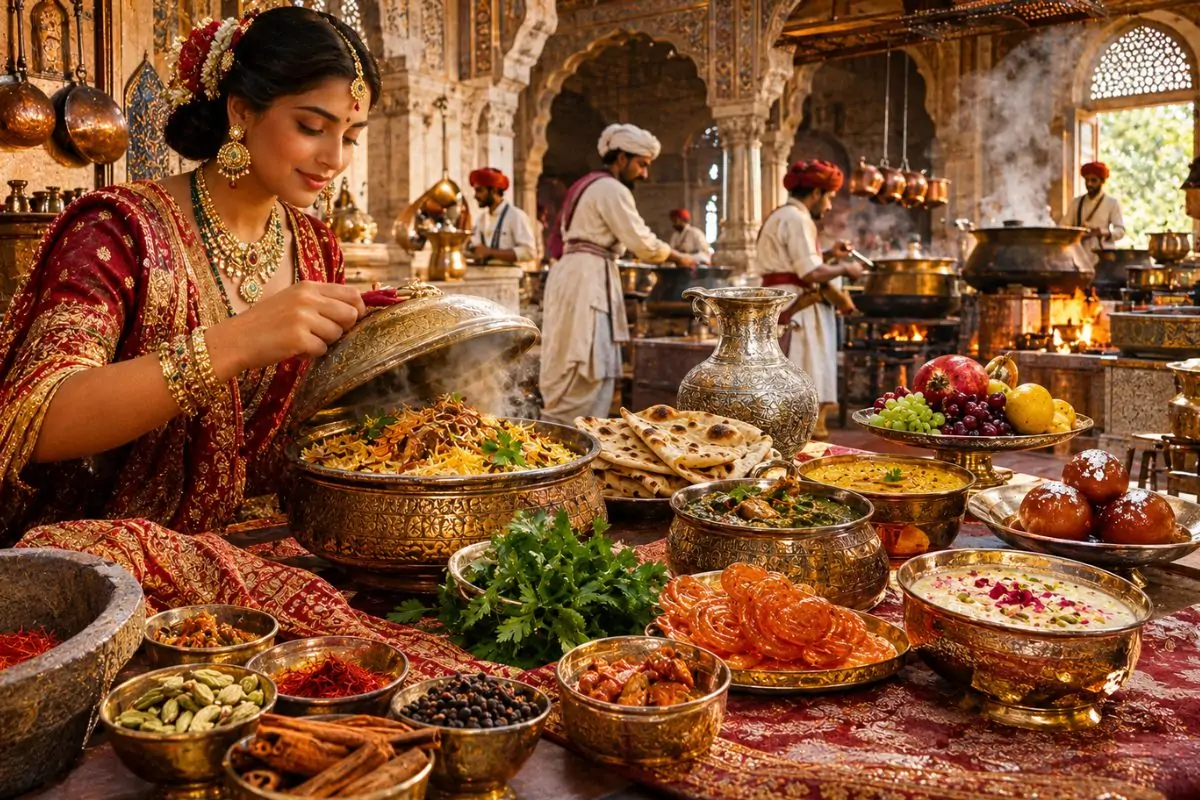
Imagine entering an Indian royal kitchen a thousand years ago.
There are enormous copper vessels bubbling over wood fires. Cooks are grinding spices on stone slabs. Rice is being washed, clarified butter is warming in heavy pans, and fragrant herbs are being chopped for dishes that will eventually reach the royal dining hall.
Somewhere, a cook is preparing a delicate milk dessert. Another is watching a pot of meat simmer slowly with spices. A specialist is making an elaborate rice preparation, while attendants arrange pickles, curd, fresh ginger and bread for the royal meal.
It sounds like a scene from a historical drama, but India’s royal food culture was far more fascinating than most people imagine.
Kings did not simply eat elaborate versions of the food served in ordinary homes. Their kitchens were organised institutions, employing specialised cooks, food tasters, attendants, suppliers and sometimes physicians who advised on ingredients and dietary practices.
And surprisingly, we have historical texts that tell us what was actually being prepared.
From the 12th-century Sanskrit encyclopaedia Mānasollāsa to the illustrated 15th-centuryNi’matnamaand Abu’l-Fazl’sAin-i-Akbari, Indian culinary history contains some remarkable records of royal dining.
Let’s take a journey into these forgotten kitchens.
Table of Contents
1. India’s Royal Kitchens Were Nothing Like Ordinary Kitchens
A royal kitchen was an enormous operation.
Food had to be prepared for kings, queens, princes, visiting dignitaries, military commanders and members of the royal household. Depending on the court, hundreds of people could be involved in food production and service.
The Mughal imperial kitchen, for example, operated with a hierarchy of specialised workers. Different people were responsible for preparing food, managing supplies, handling utensils, tasting dishes and arranging the dining experience.
The imperial kitchen was known as thematbakh, and its organisation reflected the importance of food in courtly life.
According to theAin-i-Akbari, written by Abu’l-Fazl during Akbar’s reign, the emperor’s kitchen was carefully regulated. The text describes how food was organised, how dishes were served and how the imperial household approached dining.
One particularly fascinating detail is the variety of accompaniments served alongside the main meal. Bread, curds, pickles, ginger, limes and fresh greens all formed part of the dining arrangement.
The royal dining experience was not simply about expensive ingredients. It was also about discipline, presentation and control.
2. The 12th-Century King Who Had an Entire Culinary Encyclopaedia
One of the most fascinating historical sources for Indian royal food isMānasollāsa, also known asAbhilashitartha Chintamani.
It was composed in the 12th century under the patronage of Western Chalukya king Someshvara III.
This was not an ordinary cookbook. It was a vast Sanskrit encyclopaedia covering subjects ranging from music and architecture to royal life, entertainment and food.
Its section on food, often calledAnnabhoga, offers a remarkable window into the culinary imagination of medieval South India.
The text includes hundreds of verses discussing food preparations, ingredients and cooking techniques.
And here is something that may surprise modern readers: the royal cuisine described in this text was not exclusively vegetarian.
A scholarly study of theMānasollāsapublished in 2024 found that its royal food section contains extensive preparations involving fish and game, alongside other meats and vegetarian dishes.
The menu reflects a world of culinary variety that is often missing from simplified accounts of India’s historical food traditions.
It is a reminder that royal dining differed across regions, religious traditions and periods.
3. Rice Was Royalty, But Not Always in the Way We Eat It Today
Rice has been central to Indian food culture for centuries, particularly in eastern, southern and coastal regions.
Royal kitchens took this everyday ingredient and transformed it into elaborate preparations.
TheMānasollāsadescribes a sequence of dishes for a royal meal. One account mentions boiled rice, followed by rice cooked with milk, sugar and ghee, with buttermilk and salt appearing towards the end.
Think about that combination.
Plain rice, rich milk, clarified butter, sweetness and a cooling fermented dairy preparation.
It sounds simple, but the order of serving tells us something about the sophistication of historical dining practices.
Rice also appeared in different forms in later royal kitchens.
The Mughal-eraAin-i-Akbaridescribes preparations such aszard biranj, a sweet rice dish involving ingredients including sugar, ghee, nuts and aromatic spices.
The dish is particularly interesting because it demonstrates how rice could move between savoury and sweet culinary traditions.
Royal chefs were not merely cooking rice. They were experimenting with texture, aroma, colour and combinations of ingredients.
4. The Mughals Had a Taste for Extraordinary Food
When people think of Mughal food, they immediately imagine biryani, kebabs, korma and rich gravies.
But the historical record reveals a much wider culinary world.
TheAin-i-Akbaridescribes three broad categories of cooked dishes:
- Vegetarian preparations without meat.
- Dishes combining meat with rice or wheat.
- Meat preparations cooked with spices and other ingredients.
This classification is particularly revealing because it shows that vegetarian food had a defined place in the imperial kitchen, alongside meat-based preparations.
Akbar himself followed periods of dietary abstinence. The text describes a category of food calledsufiyana, which included meat-free preparations involving rice, wheat, lentils, spinach, leafy vegetables, sweets and sherbets.
Other dishes combined meat, rice, wheat, ghee, yoghurt, eggs and spices.
The Mughal table was therefore not a single menu repeated every day. It reflected the emperor’s preferences, religious practices, health considerations and the availability of ingredients.
5. The Sultan of Mandu Who Loved Food So Much That His Court Preserved Recipes
Perhaps the most fascinating culinary manuscript from medieval India is theNi’matnama, often translated as the Book of Delights.
It is associated with Sultan Ghiyath Shah of Mandu in present-day Madhya Pradesh, during the late 15th century. His successor, Nasir Shah, also contributed to its history.
Unlike many historical texts that merely mention food, theNi’matnamacontains actual recipes and illustrations.
It is an extraordinary document because its miniature paintings show royal food preparation, cooks, kitchen activities and the sultan observing aspects of courtly life.
Its culinary interests include:
- Rice preparations.
- Meat and minced-meat dishes.
- Soups and broths.
- Samosas and other savoury preparations.
- Buttermilk-based dishes.
- Sweet preparations and sherbets.
- Betel leaf preparations.
The manuscript also includes material about medicinal preparations and other aspects of royal indulgence.
One particularly interesting detail is that its recipes do not follow the neat modern division of starters, main courses and desserts. Sweet and savoury preparations appear alongside one another.
It gives us a glimpse of a royal court where food was an important form of pleasure, experimentation and cultural expression.
6. Kebabs, Pulao and the Art of Slow Cooking
The evolution of Indian royal cuisine involved centuries of interaction between regional Indian traditions and culinary influences from Central Asia, Persia and other parts of the world.
The result was not a simple replacement of one cuisine by another. It was a process of adaptation.
Rice dishes, meat preparations, breads and sweets developed through the exchange of ingredients and techniques.
Royal kitchens experimented with cooking meat in yoghurt, ghee and spices. Rice was prepared using aromatic stocks, saffron and nuts. Breads were baked or cooked in different ways.
Slow cooking became an important technique in several courtly traditions.
In later Awadhi cuisine, the method known asdum pukhtbecame particularly associated with cooking food in a sealed vessel over low heat.
The technique allows flavours to develop gradually while retaining moisture and aroma.
Yakhni pulao is another example of the importance of cooking technique. Rice is cooked using an aromatic stock, often prepared from meat, with carefully controlled seasoning.
Unlike heavily spiced preparations, a good pulao depends on balance. The stock, rice, fat and aroma must work together.
These dishes are reminders that Indian royal cuisine was as much about technique as it was about expensive ingredients.
7. What Vegetables Did Royal Kitchens Use?
Royal food was not all meat, elaborate rice and expensive sweets.
Vegetables, lentils, leafy greens and dairy preparations were also important.
Historical texts mention ingredients such as spinach, pulses, fresh greens, curd and various seasonal vegetables.
TheAin-i-Akbaridescribes vegetarian dishes served during Akbar’s periods of abstinence.
In South Indian royal culinary traditions, theMānasollāsaoffers a different picture of the relationship between plant-based and animal-based food.
The diversity of these sources challenges the idea that there was one universal royal Indian diet.
A king’s menu depended on geography, agricultural production, religious practice and personal preference.
A court in the Deccan could have access to ingredients and preparations quite different from those available to a court in Rajasthan or Bengal.
8. The Ingredients That Made Royal Food Extraordinary
What made these dishes taste so distinctive?
A combination of local produce, specialised cooking techniques and ingredients that were sometimes expensive or difficult to obtain.
Some important ingredients included:
Saffron:Used to provide aroma, colour and luxury to selected rice preparations, sweets and other dishes.
Ghee:Clarified butter was an important cooking fat and a valued ingredient in several culinary traditions.
Cardamom and cinnamon:Aromatic spices that contributed fragrance to both sweet and savoury preparations.
Pepper:Long valued in Indian trade and cooking, pepper was an important seasoning long before chilli became widespread.
Ginger:Used fresh and dried in a variety of preparations.
Yoghurt and buttermilk:Important ingredients in marinades, gravies, cooling preparations and drinks.
Almonds and pistachios:Particularly prominent in later elite and Mughal-influenced culinary traditions.
Rosewater:Used in selected sweets, drinks and preparations for its fragrance.
One important historical detail deserves attention: chillies, tomatoes and potatoes were not traditional ingredients of ancient Indian cuisine. They arrived in India through exchanges following the arrival of Europeans in the Indian Ocean world, and their use spread over time.
So the fiery red curries many people associate with Indian food today would not have existed in the same form in much earlier royal kitchens.
9. What Did Royal Desserts Look Like?
If the main meal was elaborate, desserts were hardly an afterthought.
Milk, sugar, ghee, rice, wheat, nuts and aromatic ingredients formed the foundation of many traditional sweet preparations.
Historical Indian kitchens made different varieties of milk-based sweets, puddings, halwas and sweetened rice dishes.
TheAin-i-Akbarirecords preparations such as sweet rice, including zard biranj.
TheNi’matnamaalso offers evidence of a courtly interest in sweet preparations and sherbets.
What is particularly interesting is that the distinction between dessert and the rest of the meal was not always as rigid as it is in modern restaurant dining.
Sweet preparations could appear in different contexts, and the meal was shaped by the customs of the particular court.
10. Royal Drinks Were an Art in Themselves
Food was only one part of royal hospitality.
Drinks also had an important place in the courtly dining experience.
Sherbets were made using fruit, flowers, herbs, sugar and aromatic ingredients. Rosewater and other fragrant elements could be used to create elaborate refreshments.
Buttermilk and other dairy-based drinks were also valued.
TheNi’matnamaincludes recipes and references connected with sherbets, soups and other liquid preparations.
These drinks were not merely refreshments. Their ingredients and presentation reflected the sophistication of courtly life.
And while modern cafés advertise floral drinks and botanical beverages as new discoveries, Indian culinary traditions have experimented with aromatic and herbal refreshments for centuries.
11. The Royal Kitchen Was Also a Place of Science
Historical cooks were not simply following recipes.
They understood the behaviour of ingredients through practical experience.
They knew that certain foods required slow cooking, that some ingredients needed soaking or grinding, that fermented preparations behaved differently from fresh ones and that the order in which ingredients were added could change the final result.
Royal households also paid attention to diet and digestion.
TheAin-i-Akbariexplicitly connects proper food with physical well-being and the condition of the human body.
Food was therefore linked to medicine, routine and ideas about health.
It is important not to confuse historical dietary theories with modern nutritional science. But the records do show that food was regarded as something requiring knowledge and attention.
12. What Happened to These Royal Recipes?
Some survived and evolved into dishes we still recognise.
Others changed beyond recognition as ingredients, cooking equipment, regional preferences and social conditions changed.
Royal chefs moved between courts. Recipes travelled with merchants, migrants and families. Local cooks adapted elaborate dishes using ingredients available to them.
Over generations, a preparation that began in a palace could become part of a regional food tradition.
At the same time, some recipes remained restricted to manuscripts, specialist families or historical collections.
TheNi’matnamais particularly valuable because it preserves a record of food preparations that might otherwise have been lost.
TheMānasollāsaandAin-i-Akbarisimilarly help historians reconstruct culinary traditions that cannot be understood simply by looking at modern restaurant menus.
India’s food history is not a straight line. It is a story of constant exchange, reinvention and regional creativity.
The Real SHEE Power Takeaway
The next time you sit down to a plate of fragrant rice, a bowl of slow-cooked curry or a traditional Indian sweet, remember that you are participating in a culinary story that has been unfolding for centuries.
India’s royal kitchens were places of ambition, experimentation, technical knowledge and extraordinary diversity.
They brought together ingredients from local farms, spices from distant trading networks, techniques developed by generations of cooks and culinary preferences shaped by kings and queens.
But perhaps the most interesting lesson is that Indian food history cannot be reduced to a single royal cuisine or a single golden age.
A medieval South Indian king, a Sultan of Mandu and a Mughal emperor could have eaten remarkably different meals.
Their kitchens tell us something much bigger than what was served for dinner. They reveal how people lived, what they valued, how cultures met and how food became an expression of power, identity and imagination.
And somewhere in an old manuscript, between a recipe for rice and instructions for a fragrant sherbet, lies another delicious piece of India’s history.
Frequently Asked Questions
What did ancient Indian kings eat?
Royal diets varied considerably by region and period. Historical sources describe rice, wheat, lentils, vegetables, dairy products, sweets, meat, fish, breads and aromatic drinks. Some courts had predominantly vegetarian preparations, while others included extensive meat and game dishes.
Did Mughal emperors eat vegetarian food?
Yes. Mughal kitchens prepared both vegetarian and non-vegetarian food. Abu’l-Fazl’sAin-i-Akbaridescribes meat-free dishes associated with Akbar’s periods of dietary abstinence, alongside preparations involving meat, rice and spices.
What is the oldest known Indian royal cookbook?
One important early source is the 12th-century Sanskrit encyclopaediaMānasollāsa, composed under Western Chalukya king Someshvara III. Its food section contains detailed descriptions of royal preparations.
What was the Ni’matnama?
TheNi’matnama, or Book of Delights, is a late 15th-century illustrated culinary manuscript associated with the Sultans of Mandu. It records recipes, food preparations, drinks and aspects of courtly life.
Did ancient Indians use tomatoes and chillies?
Not in the way modern Indian cooking does. Tomatoes, chillies and potatoes arrived in India after the arrival of Europeans in the Indian Ocean world. Their adoption occurred gradually over subsequent centuries.
Did royal Indian kitchens have professional chefs?
Yes. Large royal establishments employed specialised cooks and kitchen workers. Mughal court records, in particular, describe an organised kitchen with distinct responsibilities for cooking, supplies, tasting and serving.