Meena Kandasamy and the Language of Necessary Anger
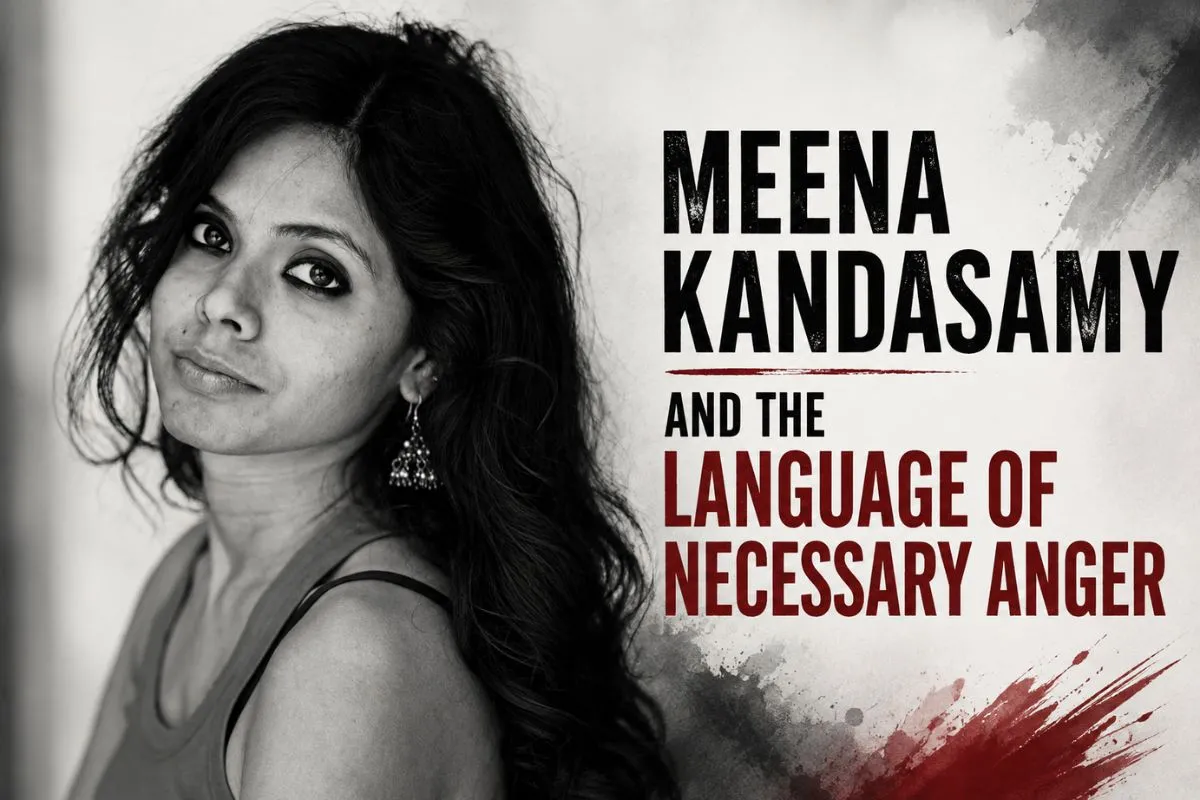
There are writers who observe the world and writers who refuse to let the world remain as it is. Meena Kandasamy belongs firmly to the second kind. Born Ilavenil Kandasamy in Chennai in 1984, she has spent more than two decades turning poetry, fiction, translation and public speech into instruments of confrontation. Her work does not merely describe caste, patriarchy, domestic violence or state power. It names them, strips them of their respectable clothing, and forces the reader to look at the raw machinery underneath.
What makes her writing unusual is not simply its political content. Many Indian writers address injustice. Kandasamy’s distinction lies in the way she treats language itself as a site of struggle. She does not trust polished, academic, or “civil” English when the subject is oppression. Her sentences often arrive sharp, sometimes crude, sometimes lyrical, always restless. She has said that her poetry “smells of blood” and “speaks like my people.” That claim is both aesthetic and ethical. For her, beauty that softens violence is a form of betrayal.
Roots of a Militant Voice
Kandasamy grew up in a household marked by quiet but persistent resistance. Her parents, both university teachers from lower-caste backgrounds, understood the weight of social hierarchy from the inside. Her mother fought a long legal battle for recognition and for the proper implementation of reservation policies in a hostile academic environment. The atmosphere of argument, of insisting on rights that others preferred to deny, shaped the daughter’s sensibility early.
She began writing poetry as a teenager. By her early twenties she was editing a Dalit magazine and translating the fiery speeches of anti-caste leaders. These early acts of translation were already political. To bring the language of militant Dalit assertion into English was to refuse the idea that such voices belonged only to the margins of Tamil or to the local. From the beginning, her project was one of amplification and confrontation at the same time.
Poetry as Reclamation and Attack
Her first major collection,Touch(2006), placed caste at the centre. The poems do not plead for sympathy. They register the daily humiliations of untouchability and the stubborn dignity of those who refuse to accept it. Kamala Das wrote a foreword, recognising a new and necessary voice.
Ms Militancy(2010) went further. Here Kandasamy takes the female figures of Tamil and Hindu myth and rewrites them as agents of desire, rage and refusal. Sita, Draupadi, and others are no longer symbols of patient suffering. They become women who claim their bodies and their anger. The book is deliberately provocative. It refuses the polite feminism that seeks only inclusion within existing structures. Instead it imagines women as militants who overturn the old stories rather than merely reforming them.
Later poetry, especially the 2023 collectionTomorrow Someone Will Arrest You, shows a writer watching the shrinking space for dissent in contemporary India. The title poem, written after friends were arrested under anti-terror laws, carries a bleak clarity. The personal and the political collapse into each other. Love poems sit beside poems about state violence. The effect is not sentimental. It is a record of how public fear seeps into private life.
Fiction That Refuses Comfort
Kandasamy’s novels extend this refusal of comfort into longer form.The Gypsy Goddess(2014) takes the 1968 Kilvenmani massacre, in which forty-four landless Dalit workers were burned alive by upper-caste landlords, and refuses the conventional historical novel. The book is restless, self-interrupting, full of authorial asides and formal experiments. It asks how one can write about atrocity without turning it into a neat narrative that the reader can consume and then set aside. The answer it offers is that one cannot. The form itself must remain broken.
When I Hit You(2017) is her most widely known work, and for good reason. It is an autofictional account of a young woman trapped in a marriage with a controlling leftist intellectual. The husband uses progressive language as a weapon. He isolates her, humiliates her, and eventually subjects her to physical and sexual violence. The novel is devastating precisely because it shows how ideology can become a cover for domination. Kandasamy does not present the victim as purely helpless. The narrator is a writer who keeps trying to turn her experience into language even as language is being taken from her. The book was shortlisted for the Women’s Prize for Fiction and forced many readers, especially on the Indian left, to confront the gap between their rhetoric about women’s liberation and the realities of intimate life.
Exquisite Cadavers(2019) experiments further with the boundary between fiction and lived experience. A story of an interracial couple is interrupted by the author’s own commentary on racism, Islamophobia, and the act of writing itself. The result is a text that feels both intimate and urgently public.
Her most recent novel,Fieldwork as a Sex Object(2026), turns to the digital present. Deepfakes, revenge pornography, coordinated online harassment, and the Indian version of the manosphere become the terrain. The book is partly comic, partly furious. It recognises that the old forms of misogyny have found new technologies, and that political power increasingly operates through the public sexual humiliation of women who speak. Kandasamy has lived this reality for years as a frequent target of sustained online abuse. The novel does not simply document the phenomenon. It tries to think through what resistance looks like when the attack is designed to turn a woman’s body into a spectacle of shame.
Style, Risk, and the Problem of Reception
Kandasamy’s style is often described as angry. That description is accurate but incomplete. Anger in her work is not a mood. It is a method. She uses it to cut through the layers of respectability that protect power. At the same time, she is capable of great tenderness, especially in poems about love, motherhood, and friendship. The two registers exist side by side because real life does not separate them.
She has been accused of being too polemical, too autobiographical, too experimental. These criticisms often reveal more about the critic’s desire for a certain kind of literary restraint than about the work itself. Kandasamy has never pretended to be a neutral observer. She writes as someone who has a stake in the fight, and she expects her readers to feel the pressure of that stake.
Her position within Indian literary culture is therefore complicated. She is celebrated internationally and has received major recognition, including election as a Fellow of the Royal Society of Literature and the PEN Hermann Kesten Prize for her defence of free expression. Inside India she remains a polarising figure, precisely because she refuses to soften her critique of caste, of Hindutva politics, or of the failures of progressive men on questions of gender and sexuality.
The Deeper Project
What unites Kandasamy’s poetry, fiction, translation and public writing is a single underlying question: what does it mean to speak when speech itself is policed, when the body is treated as evidence against the speaker, and when the language available has already been shaped by those who hold power?
Her answer is not resignation. It is a stubborn insistence on using every available form, classical and contemporary, lyrical and documentary, to keep the pressure on. She revisits ancient Tamil texts not out of nostalgia but in order to claim them for a feminist and anti-caste present. She writes novels that refuse the comfort of closure. She turns her own experiences of violence and harassment into material that others can use.
In an age when public discourse is increasingly managed, when technology multiplies the ways women can be silenced, and when caste and gender hierarchies continually find new justifications, Kandasamy’s work remains necessary. It does not offer easy hope. It offers something rarer: the example of a writer who continues to speak with precision and fury, even when the cost is high.
Her pages do not invite the reader to feel better. They invite the reader to see more clearly, and then to decide what to do with that clarity. That is the measure of her achievement.