
India’s Top 10 Unsolved Mysteries
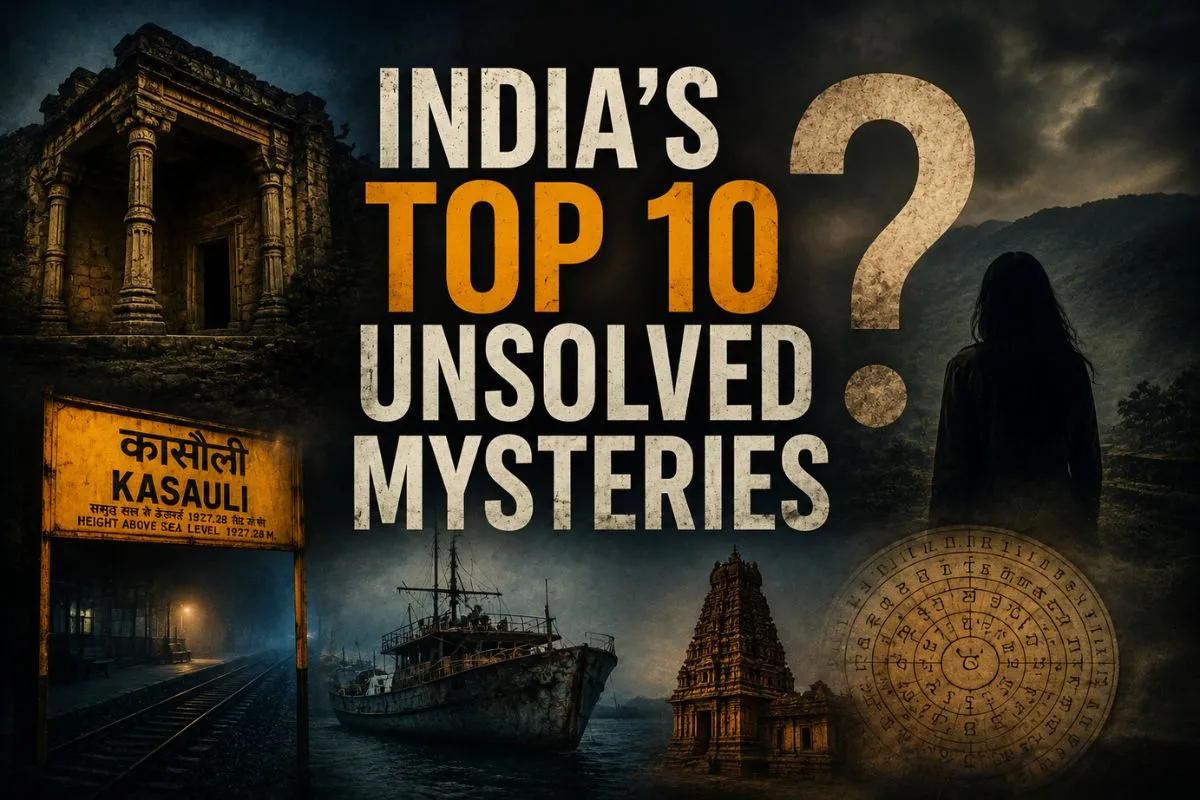
India’s history runs deep enough, and its geography varied enough, that it has accumulated its own genuine share of mysteries, ones that have survived serious scientific investigation, government inquiry commissions, and decades of dedicated research without ever being fully closed. As with any list like this, a few notes upfront. Several of these have credible scientific explanations covering most, but not all, of the evidence. A couple remain genuinely, formally unresolved even after real institutional investigation. All ten are documented, real events, not campfire invention.
1. Roopkund, The Skeleton Lake
At over 5,000 metres in the Himalayas, inside Uttarakhand’s Nanda Devi National Park, Roopkund Lake holds the scattered skeletal remains of several hundred people, first discovered by a forest ranger in 1942. Local legend describes a royal pilgrimage party struck down by the wrath of the goddess Nanda Devi after violating the sanctity of their journey, and for decades the leading scientific theory held that all the remains belonged to a single group of pilgrims killed together in a sudden, catastrophic hailstorm around 800 AD, a theory partly supported by skeletal trauma consistent with blunt force injuries from above. In 2019, a full genomic study published in Nature Communications overturned that tidy explanation entirely. Genetic analysis of 38 skeletons revealed three genetically distinct groups who died in separate events centuries apart, 23 individuals of South Asian ancestry from around the 7th to 10th centuries, and, considerably more strangely, 14 individuals with ancestry tied specifically to the eastern Mediterranean, genetically similar to modern populations from Crete, who died together in a single event roughly a thousand years later, around 1800. Isotopic analysis confirmed the two groups ate genuinely different diets and were unrelated to each other. What a group of people with Mediterranean Greek ancestry were doing at a remote Himalayan lake in the early 19th century, and why they died there together, remains completely unexplained. The mystery, if anything, only deepened the more closely scientists looked at it.
2. Netaji Subhas Chandra Bose’s Disappearance
Few unsolved mysteries carry the same national weight as the fate of Subhas Chandra Bose, the freedom fighter and leader of the Indian National Army, who was officially reported to have died in a plane crash in Taihoku, Formosa, on 18 August 1945. That official account has never fully settled public opinion in India, for reasons that go beyond simple reluctance to accept a hero’s death. No independent witnesses were ever produced to confirm the crash conclusively, and India’s own government has convened three separate official inquiries over the decades, the Shahnawaz Committee, the Khosla Commission, and the Mukherjee Commission, which reached genuinely different conclusions from one another. Most strikingly, the Mukherjee Commission, reporting as recently as 2005, found that the ashes held at Renkoji Temple in Japan, officially identified for decades as Bose’s remains, did not actually match him, a finding the Indian government formally rejected without offering a fully reconciled alternative account. Decades of reported sightings of Bose living under assumed identities across India further complicated the public record. Nearly eighty years on, no single account of his fate commands full, settled consensus.
3. Kuldhara, The Village Abandoned Overnight
Roughly twenty kilometres from Jaisalmer in Rajasthan, the ruins of Kuldhara have sat empty since the early 1800s, roofless but structurally intact, suggesting the people who lived there left in a hurry rather than gradually. The most repeated legend holds that the village’s Paliwal Brahmin residents, along with those of roughly eighty four neighbouring settlements, fled in a single night to escape a powerful, corrupt minister who had set his sights on a young woman from a prominent family, cursing the land as they left so that no one who settled there afterward would ever prosper. Historians tend to favour more grounded explanations, chronic water scarcity in an already arid region, unsustainable taxation, or broader economic and political pressure on the Paliwal community. What keeps the case genuinely open is less the cause of the exodus itself and more its scale and permanence, an entire cluster of villages abandoned essentially simultaneously, and left completely uninhabited for well over two centuries since, in a state with no general shortage of people looking for land to settle.
4. Jatinga’s Bird Deaths

In the small Assamese village of Jatinga, tucked into the hills of the Dima Hasao district, a strange and specific phenomenon has drawn ornithologists and tourists alike since it was first formally studied in 1960 by naturalist E.P. Gee and renowned ornithologist Salim Ali. During a narrow window each year, typically September through November, on specific dark, overcast nights following the monsoon, dozens of bird species, both migratory and local, appear to fly directly into buildings, trees, and lit objects around the village, often fatally. Researchers have proposed a combination of monsoon fog disorientation and artificial village lighting confusing the birds’ natural navigation as the most likely mechanism, and the phenomenon reliably stops the moment village lights are switched off during the relevant period, a strong point in favour of the disorientation theory. What genuinely remains unexplained is the extreme geographic specificity of the pattern, similar terrain, fog, and lighting conditions exist elsewhere in the region without producing anything like the same effect, and why this exact valley, out of the entire migratory flyway, has become the recurring site of the phenomenon has never been fully accounted for.
5. Kodinhi, The Village Of Twins
India has one of the lowest twin birth rates in the world, making the small Kerala village of Kodinhi, in Malappuram district, a genuine statistical anomaly. Among a population of roughly two thousand families, researchers have documented several hundred sets of twins, a rate reported to run at least six times higher than the global average by some estimates. The phenomenon has drawn serious scientific attention, researchers have examined genetics, local diet, water sources, and environmental factors looking for a cause, and the honest conclusion from the available research is that no single, confirmed explanation has been identified. The pattern holds regardless of religion or family background within the village, ruling out a purely cultural or dietary explanation specific to one community, and Kodinhi remains one of the more genuinely puzzling clusters of its kind documented anywhere in the world.
6. The Stoneman Murders
Across several Indian cities at different points in recent decades, a series of unsolved killings has been loosely grouped under the name “Stoneman murders,” referring to an unidentified attacker or attackers who bludgeoned sleeping homeless victims to death using a large stone or rock, before vanishing without leaving any consistent forensic trail. Cases attributed to this pattern have been reported in different cities in different periods, and investigators have never established with confidence whether they represent the work of a single perpetrator, multiple unrelated copycat attackers, or, in some cases, potentially unrelated crimes loosely connected after the fact by media coverage and public fear. No arrest has ever been definitively tied to the core pattern of killings, and the case remains one of the more disturbing open files in Indian criminal history, precisely because so little about the perpetrator, or perpetrators, has ever been established at all.
7. The Underwater Ruins Off Dwarka
In the Gulf of Khambhat and near the modern coastal town of Dwarka in Gujarat, marine archaeologists have documented submerged structures on the sea floor that some researchers have linked to ancient port cities, potentially predating widely accepted timelines for organised urban settlement in the region by a considerable margin. The site’s association with Dwarka carries additional cultural weight, given the city’s identification in Hindu tradition as the legendary submerged capital of Krishna. The scientific debate here is genuinely unresolved and, at points, genuinely contentious, some researchers argue the underwater features represent deliberate, ancient construction, while others attribute them to natural geological formations or later, more conventional archaeological material misread at depth. Dating the site conclusively has proven difficult given the underwater conditions, and until a fuller, broadly accepted excavation and analysis is completed, the true nature and age of what lies beneath the Gulf of Khambhat remains a genuinely open scientific question rather than a settled archaeological fact in either direction.
8. Krishna’s Butterball
In the coastal town of Mahabalipuram, Tamil Nadu, an enormous granite boulder, weighing an estimated 250 tonnes, rests on a distinctly sloped hillside at an angle that appears, to the naked eye, like it should have rolled away centuries ago. Known as Krishna’s Butterball, the boulder has sat in essentially the same precarious position for well over a thousand years, surviving monsoons, earthquakes, and, in the 1900s, a direct and deliberate attempt by British colonial authorities using seven elephants to dislodge it over fears it posed a safety risk to the town below. It did not move. Engineers and geologists have studied the boulder’s exact centre of gravity and the specific friction and terrain conditions that allow it to remain stable, and while the physics of why it does not currently roll are reasonably well understood in general terms, the boulder’s continued, undisturbed stability across a millennium of seismic activity in the region remains a genuinely remarkable, still actively studied case, less a total mystery today than an ongoing demonstration of how finely balanced natural equilibrium can sometimes be.
9. The Hovering Pillar Of Lepakshi
Inside the 16th century Veerabhadra Temple in Lepakshi, Andhra Pradesh, one of the seventy carved pillars supporting the structure appears to hang without touching the ground at all, with visitors historically able to pass a thin object beneath it to demonstrate the gap. Built during the Vijayanagara Empire, the temple’s builders are believed to have deliberately engineered the pillar’s suspended appearance as a display of architectural mastery, and it remains a celebrated example of sophisticated load bearing design centuries ahead of the tools available to verify it precisely at the time. A British engineer, attempting to understand the underlying support structure during the colonial period, reportedly shifted the pillar slightly during examination, and it has never fully returned to its original position since, leaving even art historians and structural engineers today without a fully agreed account of exactly how the original builders achieved and calculated the effect.
10. The 1995 Ganesha Milk Miracle
On 21 September 1995, reports began spreading from a temple in Delhi that a stone idol of Lord Ganesha was drinking milk offered to it by devotees, milk poured near the trunk visibly disappearing from the spoon. Within hours, the phenomenon was being reported at temples across India and, remarkably, at Hindu temples around the world simultaneously, from London to Hong Kong to Toronto, drawing crowds so large that milk shortages were reported in parts of the country. Scientists, including researchers from the Indian Science and Rationalists’ Association, later demonstrated the effect was consistent with simple capillary action and surface tension, porous stone and marble idols drawing in small quantities of liquid in a way that looked, to an eager crowd, like genuine drinking. That explanation accounts well for the mechanism itself. What it does not fully explain is the sheer, near simultaneous global scale and timing of the reports on that single day, a detail that still gets raised by those who find the purely mechanical explanation, however scientifically sound, insufficient to explain why an ordinary physical property of stone produced headlines on the same morning across several continents at once.
Holding The Mystery Honestly
What runs through all ten of these cases is a similar tension worth sitting with rather than resolving too quickly in either direction. Several, Jatinga’s bird deaths, Krishna’s Butterball, the 1995 milk phenomenon, have genuinely credible scientific mechanisms behind them, even where the full picture, why here, why this specific scale, why this particular timing, remains incompletely accounted for. Others, Roopkund’s Mediterranean skeletons, Netaji Bose’s actual fate, the Stoneman murders, the true nature of the Dwarka ruins, remain genuinely, formally open questions, unresolved by serious scientific and institutional investigation rather than merely under-researched. The honest position on a list like this one is not to force everything into either full belief or full dismissal, but to notice, case by case, exactly how much has actually been established, and how much genuinely has not, and to let that distinction stand rather than smoothing it over for the sake of a tidier story.