The Kohinoor: The Diamond That Has Outlasted Every Empire That Claimed It
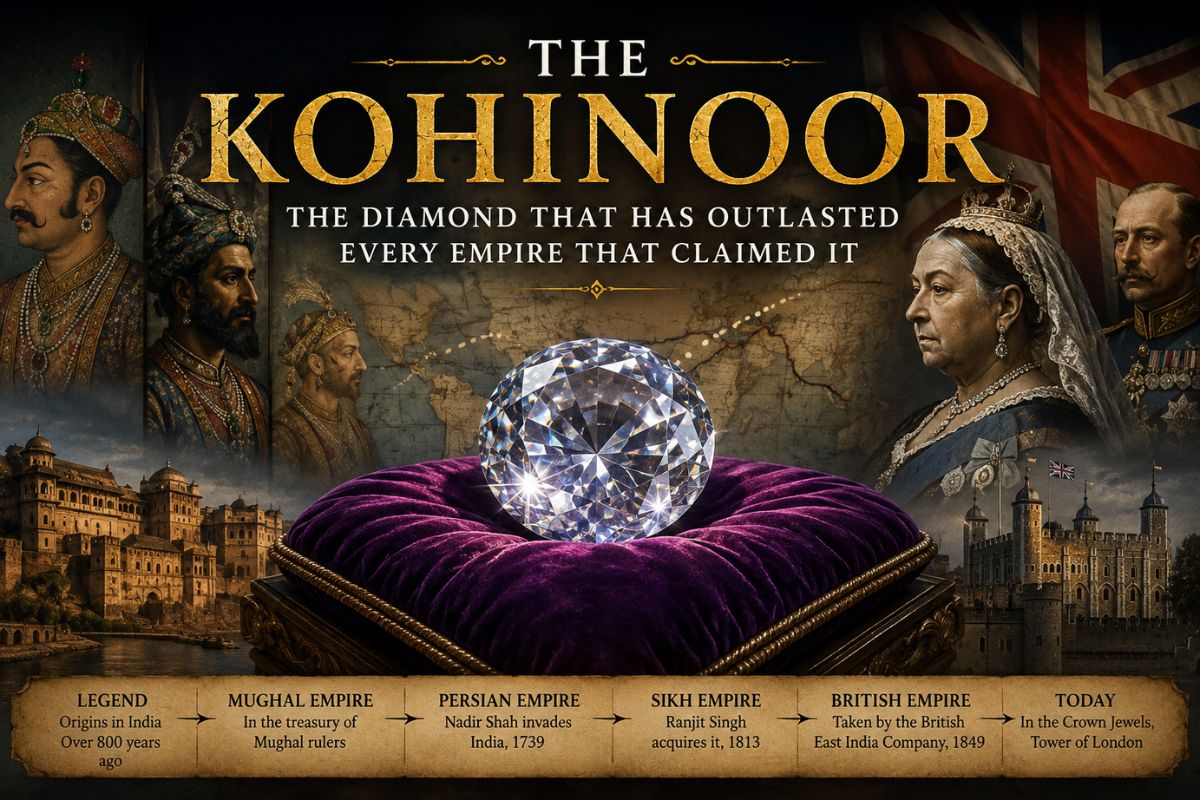
Inside the Tower of London, behind reinforced glass and a rotating queue of tourists, sits a 105.6 carat diamond that has been fought over, stolen, gifted, forcibly surrendered, and recut by nearly every major power that has touched the Indian subcontinent over the past seven centuries. The Kohinoor, whose name means Mountain of Light in Persian, is not simply a piece of jewellery. It is a physical object that has passed through the Kakatiya dynasty, the Delhi Sultanate, the Mughal Empire, the Persian Empire, the Afghan Durrani dynasty, and the Sikh Empire, before ending up, in 1849, in British hands, where it has remained ever since, at the centre of one of the world’s longest running cultural repatriation disputes.
Where It Actually Came From
The diamond’s earliest history is genuinely difficult to pin down with full certainty, and much of what circulates as fact is closer to legend layered over a real object. Most historians agree it was mined from the Kollur mines in the Golconda region of what is now Andhra Pradesh, a part of India already famous for producing some of the largest and finest diamonds in the world, including other legendary stones like the Hope Diamond. The earliest solid documented reference places the diamond in the possession of the Kakatiya dynasty of southern India in the early fourteenth century, where it was known by a different name, the Syamantaka, and was already believed to carry supernatural properties, bringing fortune to a rightful owner and misfortune to anyone who obtained it through treachery or violence.
From there, the diamond’s path runs through the Delhi Sultanate, seized, according to one account drawn from the memoirs of the Mughal emperor Babur, from Indian rulers by Sultan Alauddin Khilji in the fourteenth century. It passed into Mughal hands, where it remained a prized possession of the empire for generations, and later into the hands of the Persian ruler Nadir Shah, who invaded Delhi in 1739 and, according to popular legend, is the source of the diamond’s current name, reportedly exclaiming “Koh-i-Noor,” Mountain of Light, upon first seeing it. From Persia it moved to Afghanistan, carried by the Durrani dynasty, before a final, decisive turn back toward India.
Ranjit Singh, And The Bicep That Made It A Symbol Of Sikh Power
In the early nineteenth century, Shah Shuja Durrani, a deposed claimant to the Afghan throne, sought refuge with Maharaja Ranjit Singh, the powerful founder of the Sikh Empire based in Lahore. In exchange for protection and military support, Shah Shuja handed the Kohinoor over to Ranjit Singh, who wore the diamond strapped to his upper arm as a visible, deliberate symbol of sovereignty and imperial prestige, displaying it as one of the central treasures of the Sikh royal court. Under Ranjit Singh, the diamond became genuinely synonymous with Sikh political power, a status object worn on the body rather than locked away, precisely so it could be seen.
Ranjit Singh’s death in 1839 triggered a period of genuine instability within the Sikh Empire, a rapid succession of rulers, court intrigue, and weakening central authority that left Punjab vulnerable at exactly the moment the British East India Company was consolidating power across the subcontinent. That instability culminated in the Anglo-Sikh Wars, and following the British victory in the Second Anglo-Sikh War in 1849, the Company moved to formally annex Punjab entirely.
The Treaty That Britain Still Points To
The Treaty of Lahore, signed on 29 March 1849, sealed both the annexation of Punjab and the transfer of the Kohinoor. Its terms were negotiated, if that word can even fairly apply, with Maharaja Duleep Singh, Ranjit Singh’s youngest son and the last ruler of the Sikh Empire, who was somewhere between ten and eleven years old at the time. Article III of the treaty stated plainly that the diamond, taken by Ranjit Singh from Shah Shuja, would be surrendered by the Maharaja of Lahore to the Queen of England. This clause remains the entire legal foundation of Britain’s ownership claim to this day.
The circumstances surrounding that signature are precisely where the dispute actually lives. Duleep Singh was a child, ruling a kingdom that had just been militarily defeated, and his mother, Rani Jindan, had reportedly already been imprisoned by British authorities by the time the treaty was finalised. Whether a treaty signed under those conditions, by a child ruler with no genuine independent political agency, constitutes a legitimate transfer of property or a coerced surrender extracted under military duress is the exact question that has never been resolved to the satisfaction of both sides, and probably never fully will be, since it depends less on any single disputed fact and more on how each side weighs the legal form of the treaty against the obvious power imbalance behind it.
From Lahore To Queen Victoria’s Crown
The Company formally presented the Kohinoor to Queen Victoria in 1850, and it was publicly displayed for the first time the following year at the Great Exhibition in London’s Crystal Palace. The reaction was, by most contemporary accounts, a genuine anticlimax. In its original Mughal cut, the diamond simply did not sparkle the way European audiences expected under the era’s gas lighting, and Prince Albert, Victoria’s husband, ordered it substantially recut in 1852, reducing it from roughly 186 old carats down to its current 105.6 carats, a transformation designed specifically to maximise its brilliance under Western cutting conventions, at the direct cost of the stone’s original historical form.
The diamond has since been set into several different pieces of royal regalia, worn by Queen Alexandra and Queen Mary before eventually being placed into the crown made for Queen Elizabeth, the Queen Mother, in 1937. That crown was famously displayed atop the Queen Mother’s coffin during her funeral procession in 2002, and has remained one of the most visible pieces of the wider Crown Jewels collection ever since.
The Curse That Only Seems To Punish Men
No account of the Kohinoor is complete without its most persistent piece of folklore, a curse said to have been placed on the diamond, according to popular legend, as far back as 1306, decreeing that any man who wore it would suffer catastrophic misfortune, while it would bring good fortune to any woman who possessed it instead. Historians studying the diamond’s actual documented history tend to treat the curse as folklore layered onto a period of genuinely turbulent politics rather than a real causal pattern, pointing out that assassination, coup, and dynastic collapse were simply common features of medieval and early modern empires generally, curse or no curse, and that figures like Ranjit Singh experienced ordinary age related health decline rather than anything specifically tied to the stone.
What is genuinely notable, whatever one makes of the curse’s historical accuracy, is how seriously the British royal family appears to have taken it, whether sincerely or simply as convenient symbolism. Since the diamond entered the Crown Jewels, it has been worn exclusively by female members of the royal family, queens and queen consorts, never by a reigning king, a pattern that has held consistently for well over a century and has done real work in keeping the legend alive in popular imagination, curse believers and skeptics alike.
A Dispute Claimed By Four Countries At Once
India first formally requested the diamond’s return in 1947, immediately upon gaining independence, and has renewed that request repeatedly in the decades since, each time meeting the same firm refusal from successive British governments. In 2010, then Prime Minister David Cameron rejected the idea outright during a visit to India, arguing that returning the Kohinoor would open the floodgates to a wave of similar restitution claims that would, in his words, leave the British Museum empty. India is not, however, the only claimant. Pakistan has argued the diamond rightfully belongs to it as the successor state most directly tied to Lahore, where the stone was held at the time of annexation. Afghanistan has staked its own claim, tracing the diamond’s more recent lineage through the Durrani dynasty before it ever reached Ranjit Singh. Iran has occasionally raised a claim as well, rooted in the stone’s passage through Persian hands under Nadir Shah. The result is a genuinely unusual situation in international cultural property disputes, a single object claimed by four separate sovereign nations, each with a real, documented historical connection to it, and no international legal mechanism currently capable of resolving a dispute involving that many competing claims at once.
Britain’s own legal position has occasionally shifted in ways that complicated its consistency. In 2016, India’s own Solicitor General told the country’s Supreme Court that the Kohinoor had not technically been stolen, arguing instead that it was voluntarily surrendered by Ranjit Singh’s successors to the East India Company as compensation for British assistance during the Sikh Wars, a position that drew immediate criticism domestically for appearing to concede Britain’s legal argument on India’s own government’s behalf. The Indian government subsequently walked the statement back, reaffirming its position that the diamond had been taken under conditions no honest reading of the historical record could describe as a free and willing gift.
The Coronation That Tried To Avoid The Whole Argument
The dispute’s most recent, and most visible, flashpoint came ahead of King Charles III’s coronation in May 2023. Camilla, as Queen Consort, had originally been expected to wear the same crown containing the Kohinoor that the Queen Mother had worn decades earlier, and that Camilla herself had worn to Queen Elizabeth II’s funeral procession in 2022. Buckingham Palace ultimately announced that Camilla would instead wear a modified version of Queen Mary’s 1911 crown, reset with the Cullinan III, IV, and V diamonds from Elizabeth II’s personal collection, deliberately avoiding the Kohinoor altogether. Royal commentators and diplomatic analysts were largely direct about why, avoiding a fresh diplomatic controversy with India at a moment when the relationship between the two countries carried real economic and political weight neither side particularly wanted complicated by a centuries old jewel. India’s own government was notably restrained in its public reaction, sending Vice President Jagdeep Dhankhar to attend the ceremony rather than escalating the moment into a formal diplomatic incident, though commentary in the Indian press was considerably less restrained, with one prominent op-ed describing Camilla’s decision as a convenient distraction from the much larger, unresolved question of colonial era plunder rather than any genuine step toward resolution.
Why This Argument Resists A Clean Answer
The Kohinoor dispute sits at the centre of a much larger, genuinely contested global conversation about colonial era cultural property, one where reasonable people land in different places depending on which principle they weigh most heavily. Britain’s position rests on the existence of a formally signed treaty and a broader concern, openly stated by figures like Cameron, that any single restitution sets a precedent capable of emptying major Western museums and collections built substantially on colonial era acquisition. India, Pakistan, Afghanistan, and Iran’s positions rest on a different, equally serious principle, that a treaty extracted from a child ruler under military occupation, with his own mother imprisoned by the counterparty to the agreement, cannot reasonably be treated as a freely negotiated transfer regardless of what the document’s literal text says. Neither position is frivolous, and the dispute is unlikely to resolve cleanly in either direction any time soon, particularly given how many separate, legitimate national claims now sit on the same single object.
What The Diamond Actually Represents Now
Seven centuries after it first appears in the historical record, the Kohinoor has arguably become more significant as a symbol than as a gemstone, a single, physical object still capable of shaping a British coronation’s wardrobe choices, still cited in Indian parliamentary questions, still painted onto murals by diaspora artists demanding its return decades after independence. It has outlasted the Kakatiya dynasty, the Delhi Sultanate, the Mughal Empire, the Durrani dynasty, and the Sikh Empire, and it appears likely to outlast the current diplomatic stalemate as well, sitting behind glass in the Tower of London, drawing a queue of visitors who, whatever they know or don’t know about the treaty that put it there, rarely leave without at least a passing sense that the stone’s real story is nowhere near as settled as the display case suggests.