Bhanwari Devi: The Village Woman Whose Fight Changed India’s Workplace Safety Laws
Summary of the Bhanwari Devi Case
- Who: Bhanwari Devi, a low-caste social worker (saathin) from Bhateri village near Jaipur, Rajasthan.
- What happened: On 22 September 1992, she was allegedly gang-raped by five men from a higher caste after she tried to stop a child marriage in their family.
- Why it mattered: The attack was linked to her official work under the Rajasthan government’s Women’s Development Programme.
- Court outcome: In 1995, a district court acquitted the accused of rape (they received short sentences for lesser charges). An appeal has seen almost no progress in the High Court for decades. Some accused have since died.
- Biggest impact: Her case led to the 1997 Supreme Court Vishaka Guidelines on workplace sexual harassment. These later formed the base of the 2013 POSH Act that protects millions of working women in India.
- Her status: She never received full justice in her own case but is remembered as a catalyst for major legal change on women’s safety at work.
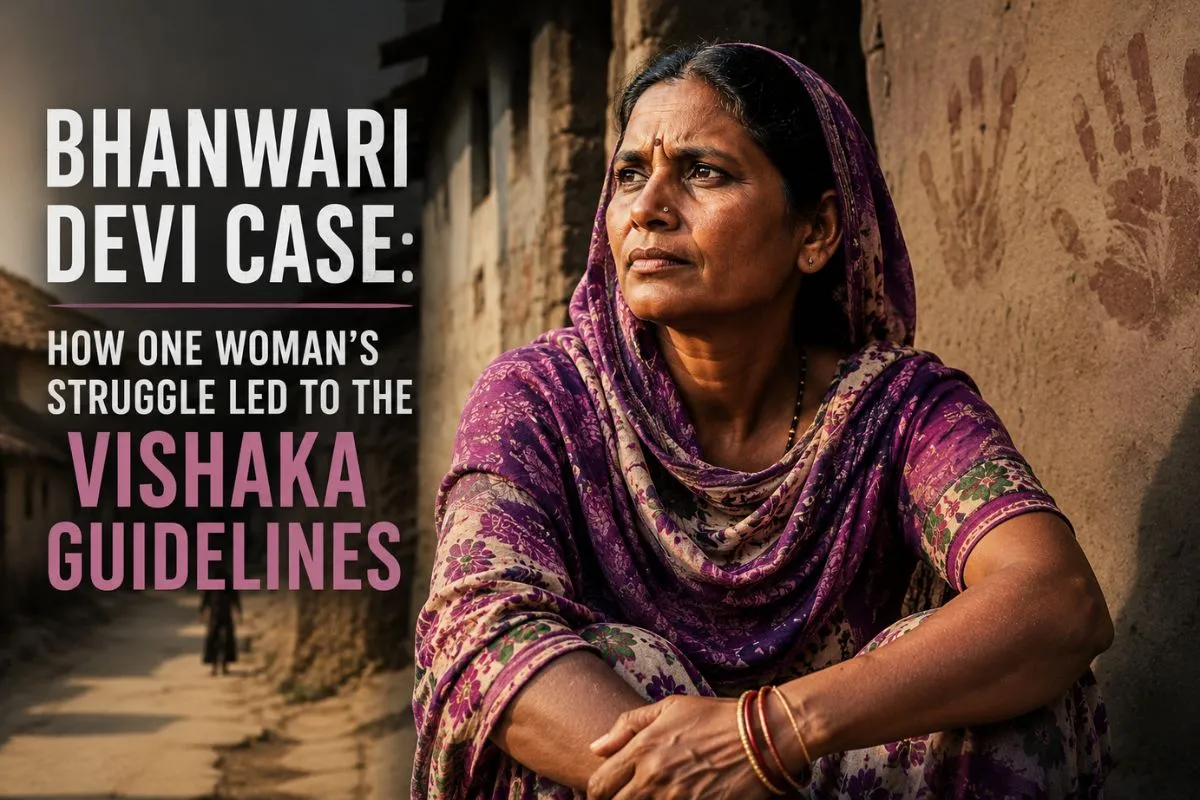
Bhanwari Devi is one of the most important figures in modern Indian women’s rights history. She never sought fame. She was a simple village woman doing her government job. Yet the violence she faced in 1992 and the long legal battle that followed changed how India protects women at the workplace.
This article explains her story in clear language, based on court records, news reports, and accounts from women’s rights groups.
Early Life and Work
Bhanwari Devi was born around 1951 or 1952 into a Kumhar (potter) family in Bhateri village, about 50 to 55 kilometres from Jaipur in Rajasthan. Her community ranks lower in the traditional caste order than the dominant Gujjar community in the same village.
She was married as a child, around the age of five or six, to Mohan Lal Prajapat. They later had four children: two sons and two daughters.
In 1985, the Rajasthan government started the Women’s Development Programme (WDP). Bhanwari joined as a “saathin,” which means “friend” or companion. Saathins were grassroots workers who went door to door. Their tasks included teaching women about health, hygiene, family planning, the value of educating girls, and the dangers of dowry, female foeticide, and child marriage.
Child marriage was common in rural Rajasthan at that time, even though it was illegal. Families often married off infants or very young children on auspicious days like Akha Teej.
Bhanwari took her work seriously. She had herself been a child bride, and she believed the next generation of girls deserved better.
The Child Marriage That Triggered the Attack
In 1992, the state government ran a special campaign against child marriage before Akha Teej. Bhanwari learned that Ram Karan Gujjar, a man from an influential family in her village, planned to marry his nine-month-old daughter to a one-year-old boy.
She tried to persuade the family to stop. When persuasion failed, higher officials and police were informed. On 5 May 1992, the Deputy Superintendent of Police and a Sub-Divisional Officer visited the village. They managed to stop the ceremony on the festival day itself. However, the family went ahead with the marriage early the next morning at around 2 a.m. No action was taken against them.
Villagers blamed Bhanwari for bringing the police. A social and economic boycott followed. People stopped buying the clay pots her family made and stopped selling them milk. Her husband was beaten. She faced threats. She was forced to leave her saathin job for a time after her employer was attacked.
The Night of 22 September 1992
According to Bhanwari Devi’s statement, on the evening of 22 September 1992 she and her husband were working in their fields collecting fodder. Five men from the Gujjar community attacked them. She named the men as Ram Sukh Gujjar, Gyarsa Gujjar, Ram Karan Gujjar (whose infant daughter’s marriage she had tried to stop), Badri Gujjar (their uncle), and Shravan Sharma.
The men beat her husband with sticks until he became unconscious. When she tried to help him, they attacked her. Two held her husband down while others raped her. She said the assault happened in front of her husband.
After the attack, the couple sought help. Getting a First Information Report (FIR) registered at Bassi police station took time and effort. Police showed reluctance and scepticism, a common problem for rape survivors in many parts of India at the time.
Medical examination faced serious delays. At the local primary health centre, a male doctor refused to examine her properly. She was referred to Sawai Man Singh Hospital in Jaipur. Even there, formalities delayed the examination. The vaginal swab was finally taken more than 48 hours (some reports say about 52 hours) after the alleged rape. Indian law at the time expected such examination within 24 hours for better evidence. Her visible injuries and scratches were not properly recorded.
Investigation and Trial
Local newspapers first reported the case. Women’s groups in Jaipur and elsewhere took up the issue. Public pressure led to the case being transferred to the Central Bureau of Investigation (CBI).
The five accused were arrested more than a year later. They were charged with gang rape, assault, conspiracy, and related offences. In 1993, while denying bail to one of the accused, a Rajasthan High Court judge wrote that he was convinced the rape was done in revenge for Bhanwari’s attempt to stop the child marriage.
The trial, however, moved slowly. Judges hearing the case were changed several times (reports say five times). On 15 November 1995, the District and Sessions Court in Jaipur acquitted all five men of the charge of rape. They were convicted only of lesser offences such as assault and conspiracy and sentenced to about nine months in prison.
The judgment contained reasons that women’s groups and many observers found deeply troubling. The court suggested, among other things, that:
- Upper-caste men would not rape a lower-caste woman because of ideas of purity.
- Men of different castes would not join in a gang rape.
- Older men (some were around 60) could not commit rape.
- An uncle and nephew would not rape together.
- A husband would not stand by and watch his wife being raped.
These observations were widely criticised as based on caste prejudice and outdated social assumptions rather than evidence.
The Fight for Justice Continues
Women’s organisations organised large protests in Jaipur and other places. The Rajasthan government, under pressure, filed an appeal in the High Court. That appeal has moved extremely slowly. By the mid-2000s, only one hearing had taken place. Two of the accused later died. As of the latest available reports, Bhanwari Devi has still not received a final conviction of the men for the rape charge.
She and her family faced continued social isolation in the village. Relatives sometimes refused to invite them to family events. Her mother-in-law’s funeral arrangements became complicated. Despite this, Bhanwari continued living in the same village.
She received some recognition. In 1994 she was given the Neerja Bhanot Memorial Award for courage. She was invited to the United Nations Fourth World Conference on Women in Beijing. Later state governments offered her some land and financial help for her children’s education. Still, she has often said that awards cannot replace justice.
How One Case Changed the Law for Millions
The most lasting impact of Bhanwari Devi’s case did not come from her criminal trial. It came from a separate Public Interest Litigation (PIL) filed in the Supreme Court.
Women’s groups, including the organisation Vishaka and others from Rajasthan and Delhi, argued that Bhanwari was attacked because of her official work as a government employee. They said the state had a duty to protect women workers and that India had no proper law against sexual harassment at the workplace.
In 1997, a three-judge Supreme Court bench delivered the landmark judgment known as Vishaka and Others v. State of Rajasthan. The Court used the Indian Constitution (especially the rights to equality, life, and liberty) and international conventions such as CEDAW to create binding guidelines.
These Vishaka Guidelines defined sexual harassment, required employers to prevent it, set up complaint committees, and laid down procedures for handling complaints. They applied to all workplaces, government and private, until Parliament passed a proper law.
Sixteen years later, in 2013, Parliament enacted the Sexual Harassment of Women at Workplace (Prevention, Prohibition and Redressal) Act, commonly called the POSH Act. The Act is built on the foundation of the Vishaka Guidelines. Today, every workplace with ten or more employees must have an Internal Complaints Committee. Millions of working women across India now have a formal legal framework for safety that did not exist before Bhanwari’s case.
Why the Case Still Matters
Bhanwari Devi’s story shows several hard truths about Indian society in the 1990s and the challenges that remain:
- Caste hierarchy can shape both violence and the response of institutions.
- Rural women doing development work often face backlash when they challenge traditional practices.
- Delays in medical examination, police indifference, and biased judicial reasoning can destroy a case.
- Individual courage combined with collective action by women’s groups can produce lasting legal change even when personal justice is delayed or denied.
She has said in interviews that she does not feel fear. She continues to live in Bhateri and has kept working on women’s issues in her own way. Her husband has supported her publicly.
Many people who know the case describe her as the woman who never got justice for herself but helped create protection for countless others. The POSH Act and the awareness around workplace harassment that exists today can be traced in large part to the evening of 22 September 1992 in a field near Jaipur and to the determined woman who refused to stay silent.
Her case remains a powerful reminder that progress in women’s rights often comes at a high personal cost, and that the fight for justice can outlast any single courtroom verdict.