The Secret Signs on a Woman’s Hands According to Samudrik Shastra
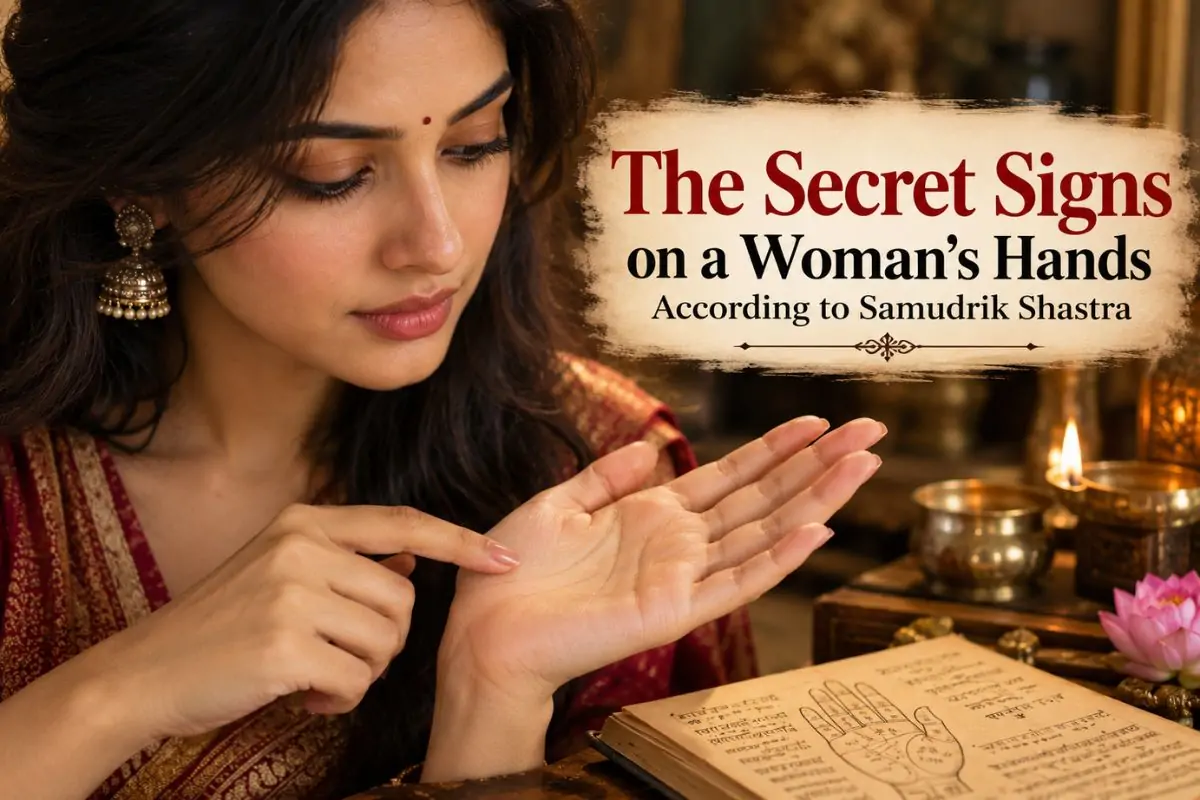
In Indian tradition, the hand has never been considered merely a physical feature.
For centuries, systems of traditional physiognomy have treated the hands as a kind of symbolic map, with their shape, fingers, nails, lines and texture believed to offer clues about temperament, fortune and the direction of a person’s life. Samudrik Shastra, one of India’s traditional systems of body reading, gives considerable attention to these details.
For women, some interpretations are particularly fascinating because they connect the appearance of the hands with qualities such as determination, emotional nature, prosperity and relationships.
These are traditional interpretations, not scientifically established methods of predicting personality or destiny. But the symbolism surrounding the female hand has survived for generations, making it one of the more intriguing parts of Indian Samudrik Shastra.
1. Soft, Smooth Hands
Traditional Samudrik Shastra considers the texture of the hand significant. Soft, smooth and well-proportioned hands have historically been viewed as favourable signs, particularly when the palm appears healthy and flexible.
Such hands are traditionally associated with refinement, comfort, sensitivity and an appreciation for beauty. In older interpretations, they could also indicate a life in which the woman enjoys support, comfort or favourable circumstances.
“The hand was traditionally read not simply for its beauty, but for what its texture was believed to suggest about a woman’s life.”
2. Long, Elegant Fingers
Long fingers have traditionally been associated with intelligence, sensitivity and an analytical temperament.
A woman with long, well-shaped fingers is sometimes described in Samudrik Shastra-inspired readings as someone who notices details others overlook. She may be thoughtful, particular about her surroundings and inclined towards creativity or intellectual pursuits.
The symbolism becomes particularly interesting when the fingers are proportionate to the palm. Traditional texts and later interpretations often place importance on overall balance rather than one isolated feature.
“According to traditional reading, proportion matters more than perfection.”
3. A Broad and Well-Formed Palm
A broad palm is traditionally interpreted as a sign of practicality, strength and groundedness.
Women with this type of hand may be described as capable of dealing with responsibilities without becoming easily overwhelmed by them. Traditional interpretations sometimes associate such palms with decisiveness and an ability to take charge when circumstances demand it.
This is one reason the hand became such an important symbolic feature in Indian body-reading traditions. It was not merely its shape that mattered, but the impression of strength and balance created by the entire hand.
“A strong palm was traditionally seen as a sign of a woman who could carry responsibility.”
4. Clearly Defined Fingers
Samudrik Shastra does not treat the fingers as insignificant details.
The length, spacing and form of each finger have traditionally been examined as part of the larger reading. Well-defined fingers, particularly when they appear proportionate and neatly aligned, are generally interpreted favourably.
Such hands are traditionally associated with an organised mind, self-control and clarity of thought. A woman whose fingers are neither excessively stiff nor unusually irregular may be described as someone who can combine discipline with adaptability.
“The fingers were traditionally regarded as extensions of the mind, each adding another layer to the reading.”
5. A Prominent Thumb
The thumb occupies a particularly important position in traditional palmistry and Samudrik Shastra-inspired interpretations.
A strong, well-shaped thumb is often associated with willpower, independence and the ability to make decisions. A woman with a prominent thumb is traditionally portrayed as someone who does not easily surrender control over important aspects of her life.
This interpretation is especially interesting because the thumb is the finger that gives the hand much of its functional strength. Traditional symbolism turned that physical importance into a metaphor for personal determination.
“The thumb represents one of the oldest ideas in hand reading: the strength to decide for yourself.”
6. Pink, Healthy-Looking Nails
The nails also receive attention in traditional interpretations.
Clear, naturally pink and well-formed nails are generally regarded as favourable signs, while unusually pale, damaged or irregular nails may be interpreted differently in traditional systems.
However, this is an area where tradition should not be confused with medicine. Changes in nail colour, texture or shape can have ordinary health, nutritional or environmental explanations and should not be treated as predictions about personality or fortune.
“In traditional Samudrik Shastra, the nails complete the picture; they were never meant to replace medical understanding.”
7. Fingers That Sit Close Together
The spacing between the fingers is another detail traditionally examined.
Fingers that naturally sit relatively close together when the hand is relaxed have sometimes been associated with caution, practicality and a tendency to think carefully before acting.
By contrast, widely separated fingers have traditionally been interpreted as a sign of independence and a willingness to take one’s own path.
These interpretations reveal something fascinating about traditional physiognomy: even the smallest physical spaces were given symbolic meaning.
“Even the spaces between the fingers were once considered clues to character.”
8. A Clearly Visible Life Line
The lines of the palm form perhaps the most famous part of traditional hand reading.
A clearly visible life line is traditionally interpreted as a sign of vitality and physical resilience. Contrary to a popular misconception, the traditional life line is not simply a countdown of how long someone will live.
Its shape, depth, curvature and relationship with other lines have historically been considered more important than its mere presence.
“The life line was never simply a clock; traditional readers treated it as part of a much larger pattern.”
9. A Strong Heart Line
The heart line has traditionally been associated with emotions, affection and relationships.
A clear and well-defined heart line is generally interpreted as an indication of emotional strength and sincerity. Its direction and interaction with other lines may be given additional meanings depending on the particular school of palmistry being followed.
For women, traditional readings sometimes connect a strong heart line with deep attachments and an ability to invest emotionally in relationships.
“The heart line was traditionally read as a story of emotional nature, not a guarantee of romantic destiny.”
10. The Overall Balance of the Hand
Perhaps the most important principle is also the easiest to overlook.
Traditional Samudrik Shastra does not necessarily treat one feature as an absolute prediction. The shape of the palm, fingers, thumb, nails and lines are considered together, creating an overall interpretation.
That is why two women may have similar-looking palms but receive completely different traditional readings.
The philosophy is essentially holistic. One sign is a clue; the entire hand is the story.
“The ancient idea was not that one line could reveal everything. It was that the whole hand had to be understood together.”
What Samudrik Shastra Believed a Woman’s Hands Could Reveal
The fascination with Samudrik Shastra lies in the extraordinary amount of meaning traditional Indian thought attached to the human body.
A palm was not merely a palm. Fingers were not merely fingers. Even the texture of the skin, the shape of a nail or the spacing between two fingers could become part of a symbolic language.
Whether someone approaches these interpretations as spiritual tradition, cultural history or simply an intriguing form of ancient observation, the underlying idea remains fascinating: our ancestors believed the body could carry a visible record of the person within.
And perhaps that is why the hand has remained such a powerful symbol across Indian traditions.
“We use our hands to build, create, love, protect and change our lives. Samudrik Shastra simply gave those hands a language of its own.”