The Jamui Outrage: A Mirror to Bihar’s Struggles with Safety, Society and Accountability
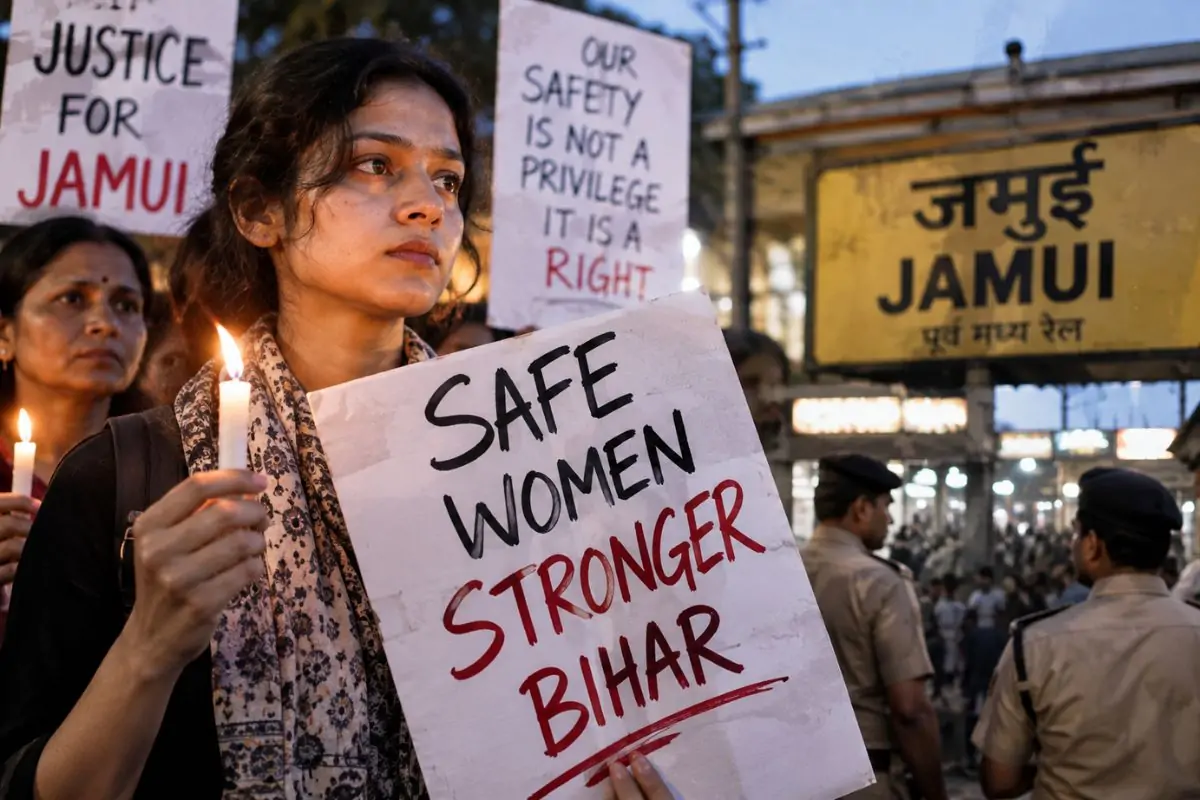
On 19 September 2026 in Jamui, Bihar, a group of men stopped, harassed and molested two Class 10 students (a girl and a boy) returning from Madwa Pahad on a scooter. The video went viral, leading to a POCSO case, arrests of all seven accused, and the main accused being shot in the leg during a police encounter.
On the evening of 19 September 2026, two Class 10 students, a girl and a boy, were returning from Madwa Pahad (also referred to as Marwa hill) near Jamui in Bihar on a scooter after attending coaching classes or a short outing. What should have been an ordinary journey turned into a public nightmare. A group of young men stopped them on a lonely stretch of road, roughly three kilometres off the Jamui-Lakhisarai main road. The youths surrounded the pair, abused them, forced them off the vehicle, assaulted the boy and sexually harassed the girl. One of the men grabbed the girl by the neck, lifted her and touched her inappropriately while others filmed the entire episode on a phone. The ordeal lasted around 15 to 20 minutes, possibly longer according to some accounts, before the teenagers managed to escape.
The video clips surfaced on social media on 21 September and spread rapidly across Facebook, Instagram and X. Public anger was immediate and intense. People across the country expressed shock and demanded justice. Bihar Police moved quickly once the footage went viral. They traced the victims using a vehicle registration number visible in the clips, recorded their statements and registered a first information report under the Protection of Children from Sexual Offences (POCSO) Act along with relevant sections of the Bharatiya Nyaya Sanhita. A Special Investigation Team headed by a woman Sub-Divisional Police Officer was formed. Around seven accused were identified from the video. Three were arrested early, including some minors who will be dealt with by the juvenile justice system. Later reports confirmed that all seven had been taken into custody. The main accused, Nandan Yadav, was shot in the leg during a police encounter while allegedly firing at officers and attempting to flee. He was hospitalised under custody. Police also acted against social media accounts that shared the video and exposed the minor girl’s face, filing cases against dozens and later around 120 profiles for violating laws that protect the identity of child victims.
The National Commission for Women and the Bihar State Women’s Commission took suo motu cognisance of the matter. The National Commission directed the Bihar Director General of Police to ensure proper investigation and arrests. The district administration and senior officers publicly assured that strict action would follow.
Yet the political response quickly turned the tragedy into a heated debate. Bihar’s Rural Development and Information Minister Shravan Kumar described the event as a “sporadic incident,” saying the world is not free of crime and that the government keeps an eye on such cases. Other ruling alliance leaders stressed that police had acted swiftly once the video appeared and that no one would be spared. Opposition leaders reacted sharply. Rahul Gandhi called the incident deeply disturbing and said it reflected patriarchy rather than culture. He asked why a girl was not safe on a public road in the evening and demanded prosecution under POCSO. Tejashwi Yadav of the Rashtriya Janata Dal criticised the state government, questioned women’s safety and called for accountability at the highest levels. Protests and political statements continued, with some student organisations also raising their voice.
This single incident cannot be viewed in isolation. It forces us to examine the larger picture of law and order, women’s safety and social attitudes in Bihar. Official data paints a mixed but concerning image. According to State Crime Records Bureau figures reported by The Indian Express, the overall number of crimes in Bihar rose by about 80 percent between 2015 and 2024. In the same broad period, the national increase was significantly lower, around 32 to 33 percent. In 2023 Bihar recorded roughly 3.54 lakh crimes, with a slight fall to 3.52 lakh in 2024. The state has consistently ranked among the higher ones in absolute numbers of crimes, though the rate per lakh population has often stayed below the national average.
Murder figures show a decline in absolute numbers over the years, from 3,178 in 2015 to around 2,800 in recent full years, yet Bihar has frequently ranked second in the country after Uttar Pradesh in total murders. Attempted murders have risen. Population-adjusted rates for murders and attempted murders have at times exceeded national averages. These numbers come from official records and independent reporting based on them. They do not prove that every street is unsafe, but they do show that challenges persist despite years of political claims about restoring order.
Women’s safety remains a particularly sensitive issue. Cases of harassment, molestation and assault continue to surface with disturbing regularity in different parts of India, including Bihar. When such crimes are filmed and circulated, the humiliation multiplies. The decision by some of the accused in Jamui to record and share the act points to a deeper problem of entitlement and lack of fear of consequences. Moral policing, where groups take it upon themselves to “correct” young people, especially couples, has been reported in several states. It often turns into violence and humiliation rather than any genuine concern for society.
Bihar has made progress in many areas over the past two decades. Road networks improved, electricity reached more villages, and school enrolment rose. Governments of different political combinations have claimed credit for ending the earlier phase of extreme lawlessness often called “jungle raj.” Yet data on crime trends, repeated incidents of violence against women and girls, and the speed with which political blame games begin after every major case show that governance and social change still lag behind public expectations.
Several factors contribute to the problem. High population density, large numbers of young people with limited employment opportunities, weak policing in some rural and semi-urban pockets, and slow judicial processes all play a role. Education levels, especially among women, remain lower than the national average in older census data, though newer surveys show improvement. Social attitudes that treat girls and young women as needing constant control rather than protection create an enabling environment for harassment. When videos of such crimes go viral, the victims face a second trauma through online exposure. Laws exist to prevent this, yet enforcement against those who share such content needs to be consistent and visible.
The police response in the Jamui case, once the video spread, was relatively prompt. An SIT was formed, arrests followed, and action was taken against those circulating the footage. That is welcome. But the fact that the victims themselves did not immediately approach the police, and that the case gained momentum mainly after public outrage, raises questions about trust in the system and access to justice for ordinary families, especially those from modest backgrounds.
Therefore, the real test is whether institutions learn and improve. Police need better presence on highways and lonely stretches popular with students. Public awareness campaigns against moral policing and street harassment must become continuous rather than reactive. Schools and coaching centres should counsel students on safety without restricting their freedom. Political parties of all colours should resist the temptation to use every crime only for electoral point-scoring and instead support long-term reforms in policing, prosecution and social education.
The father of the girl in the Jamui case reportedly said that arrests alone are not enough. That simple statement captures the public mood. People want not just punishment of the guilty but a visible reduction in the conditions that allow such incidents to occur. Bihar’s young population is its greatest strength. Ensuring that girls and boys can travel safely for education or simple recreation is not a luxury. It is a basic requirement of a functioning society.
The Jamui incident is one case. Behind it stand thousands of unreported or less publicised instances of harassment across the state and the country. Data on rising overall crime numbers, high absolute figures for violent offences, and repeated political controversies over law and order together form a warning. Progress is possible, but it demands honest acceptance of problems, consistent administrative action, and a change in social attitudes that still treat women and girls as lesser beings subject to public control. Until that happens, sporadic incidents will keep occurring, and each new viral video will reopen the same painful questions about safety and justice in Bihar.
📖 Suggested Reading: Domestic Violence & Crimes Against Women in India
- Deaths Due to Domestic Violence in India: A Silent Epidemic That Demands Urgent Action
- The Silent Genocide: Women Dying Every Day in Their Own Homes
- Crimes Against Women in August 2026: A Detailed Report
- I Think It’s Easy to Blame Women for Domestic Violence
- Shivani Bhatnagar Murder Case: The Journalist, the Killing, and the Evidence That Divided the Courts
- Aftab Ameen Poonawala Murdered His Girlfriend and Cut Her Body Into 35 Pieces