“Why Doesn’t She Just Leave?” 7 Psychological Reasons Women Stay Too Long in Situations That Hurt Them
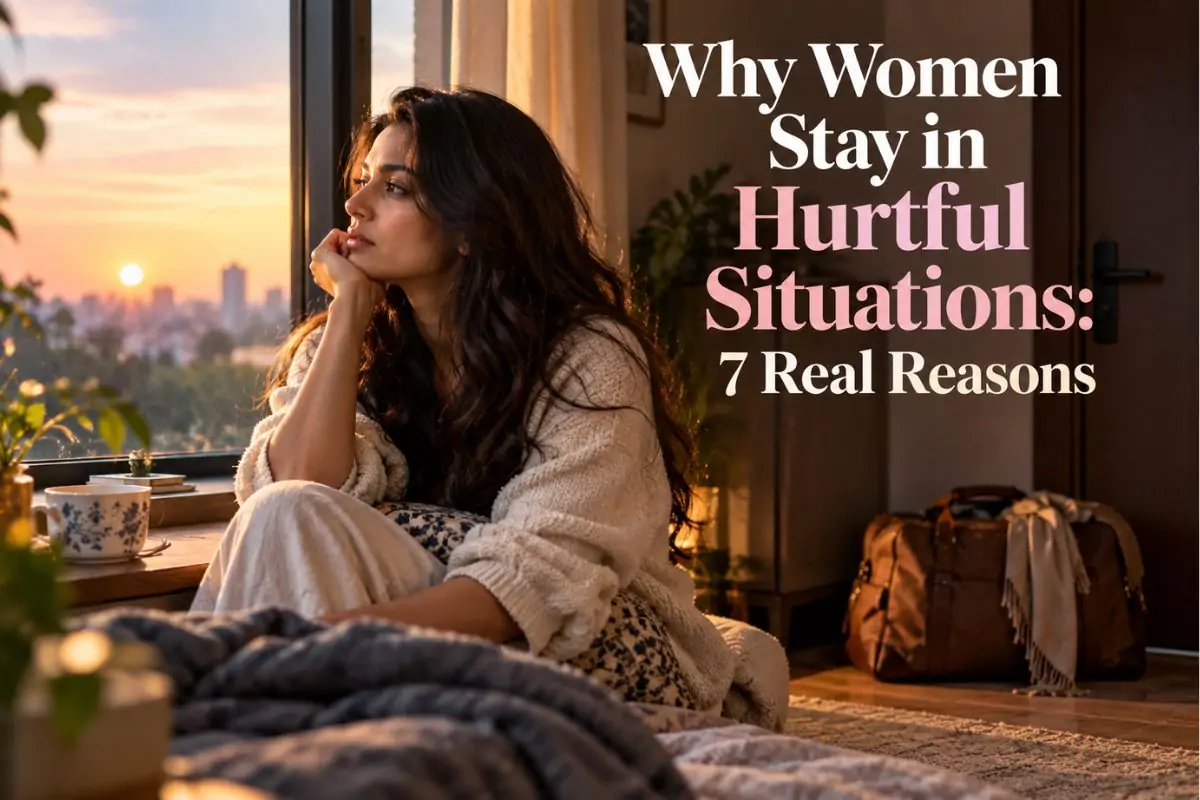
Let’s start with the most irritating question in the English language.
“Why doesn’t she just leave?”
Said with a head tilt and the confidence of someone who has never had to leave anything harder than a bad restaurant.
Here’s the truth the question skips: it’s almost never “just.” Staying in a hurtful relationship, job, friendship or family dynamic isn’t a sign of weakness, stupidity or lack of self-respect. It’s what happens when predictable, well-documented psychological forces meet real-world constraints. Smart, funny, accomplished women stay. Women who give brilliant advice to their friends stay. Women who wouldnevertolerate this from anyone else stay.
This article unpacks seven of those forces. If you’re reading because you’re in the thick of it, you’re not broken, and you’re not alone. If you’re reading to understand someone you love, thank you. For more on how women think, feel and navigate the world, bookmark theWomen Psychologyhub and theReal Talksection.
First, a Few Myths to Bin
- Myth: “If it were really bad, she’d have left.”Reality: harm often escalates slowly, which makes it hard to notice the line you crossed.
- Myth: “She must like the drama.”Reality: attachment to an unpredictable person is a stress response, not a preference.
- Myth: “Strong women don’t stay.”Reality: strength is oftenwhyshe’s still standing there, absorbing, adapting and surviving.
- Myth: “Leaving is the end of the problem.”Reality: for some women, the period around leaving is the most dangerous. That’s a reason for careful planning and support, not a reason to stay forever.
Table of Contents
Reason #1: The Sunk Cost Trap (“I’ve Already Given Them So Much”)
Economists and psychologists call it thesunk cost fallacy: the tendency to keep investing in somethingbecausewe’ve already invested, rather than because it’s working.
Five years, ten years, two children, a shared home, a wedding that cost a fortune, a career built around someone else’s. When you’ve poured so much in, walking away can feel like declaring all of it wasted. So we double down.If I just try a little harder, it’ll pay off.
It applies beyond romance. Women stay in jobs where they’re overlooked because they’ve “put in the time,” and in friendships because “we go back years.”
Try this reframe:the question isn’t “How much have I already spent?” It’s “If I were starting today, knowing everything I know now, would I choose this?” The time is gone either way. The only decision left is what you do with the time you still have.
Money matters here too. If you’re financially tangled, it’s worth quietly getting clear on where you stand. Skim9 things you should stop buying if you want to build wealth, and browseMoney,FinanceandCareerfor ways to build independence at your own pace.
Reason #2: Intermittent Reinforcement and Trauma Bonding (“But He’s Wonderful When He’s Good”)
This one is the heavyweight, and it explains why leaving can feel physically impossible.
In behavioural psychology, intermittent reinforcement means rewards arriveunpredictably. Slot machines use it. So do some hurtful relationships. If someone were cruel all the time, the choice would be easy. But when cruelty is followed by apology, tenderness, gifts, holidays or a glimpse of the person you fell for, your brain gets a hit of relief that can feel like love.
The cycle often looks like this: tension builds, a hurtful incident happens, remorse and affection follow, calm returns, then tension builds again. The “good” stretches don’t cancel the harm. Theyanchorit. Many people describe this as a trauma bond , a strong emotional attachment formed through repeated cycles of hurt and relief. Trauma bonding is a widely used concept in clinical and support settings, though researchers continue to refine how it’s defined and studied.
The confusing part is that the relief feels like intimacy. Calm after chaos can be mistaken for connection, and the highs feel higherbecauseof the lows.
What helps:keep a private record of what actually happens, not what you hope will happen. When memory softens the hard moments, notes keep the full picture visible. If you’re in a relationship that may be abusive, read aboutabuseanddomestic violenceto recognise the patterns, and use a safe device and storage so the record isn’t discovered.
Reason #3: Cognitive Dissonance and Hope (“He’s Not Like This Really”)
Humans hate holding two conflicting beliefs.This person loves meandthis person hurts mecan’t comfortably sit together. Psychologists call the discomfort cognitive dissonance , and the brain resolves it in sneaky ways:
- Minimising: “It wasn’tthatbad.”
- Excusing: “He’s just stressed.”
- Blaming yourself: “I shouldn’t have said that.”
- Clinging to potential: “He’ll change once things settle down.”
Hope is a beautiful human feature and a very effective trap. Many women fall in love with a person’spotential, the version that appears on good days or in the early months. Staying becomes an act of loyalty to that version.
There’s a related pattern in manipulation: charming people who build trust fast, then use it. For a historical masterclass in how persuasion and false promises work, read aboutVictor Lustig, the con man who sold the Eiffel Tower, twice. Manipulation succeeds because the targetwantsthe story to be true, which is not a character flaw. It’s human.
What helps:watch behaviour over time, not promises. Apologies that come with changed actions are real. Apologies that arrive on a loop are a pattern. Hope is lovely, but it isn’t a plan.
Reason #4: Conditioning to Be the Self-Sacrificing One (“A Good Woman Endures”)
Many women grow up absorbing a script: be patient, be accommodating, hold the family together, put others first, and don’t make a fuss. We’re praised for sacrifice and quietly warned about the cost of selfishness.
The result is a woman who confusesendurancewithvirtue. Leaving a hurtful situation can feel like failing at being “good,” so she stays longer than anyone should, offering patience that the other person hasn’t earned. This is closely linked to people-pleasing, the habit of over-apologising and the reflex to manage everyone else’s feelings. (If you recognise that pattern, the follow-up read is our piece on why women over-apologise.)
Culture, religion and family expectations can deepen this. In some communities, divorce or separation carries heavy stigma, and women are expected to “adjust.” In the starkest cases, early marriage and coercion remove choice entirely. Learn more underCrime Against WomenandChild Marriage, and see the full scale of what women are asked to tolerate in11 things women are officially too old to put up with.
What helps:question the script.Who benefits when I endure this? Would I tell my daughter, sister or best friend to stay?Read10 things emotionally mature women no longer explain to anyoneand10 things women stop caring about when they finally become comfortable with themselvesto see the other side of that conditioning.
Reason #5: Eroded Self-Worth, Gaslighting and Isolation (“Maybe ItIsMe”)
Slowly, sometimes imperceptibly, a hurtful dynamic can wear down your sense of self. Common tactics include:
- Gaslighting:making you doubt your memory or perception. (“That never happened.” “You’re too sensitive.”)
- Constant criticism:about your body, your intelligence, your parenting, your friends.
- Isolation:discouraging contact with family and friends, or souring those relationships.
- Withholding:affection, money, information or approval as punishment.
Over time, you may stop trusting your own judgement. When the person who hurts you is also your main source of feedback, their version of reality starts to feel like the truth. And if your confidence is rattled, leaving seems unthinkable:Who would want me? How would I manage alone?
This can overlap with anxiety, low mood and depression, which make decisions feel impossible. ExploreDepression,Body Image,Mental HealthandStress Management, and check11 signs you are mentally exhausted, even when you look fineand the35 signs of burnout before it becomes a breakdown. Chronic stress narrows your thinking, and that’s physiology, not weakness.
For a gut-level reminder that your instincts deserve a hearing, readStanislav Petrov: the man who trusted his gut over the machine. The quiet voice saying “this isn’t right” isn’t dramatic. It’s data.
What helps:reconnect with one trusted person, even briefly. A friend, sibling, colleague or counsellor can offer an outside view that your inner critic can’t. Rebuilding trust in yourself starts with one honest conversation.
Reason #6: Real, Practical Fears (Money, Children, Safety, Housing)
Not every reason is psychological. Some are brutally practical, and they’re valid.
- Money:If you don’t control the finances, or your income can’t cover rent alone, leaving is a genuine risk. Economic dependence is one of the most common barriers. This is also why articles likeShe’s Paying the Bills, and He’s Loving It: The Hidden Cost for Womenmatter: money and power are tied together.
- Children:Many women stay “for the kids,” or fear losing custody, or worry about their children’s stability.
- Housing:Nowhere safe to go is a real barrier.
- Immigration or legal status:Fear of deportation or legal consequences can trap people.
- Safety:Some women stay because they’ve learned, correctly, that leaving could provoke escalation. Research on domestic violence consistently identifies the period around separation as a time of heightened risk.
That last point is not a reason for despair. It’s a reason forplanning with professional supportrather than leaving abruptly or alone. Trained advocates can help you build a safety plan, including documents, money, a place to go and how to leave safely.
In India, commonly listed numbers include112(national emergency),181(Women Helpline) and1091(women in distress). Availability and services vary by state, so verify the current numbers locally.Outside India, search for your country’s domestic violence helpline or contact local emergency services. If you’re in immediate danger, contact emergency services right away.
If you’re thinking of leaving, consider doing it with support, not by yourself. And if you’re a friend or relative, resist the urge to demand she gonow. Pressure often backfires. Staying connected and non-judgemental helps far more.
Reason #7: Shame, Fear of Judgement and a Fractured Sense of Identity (“What Will People Say?”)
Shame is a master jailer. It whispers that if people knew, they’d think less of you. That you should have seen the signs. That leaving means admitting you made a mistake, and that admitting it means failing publicly.
For many women, identity is also bound up in the situation:I’m someone’s wife. I’m the loyal employee. I’m the friend who never gives up. I’m the one who holds it all together.Leaving threatens not just a routine but a whole sense of who you are.
“Log kya kahenge” (what will people say) is a phrase that has ruined more lives than most villains. In close-knit families and communities, the fear of gossip, blame or isolation can be crushing.
Meanwhile, the aftermath of leaving can be lonely. Friends may take sides, routines vanish and the absence of chaos can feel strangely empty. Grief, even for a hurtful situation, is normal.
What helps:find stories of women who stepped out and rebuilt. OurConfessionssection holds honest, personal accounts, andHomecoming: The Feeling of Returning to a Place That Never Left Your Heartbeautifully captures the experience of coming back to yourself. For women who didn’t wait for permission, read aboutAir Vice Marshal Shakti Sharma,Pabiben RabariandRomita Mazumdar, and browse the widerWomen Change Makershub. Their stories remind us that a hard situation isn’t the end of the plot.
It’s Not Only Romantic Relationships
The same forces apply to:
- Toxic workplaces:sunk cost (“I’ve been here eight years”), intermittent praise, self-doubt and financial fear
- Draining friendships:loyalty, nostalgia and guilt
- Difficult family dynamics:duty, conditioning and fear of conflict
- Unhealthy habits and patterns:identity, familiarity and the comfort of the known
If you’re stuck in a job that’s wearing you down, take a look at theCareerhub andRemote Jobsfor options. And if your relationships need an honest look,Relationships,Dating,Parentingand theAdvicetag can help.
How to Tell If a Situation Is Hurting You (A Gentle Checklist)
You may be in a harmful situation if you often:
- Feel afraid, anxious or on edge around the person
- Walk on eggshells to avoid their reaction
- Feel smaller, quieter or less like yourself than you used to
- Have been cut off from friends, family or money
- Are criticised, humiliated or controlled
- Doubt your own memory or sanity
- Excuse behaviour you’d never excuse in someone else
- Feel relief when the person isn’t around
- Have been threatened, pushed, hit or forced into anything
One or two items doesn’t diagnose a relationship, but a pattern deserves attention. If any of this involves physical harm, threats or coercion, reach out to a helpline, a trusted person or professional services.
What Actually Helps (Small Steps, Not a Dramatic Exit)
You don’t have to decide everything today. Progress often looks like many quiet steps.
- Name it.Saying “this isn’t okay” to yourself is the first real step.
- Tell one safe person.Not everyone. One.
- Document safely.Keep notes, screenshots or records somewhere the other person can’t access.
- Protect your documents and money.Passport, ID, bank details and key papers. Quietly secure copies where possible.
- Build an exit fundif you can, even small amounts.
- Talk to a professional.A therapist, counsellor, lawyer or domestic violence advocate can offer guidance tailored to your situation.
- Plan, don’t improvise.Especially if there’s any risk of violence.
- Rest and look after your body.Sleep, food and movement support clear thinking. A littlesilent walkingcan calm a racing mind, andSelf-Care,Personal GrowthandWomen’s Healthhave more ideas. Even smalllife hackscan ease daily load.
- Be patient with the leaving process.Many women leave several times before it sticks. That isn’t failure. It’s often part of how people get out safely.
- Ask for help without apology.Questions and doubts are welcome atAsk Shakti.
If Someone You Love Is Staying
- Listen without judgement.“I’m worried about you” lands better than “You need to leave.”
- Believe her.Doubt can push her back toward the person hurting her.
- Keep the door open.Stay in touch, even if she makes choices you don’t understand.
- Offer practical help.A place to stay, a ride, a copy of documents kept safe, help finding a counsellor.
- Avoid ultimatums.They can isolate her further.
- Encourage professional support.Advocates and helplines know how to help safely.
- Look after yourself.Supporting someone is draining, and you need support too.
The Last Word
Women don’t stay because they’re weak, foolish or in love with suffering. They stay because the mind is wired to protect investments, crave relief, resolve contradictions, obey old scripts, doubt itself under pressure, weigh real dangers and avoid shame. Understanding that isn’t an excuse. It’s the beginning of a way out.
If you’re in a situation that hurts, you deserve better than endurance. You deserve safety, respect, peace and a life where your instincts are trusted. You don’t have to do it all today, and you don’t have to do it alone.
And to everyone who asks “Why doesn’t she just leave?”, a better question:“What would make it safe and possible for her to go?”Start there.
Want to share your own story, or help another woman feel less alone?Get featuredorwrite a guest postfor Real Shee Power. Got a question that needs straight talk?Ask Shakti.
FAQ
Why do women stay in toxic or abusive relationships?
There are usually several overlapping reasons, including emotional attachment, intermittent kindness, hope for change, financial dependence, concern for children, fear for safety, shame and eroded self-worth. It’s rarely a single factor.
What is trauma bonding?
Trauma bonding describes a strong emotional attachment that can form in relationships with cycles of hurt followed by affection or relief. It’s widely discussed in clinical and support settings, though the term is used somewhat differently across sources.
What is the sunk cost fallacy in relationships?
It’s the tendency to keep investing in something because you’ve already invested time, money or emotion, even when it no longer serves you. Asking “Would I choose this today?” can help break the pattern.
Is leaving an abusive relationship dangerous?
For some people, the period around leaving can carry increased risk. That’s why planning with a trained domestic violence advocate or support service is recommended, rather than leaving suddenly without a plan.
How can I help a friend who won’t leave?
Listen without judgement, believe her, keep in touch, offer practical help and encourage professional support. Avoid ultimatums or blaming her for staying.
Who can I call for help in India?
Commonly listed numbers include 112 for emergencies, 181 for the Women Helpline and 1091 for women in distress. Services vary by state and change over time, so verify the latest numbers locally.
When should I seek professional help?
If you feel afraid, controlled, unsafe or persistently low, or if staying is affecting your health or daily life, speak to a therapist, doctor, legal adviser or domestic violence support service.