Meet Stanislav Petrov The Man Who Trusted His Gut Over the Machine
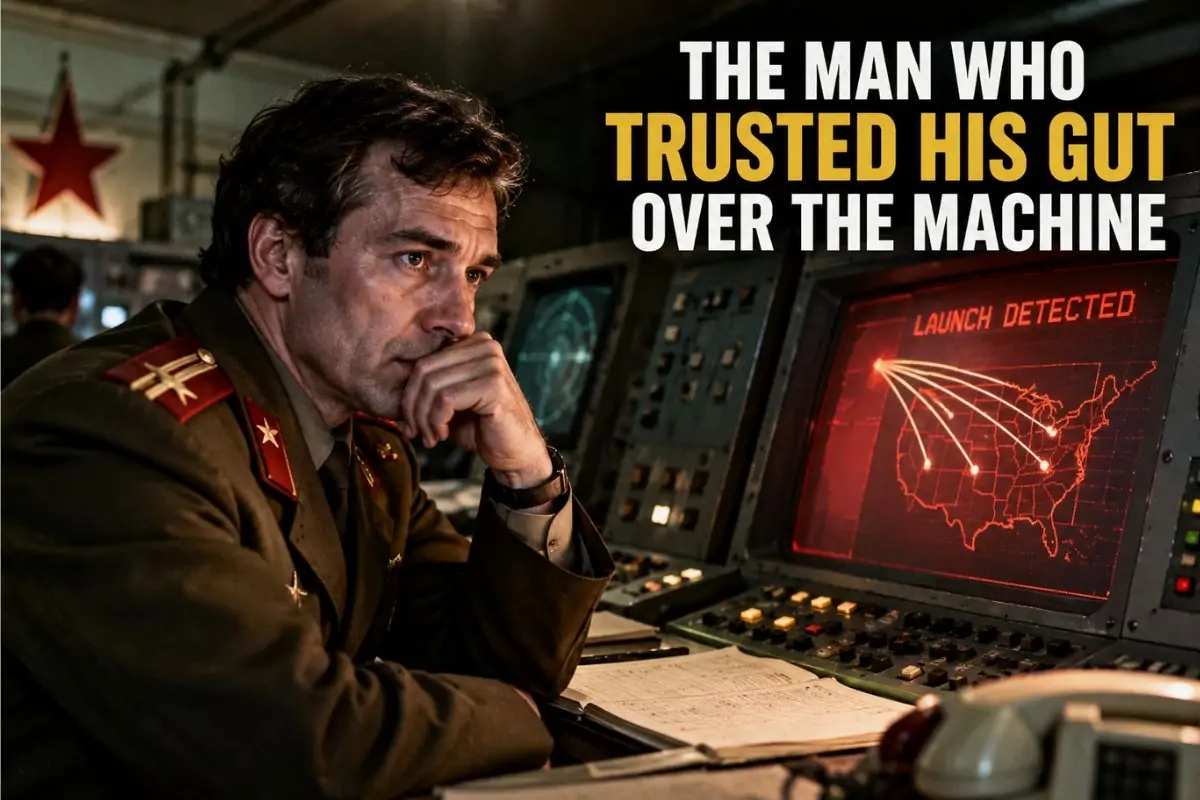
On the night of September 26, 1983, a Soviet lieutenant colonel named Stanislav Petrov sat in a bunker outside Moscow, watching a screen that told him the United States had just launched nuclear missiles. He had only minutes to decide whether to believe it.
A world on edge
The timing could hardly have been worse. Just weeks earlier, Soviet fighters had shot down Korean Air Lines Flight 007, killing everyone aboard. Relations with Washington were at their coldest in years, and Soviet leadership was gripped by fear of a surprise first strike.
When fear runs the system, every ambiguous signal looks like an attack.
Petrov’s job was to monitor Oko, the Soviet satellite network built to detect American missile launches. If it reported an attack, his duty was to pass the warning up the chain of command, where leaders would decide whether to retaliate.

The alarm
Shortly after midnight, the system reported a single missile launched from the United States. Then it reported more, a total of five. The screen displayed the highest alert level. Sirens sounded.
The machine was certain. That certainty was the most dangerous thing in the room.
By protocol, Petrov was supposed to report the launch. But something bothered him.
Why he hesitated
Petrov later explained his reasoning in several interviews. A real first strike, he figured, would involve hundreds of missiles, not five. The system was also new, and he didn’t fully trust it. And the ground-based radar, which would have picked up incoming warheads, showed nothing.
Good judgment often means asking not “what does the data say?” but “what would the world look like if this were true?”
He judged it a false alarm and reported it that way, knowing that if he was wrong, his country might lose its chance to respond.
What actually happened
The cause was later traced to an unusual coincidence. Sunlight was reflecting off high-altitude clouds in a way that the satellites’ sensors read as missile engine flares. The software had no way to tell the difference.
The system wasn’t broken in an obvious way. It was working as designed, in a situation its designers never imagined.
Nothing was launched. The minutes passed, no warheads arrived, and the false alarm was confirmed.
The aftermath
Petrov was not celebrated. The incident exposed flaws in the Soviet warning system, and the officials responsible for it had little interest in drawing attention to them. By his own account, he received no reward, and he was reportedly reprimanded over paperwork. The story stayed hidden until the late 1990s, when it came to light after a former Soviet general wrote about it.
Preventing a catastrophe is invisible. No one throws a parade for the disaster that didn’t happen.
In later years he received international recognition, including awards in Europe and from the United Nations Association of the United States, and he often downplayed his role, saying he was simply doing his job. He died in 2017 at the age of 77.
Why it still matters
Petrov’s story is more relevant now than it was in 1983. We increasingly hand decisions to automated systems, from financial trading to medical diagnosis to military targeting, and those systems often present their outputs with confidence they haven’t earned.
The most important safeguard in any automated system is a human who is allowed, and willing, to say “this doesn’t seem right.”
That takes more than skill. It takes a system that makes space for doubt and a person with enough courage to act on it, even when the rulebook says otherwise.