
The Dancing Plague of 1518: When an Entire City Danced Itself to Death
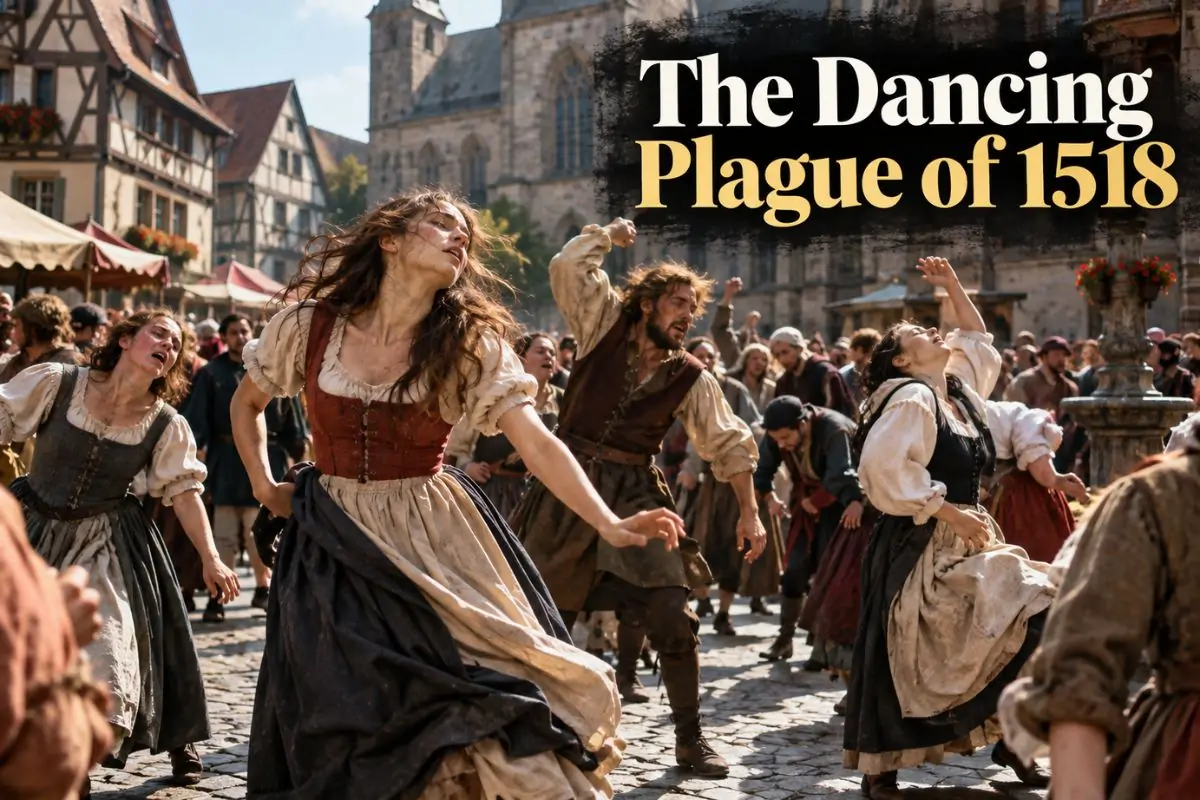
In the sweltering July heat of 1518, a woman named Frau Troffea stepped out of her half-timbered home on a narrow street in Strasbourg and began to dance. Not a performance, not a celebration, just uncontrollable, convulsive movement that didn’t stop. She danced through the day. She danced into the night. By some accounts, she kept dancing for nearly a week straight, collapsing from exhaustion only to get back up and keep going.
- The Dancing Plague of 1518 struck Strasbourg, afflicting between 50 and 400 people with uncontrollable, days-long dancing
- It was the deadliest and best documented of over ten similar dancing epidemics recorded in the region since 1374
- The city’s own council worsened the crisis by organising music and dance spaces meant to “cure” the affliction
- Historian John Waller has debunked the popular ergot poisoning theory as medically implausible for the duration involved
- Stress-induced mass hysteria, tied to famine and widespread hardship, is the explanation most historians now favour
- The outbreak ended in September 1518 after sufferers were led to a mountaintop chapel linked to Saint Vitus
- Modern mass psychogenic illness cases follow strikingly similar patterns to what happened in Strasbourg five centuries ago
Within a month, hundreds of people across the city had joined her, dancing until their feet bled, until their hearts gave out, until some of them reportedly dropped dead in the street from sheer physical exhaustion. It’s one of the strangest, best documented medical mysteries in European history, and five centuries later, historians still argue over what actually caused it.
This Wasn’t the First Time, But It Was the Worst
The Strasbourg outbreak wasn’t an isolated freak event. It was the most fatal and most thoroughly documented of more than ten similar “dancing plague” episodes recorded along the Rhine and Moselle rivers going back to 1374. But nothing before or after matched the scale of what happened in Strasbourg that summer.
“That the event took place is undisputed.”
That’s historian John Waller, author of the definitive book on the subject, A Time to Dance, a Time to Die, making clear that despite how outlandish the story sounds, this isn’t folklore or exaggeration. A striking range of surviving records, physician’s notes, cathedral sermons, regional chronicles, and official notices issued by Strasbourg’s own city council, all independently confirm the same basic fact: people genuinely danced, uncontrollably, for days on end.
The City’s Catastrophic Solution
As the affliction spread and the number of dancers climbed toward four hundred, Strasbourg’s governing council made a decision that, in hindsight, almost certainly made everything worse. Convinced the sickness needed to run its course rather than be suppressed, officials actually built a stage, hired musicians, and brought in professional dancers specifically to encourage the afflicted to keep dancing, believing it would help them “dance the plague out.”
It didn’t. The music and organised dancing spaces appear to have acted more like fuel than treatment, drawing in new participants and intensifying an episode that, left alone, might conceivably have burned out sooner. At the peak of the crisis, the plague is estimated to have been killing around fifteen people a day, deaths attributed to heart attacks, strokes, and complete physical collapse from the relentless, unceasing movement.
Ruled Out: Poison, Possession, and a Fungus
Over the centuries, plenty of theories have tried to explain what actually happened. One popular explanation blamed ergot, a hallucinogenic mold that can grow on rye and cause muscle spasms and delusions. John Waller has specifically pushed back on this theory, arguing it doesn’t hold up because anyone genuinely poisoned by ergot would have been physically incapable of coordinated dancing for days at a stretch, let alone weeks.
Religious explanations circulated too, at the time and since. A contemporary account by the humanist writer Hieronymus Gebwiler, written in the early 1520s, framed the dancing as a punishment sent by God specifically to force modesty and restraint onto the city. Others at the time blamed an angry Saint Vitus, whose intervention was eventually sought to end the affliction, with sufferers led to a mountaintop chapel associated with the saint to pray for forgiveness, a ritual that does appear to coincide with the epidemic’s eventual end in September.
The Explanation That’s Held Up Best: Pure Psychological Collapse
The theory that’s gained the most traction among modern historians is stress-induced mass hysteria, also known as mass psychogenic illness, a documented phenomenon in which extreme collective psychological distress manifests as identical physical symptoms across large groups of people. Waller’s research places the Strasbourg outbreak squarely in the middle of a genuinely brutal period for the city: famine, disease, and crushing poverty had battered the region in the years leading up to 1518, creating exactly the kind of widespread psychological desperation that researchers link to this kind of collective breakdown.
Waller has described the dancers as entering something close to a trance state, a kind of involuntary psychological flight from unbearable circumstances that the body expressed as movement it couldn’t consciously control or stop. In an environment already steeped in superstition about dancing saints and divine punishment, that underlying psychological distress appears to have found a very specific, very public outlet.
An Unsettlingly Modern Echo
What makes the Dancing Plague worth revisiting isn’t just its strangeness, it’s how little the underlying mechanism seems to have changed since. Mass psychogenic illness hasn’t vanished into the medieval past. Modern cases, unexplained fainting spells sweeping through schools, sudden shared physical symptoms in workplaces or communities under collective stress, are still documented by researchers today, following patterns eerily similar to what gripped Strasbourg five centuries ago.
The dancers of 1518 weren’t faking, and they weren’t being deliberately dramatic. By every account available, they were suffering, in a form their own bodies chose for them, from a weight their minds could no longer carry quietly.
Highlights
- The outbreak began on July 14, 1518, when Frau Troffea began dancing uncontrollably in the streets of Strasbourg
- Within a month, the affliction reportedly spread to around 400 people, with the city estimated to be losing about 15 lives a day at its peak
- Strasbourg’s own council made things worse by hiring musicians and professional dancers, believing movement would cure the afflicted
- Historian John Waller has ruled out ergot poisoning, arguing victims couldn’t have danced for days if genuinely poisoned
- The leading modern explanation is stress-induced mass hysteria, linked to the famine and poverty battering the region at the time
- The episode finally ended in September 1518, coinciding with pilgrimages made to a mountaintop chapel dedicated to Saint Vitus