
The Phone Booth in Japan Where People Call Their Dead
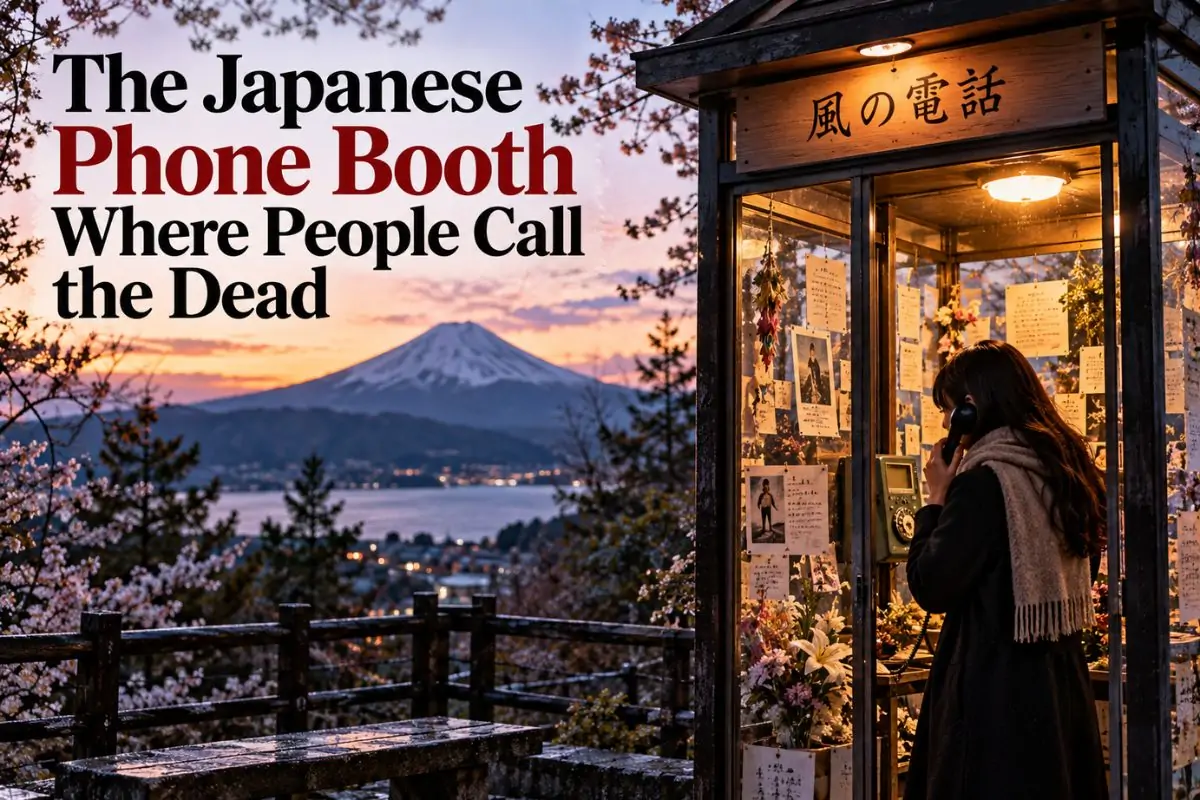
On a quiet hilltop overlooking the bay of Otsuchi, a small fishing town in Japan’s Iwate Prefecture, there’s a white, glass paned phone booth that isn’t connected to anything. No wires. No dial tone. No line running out to the rest of the world. And yet, since 2011, more than 25,000 people have climbed that hill, stepped inside, picked up an old black rotary receiver, and started talking.
- A disconnected phone booth sits on a hilltop in Otsuchi, Japan, built by garden designer Itaru Sasaki in 2010
- Sasaki built it privately to cope with his cousin’s death from cancer, calling it “kaze no denwa,” the phone of the wind
- The 2011 Tohoku earthquake and tsunami killed or disappeared 1,285 people in Otsuchi alone, about 10 percent of the town
- Word spread nationally, and the booth has since been visited by more than 25,000 grieving people
- Visitors often talk about ordinary, everyday things, the same updates they’d have shared while their loved one was alive
- A sturdier booth was rebuilt in 2018 using public donations after the original structure needed repair
- Messages left in the accompanying notebook have shifted over the years from desperate hope to quiet acceptance
They’re not talking to a wrong number. They’re talking to people who have died.
A Garden Designer’s Private Grief
The phone existed before the tragedy that made it famous. In 2010, a garden designer named Itaru Sasaki built the booth on his own property outside Otsuchi, to cope with the death of his cousin from cancer. He never intended it as a public memorial or a religious ritual, just a private way to keep talking to someone he’d lost. As he explained it himself, his thoughts couldn’t be carried over a regular telephone line, so he wanted them carried on the wind instead.
He named it kaze no denwa, the phone of the wind, and for about a year it stayed exactly what he’d built it to be: one man’s quiet way of finishing conversations death had cut short.
Then the Wave Came
On March 11, 2011, a magnitude 9.1 earthquake struck off Japan’s coast, triggering a tsunami that devastated the entire Tohoku region. Otsuchi was hit particularly hard. In the town alone, 1,285 people died or went missing, roughly ten percent of the entire population, and even the mayor was among those killed when the town office was destroyed.
In the disorientation that followed, word of Sasaki’s disconnected phone began to spread, first locally, then across Japan through newspapers and television. People who had lost parents, children, spouses and siblings without warning, often without a body to bury or a chance to say goodbye, started making the pilgrimage up that hill, looking for somewhere, an기 way, to say the things they never got to say.
What People Actually Say
The booth holds nothing but the phone and a small shelf, and beside it sits a notebook, now on its fourth volume, where visitors sometimes leave written messages instead of, or in addition to, speaking aloud. What’s remarkable is how ordinary most of these conversations actually are. People talk about their day. Children share test scores and what games they’ve been playing, the same small, mundane updates they’d have given if the person on the other end could actually hear.
Some visitors dial full phone numbers before speaking, out of habit or ritual. Others manage only a few seconds before their voice gives out entirely and they simply stand there, holding the receiver in silence.
One message, left in the notebook by a family still searching for their missing son, simply read, “Come home soon. From your father, mother and grandparents.” Sasaki later tracked down and met the family who had written it.
A Phone That Grows With Grief
Sasaki has noticed the messages themselves changing as the years pass. In the raw aftermath of the disaster, people mostly clung to disbelief and desperate hope, but over time, many messages softened into something closer to peace, with visitors writing lines like “please watch over us from heaven” instead of searching for someone still lost.
By 2018, public support for the memorial had grown so significant that donations, nearing a million yen from private citizens, companies and student groups, funded a sturdier aluminium booth with a concrete base to replace the original structure, which is the booth that still stands on that hill in Otsuchi today.
Why a Disconnected Phone Works
There’s something almost too simple about the idea, and that simplicity is exactly why it works. A phone call demands nothing back. No advice, no scripted comfort, no need to manage anyone else’s reaction to your grief. You just get to talk, uninterrupted, for as long as you need, to someone who can’t correct you, can’t rush you, and can’t disagree with what you needed to say.
Grief researchers have long pointed out that unfinished conversations, the things left unsaid before a sudden death, are often the hardest part of loss to carry. Otsuchi’s wind phone doesn’t pretend to fix that. It just gives people somewhere to put it down for a while.