French Art and Literature: Everything You Need to Know About the Artists, Writers, Masterpieces and Movements That Changed the World
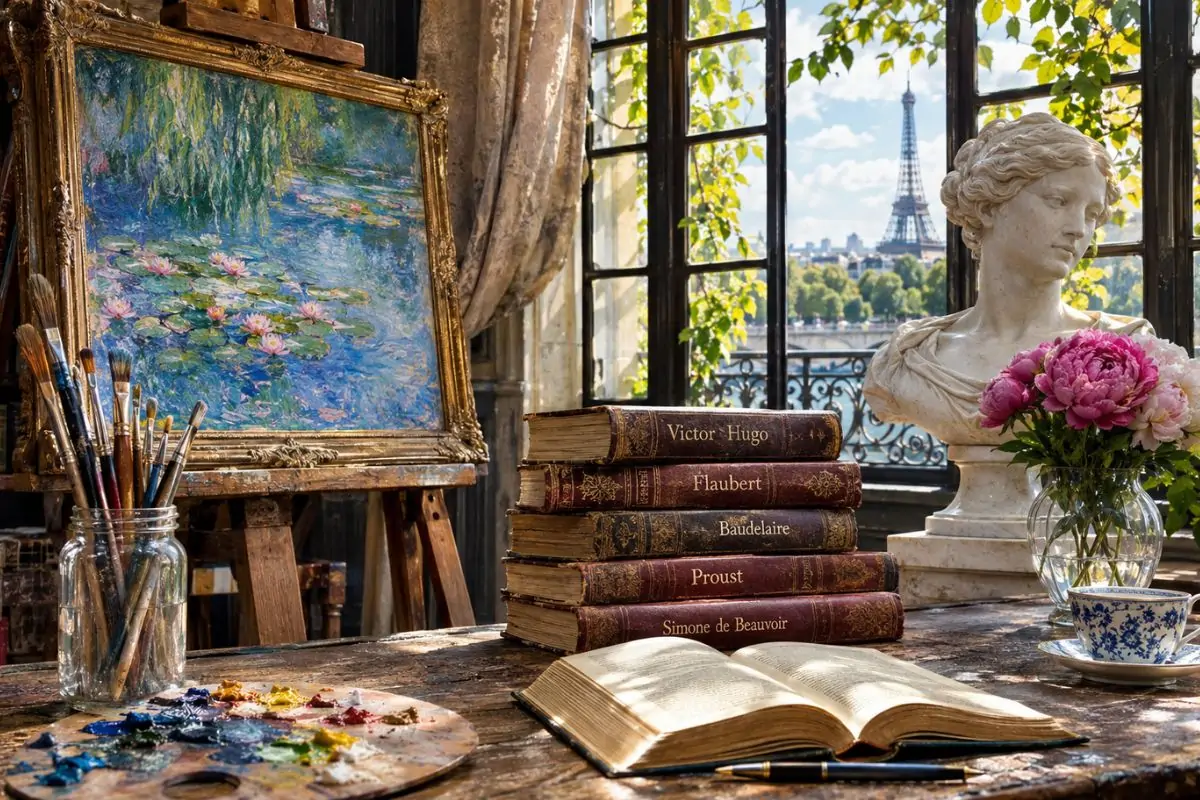
France has given the world more than beautiful paintings, elegant architecture and celebrated novels. It has given us entire ways of looking at life.
It is the country of Claude Monet’s shimmering water lilies, Victor Hugo’s revolutionary imagination, Coco Chanel’s reinvention of fashion, Auguste Rodin’s expressive sculptures, Marcel Proust’s extraordinary exploration of memory and Simone de Beauvoir’s challenge to centuries of assumptions about women.
Walk through Paris and you are surrounded by centuries of creative history. A museum holds paintings that once scandalised society. A small bookshop may contain the works of philosophers who changed how generations understood freedom, identity and human existence. A cathedral tells stories of faith, architecture and the extraordinary craftsmanship of medieval France.
French art and literature are not simply cultural achievements. They are reflections of a country repeatedly transformed by monarchy, revolution, industrialisation, war, political upheaval and changing ideas about what it means to be human.
But where should someone begin?
From the Renaissance to Impressionism, from medieval literature to existentialism, here is a journey through the people, movements, books and artworks that made French culture internationally influential.
1. Why France Became One of the World’s Great Cultural Centres
France’s cultural influence did not emerge overnight.
During the Middle Ages, religious institutions, monasteries and royal patrons supported the development of illuminated manuscripts, sculpture, architecture and religious painting. Gothic cathedrals became extraordinary expressions of artistic ambition and engineering.
During the Renaissance, French rulers invited Italian artists and architects to France. The reign of Francis I was particularly important. Leonardo da Vinci spent his final years in France under the king’s patronage, and the French court became increasingly interested in classical learning, painting, architecture and humanist scholarship.
The seventeenth century brought another transformation. Under Louis XIV, art became closely associated with royal authority. The Palace of Versailles, with its extraordinary architecture, gardens, decorative arts and ceremonial spaces, demonstrated how culture could communicate political power.
France’s artistic institutions also became increasingly influential. The Académie Royale de Peinture et de Sculpture, established in 1648, helped shape artistic education and professional recognition. Its exhibitions, known as Salons, became important spaces where artists competed for public and critical attention.
Then came the Enlightenment, the French Revolution and the nineteenth-century artistic rebellions that challenged established ideas about beauty, society and artistic authority.
By the nineteenth century, Paris had become a major centre for artists, writers, publishers, critics and intellectuals from across Europe and beyond.
The city was not simply producing art. It was arguing about what art should be.
 History & Culture
10 Interesting and Lesser-Known Facts About the Renaissance
Beyond Leonardo da Vinci and Michelangelo lies a fascinating world of hidden stories. Discover surprising facts about Renaissance artists, the Medici family, the printing press, Islamic scholarship, scientific discoveries and the cultural movement that transformed Europe.
Read Full Article2. The Renaissance: When French Art Embraced a New World
Key period: 15th to 16th centuries
The French Renaissance was influenced heavily by Italian developments in painting, sculpture, architecture and philosophy.
Artists and architects began exploring classical forms, perspective, proportion and the human figure. Royal patronage helped introduce new styles into French palaces and public buildings.
One of the most significant figures associated with this period was Leonardo da Vinci, who moved to France in 1516 at the invitation of Francis I. Although Italian rather than French, Leonardo’s presence symbolised the international exchange of artistic ideas taking place at the French court.
French artists also developed distinctive traditions in portraiture and decorative arts.
What to recognise:Renaissance architecture, elaborate royal portraits, classical ornamentation, humanist ideas and the growing importance of individual artistic skill.
3. The Baroque and Classicism: Art, Power and Grandeur
Key period: 17th century
The seventeenth century was an extraordinary period for French artistic identity.
Under Louis XIV, France promoted an aesthetic associated with grandeur, symmetry, order and magnificence.
The Palace of Versailles became the most spectacular expression of this vision. Its Hall of Mirrors, painted ceilings, formal gardens and elaborate interiors communicated the wealth and authority of the monarchy.
In painting, one important figure was Nicolas Poussin, known for his carefully structured compositions inspired by classical history and mythology.
Claude Lorrain became celebrated for landscapes filled with atmospheric light and classical references.
French classicism also influenced literature and theatre. Writers were increasingly associated with ideals of structure, proportion, clarity and dramatic discipline.
Three names are essential:
- Molière:The great comic playwright who exposed hypocrisy, vanity and social pretension.
- Jean Racine:A master of classical tragedy, known for psychological conflict and restrained emotional intensity.
- Pierre Corneille:A major dramatist whose works explored honour, duty, ambition and moral conflict.
Their plays remain central to the history of French theatre.
4. The Enlightenment: When Writers Began Challenging the World
Key period: 18th century
If there is one period that demonstrates the power of French literature to influence political and intellectual life, it is the Enlightenment.
French philosophers and writers began questioning traditional authority, religious intolerance, inherited privilege and the limits imposed on individual freedom.
They argued that reason, education, scientific inquiry and public debate could transform society.
Some of the most influential thinkers were:
Voltaire (1694–1778)
Voltaire was a fierce critic of intolerance, censorship and abuses of power. His writings combined satire, philosophy and sharp social observation.
His famous workCandide(1759) satirises excessive optimism and exposes cruelty, hypocrisy and human suffering.
Jean-Jacques Rousseau (1712–1778)
Rousseau explored freedom, inequality, education and the relationship between individuals and society.
His political workThe Social Contract(1762) became influential in debates about sovereignty and legitimate political authority.
Denis Diderot (1713–1784)
Diderot was a central figure in the creation of theEncyclopédie, an ambitious project intended to organise and circulate knowledge across a vast range of subjects.
The publication became a landmark of Enlightenment thought.
Montesquieu (1689–1755)
Montesquieu’sThe Spirit of the Laws(1748) explored political systems and the separation of governmental powers. His ideas influenced later constitutional thinking.
The Enlightenment was not simply a literary movement. It helped create the intellectual environment in which revolutionary ideas could develop.
5. The French Revolution Changed Art and Literature Forever
Key period: 1789 onwards
The French Revolution transformed the relationship between artists, writers, institutions and political authority.
The fall of the monarchy, the end of many aristocratic privileges and the changing political landscape disrupted the old systems of artistic patronage.
Art increasingly became a medium for expressing political identity, public memory and national ideals.
One of the most important artists of this period wasJacques-Louis David (1748–1825).
His famous painting,The Death of Marat(1793), depicts revolutionary leader Jean-Paul Marat after his assassination. The composition transforms a political death into an almost religious image of martyrdom.
David’sThe Oath of the Horatii(1784) had already become an influential example of Neoclassicism, with its emphasis on duty, sacrifice, discipline and classical ideals.
His art demonstrates how painting could become political communication.
The Revolution also encouraged writers to explore citizenship, rights, equality and the responsibilities of government.
It was a turning point in the history of modern European culture.
6. Romanticism: When Emotion Took Centre Stage
Key period: Early to mid-19th century
Romanticism was a reaction against excessive emphasis on classical rules, rational order and artistic restraint.
Romantic artists and writers embraced intense emotion, imagination, nature, individual experience, political struggle and the sublime.
In French painting, two names stand out.
Théodore Géricault (1791–1824)
His masterpieceThe Raft of the Medusa(1818–1819) depicts survivors of a shipwreck struggling for life.
The painting was inspired by a real disaster and became a powerful commentary on suffering, desperation and political responsibility.
Eugène Delacroix (1798–1863)
Delacroix was one of the most important figures in French Romantic painting.
His celebrated workLiberty Leading the People(1830) depicts the July Revolution in Paris, with an allegorical figure of Liberty leading revolutionaries across a barricade.
It remains one of the most recognisable political paintings in the world.
Delacroix was also deeply influenced by literature. Shakespeare, Dante, Goethe and Lord Byron inspired aspects of his imagination and artistic subjects.
Romanticism in French literature
French Romantic literature explored passion, melancholy, social injustice, nature and the conflict between individuals and society.
Important writers included:
- Victor Hugo:Poet, novelist and playwright, whose works explored justice, love, inequality and political change.
- Alphonse de Lamartine:A poet associated with emotional introspection and lyrical expression.
- George Sand:A pioneering novelist who challenged social conventions and explored women’s independence.
- Alfred de Musset:A writer whose works examined love, disillusionment and emotional conflict.
- François-René de Chateaubriand:An influential writer associated with the early development of French Romanticism.
Romanticism helped establish the idea that an artist’s individual vision could be more important than conformity to established rules.
7. Realism: Artists and Writers Turned Their Attention to Ordinary Life
Key period: Mid-19th century
Realism emerged partly as a reaction against Romantic idealisation.
Instead of depicting mythical heroes, extraordinary adventures or idealised landscapes, realist artists wanted to represent ordinary people and contemporary society.
They painted workers, peasants, everyday activities, poverty and the realities of social life.
Gustave Courbet (1819–1877)
Courbet was a leading figure of Realism.
His paintingA Burial at Ornans(1849–1850) depicts an ordinary funeral on a monumental scale. At the time, such a large painting was traditionally associated with important historical or religious subjects.
Courbet challenged that hierarchy by presenting everyday life as worthy of serious artistic attention.
Jean-François Millet (1814–1875)
Millet became famous for paintings of rural workers and agricultural life.
His masterpieceThe Gleaners(1857) depicts three women collecting leftover grain after the harvest.
The painting gives dignity and visibility to labour that society often overlooked.
Realism in literature
French realist literature explored society with extraordinary attention to detail.
Honoré de Balzac (1799–1850)
Balzac’s enormous literary project,La Comédie humaine, examined French society through interconnected novels and stories.
His writing explored ambition, money, class, power, marriage and social mobility.
Gustave Flaubert (1821–1880)
Flaubert’sMadame Bovary(1857) is one of the most important novels in French literary history.
It tells the story of Emma Bovary, a woman dissatisfied with provincial life and trapped between romantic fantasies and social realities.
The novel explores desire, disappointment, consumerism and the restrictions placed on women in nineteenth-century society.
Stendhal (1783–1842)
His novelThe Red and the Black(1830) examines ambition, class, hypocrisy and the pursuit of social advancement.
Realism made literature a powerful instrument for examining society rather than merely entertaining readers.
8. Impressionism: The Revolution That Changed the Way We See Paintings
Key period: 1860s to 1880s
If there is one artistic movement most people immediately associate with France, it is Impressionism.
The Impressionists changed the way painters approached light, colour, atmosphere and everyday life.
Rather than producing highly polished studio paintings based on academic conventions, they often painted outdoors, working rapidly to capture fleeting moments.
They were interested in how sunlight changed a landscape, how reflections moved across water and how ordinary urban scenes could become beautiful subjects.
The movement’s name came from Claude Monet’s paintingImpression, Sunrise(1872), shown in the independent exhibition of 1874.
The most important Impressionist artists
Claude Monet (1840–1926)
Must-see works:Impression, Sunrise,Water Lilies,Woman with a Parasoland theHaystacksseries.
Monet was fascinated by changing light. He repeatedly painted the same subjects at different times of day and under different weather conditions.
His garden at Giverny became one of the most famous artistic environments in history.
Pierre-Auguste Renoir (1841–1919)
Must-see works:Dance at Le Moulin de la GaletteandLuncheon of the Boating Party.
Renoir celebrated social life, friendship, leisure and human warmth through luminous colours and lively compositions.
Edgar Degas (1834–1917)
Must-see works:The Dance Classand his ballet dancer studies.
Degas was fascinated by movement, performance and the human body. His work often captures dancers in moments of preparation rather than grand theatrical poses.
Berthe Morisot (1841–1895)
Morisot was a major Impressionist painter who depicted domestic interiors, women, children and modern social life.
Her importance deserves particular recognition because women artists faced significant barriers to formal education, professional opportunities and public recognition during the nineteenth century.
Camille Pissarro (1830–1903)
Pissarro was an important Impressionist organiser and painter, known for landscapes and scenes of rural and urban life.
Why Impressionism matters
Impressionism helped liberate painting from the expectation that art must look perfectly finished or reproduce reality in a conventional manner.
It made perception, atmosphere and the artist’s experience central to the creative process.
The Musée d’Orsay in Paris is one of the best places to explore this extraordinary period.
9. Post-Impressionism: Artists Began Moving Beyond Impressionism
Key period: Late 19th century
Impressionism changed painting, but several artists felt that capturing fleeting light was not enough.
They wanted stronger structures, more expressive colours, symbolic meaning and deeper emotional content.
This led to what is broadly known as Post-Impressionism.
Paul Cézanne (1839–1906)
Cézanne explored the underlying structure of landscapes, objects and human forms.
His work influenced the development of Cubism and modern painting.
Vincent van Gogh (1853–1890)
Although born in the Netherlands, Van Gogh spent important periods working in France and became closely associated with the artistic world of Provence.
His paintings, includingThe Starry Night,SunflowersandThe Bedroom, are known for expressive colour, energetic brushwork and emotional intensity.
Paul Gauguin (1848–1903)
Gauguin explored symbolic colour and simplified forms, particularly during his time in Brittany and later Tahiti.
His career also needs to be understood in the context of European colonialism and the problematic ways in which artists represented non-European cultures.
Georges Seurat (1859–1891)
Seurat developed Pointillism, a technique involving small dots of colour that combine visually when viewed from a distance.
His paintingA Sunday Afternoon on the Island of La Grande Jatteis one of the best-known examples.
Post-Impressionism opened the door to an increasingly experimental twentieth-century art world.
10. The Birth of Modern Art: Fauvism, Cubism and Surrealism
The twentieth century transformed French art once again.
Artists began questioning whether painting needed to represent the world realistically at all.
Fauvism: Colour Without Restraint
Fauvism emerged in the early twentieth century.
Its artists used intense, sometimes unnatural colours and simplified forms to create expressive compositions.
The most famous figure wasHenri Matisse (1869–1954).
His works includeThe Joy of Life,The Danceand his later paper cut-outs.
Matisse demonstrated that colour itself could become the central language of a painting.
Cubism: Breaking Reality into Pieces
Cubism changed the visual language of modern art.
Instead of depicting an object from a single viewpoint, Cubist artists represented multiple perspectives within the same composition.
Pablo Picasso (1881–1973)was born in Spain, but his career was deeply connected to Paris and the French modernist art world.
Georges Braque (1882–1963), a French artist, was one of the central figures in the development of Cubism.
Together, their experiments helped transform modern painting.
Surrealism: Entering the World of Dreams
Surrealism developed during the 1920s, influenced by psychoanalysis, dreams, imagination and the unconscious.
The movement sought to move beyond conventional rational thought.
Important figures included:
- André Breton:Writer and principal theorist of Surrealism.
- Max Ernst:German-born artist closely associated with the French Surrealist movement.
- Salvador Dalí:Spanish artist whose work became closely associated with Surrealism.
- René Magritte:Belgian painter whose work explored perception and the relationship between images and reality.
Surrealism influenced painting, literature, photography, film and fashion.
11. French Literature: The Books and Writers Everyone Should Know
French literature is among the richest literary traditions in the world.
It includes medieval epics, Renaissance humanism, classical theatre, Enlightenment philosophy, Romantic poetry, realist novels, modernist experimentation and existential philosophy.
Here are some essential authors and books.
Victor Hugo (1802–1885)
Must-read books:Les MisérablesandThe Hunchback of Notre-Dame.
Hugo was a poet, novelist, playwright and political thinker.
Les Misérablesexplores poverty, justice, redemption, inequality and the possibility of human transformation.
The Hunchback of Notre-Damebrings medieval Paris to life through a dramatic story of love, exclusion, power and social prejudice.
Hugo was also politically active and spent years in exile because of his opposition to Napoleon III.
Alexandre Dumas (1802–1870)
Must-read books:The Three MusketeersandThe Count of Monte Cristo.
Dumas created some of the most enduring adventure stories in world literature.
His novels are filled with betrayal, revenge, friendship, courage, political intrigue and unforgettable characters.
Charles Baudelaire (1821–1867)
Must-read book:Les Fleurs du mal(The Flowers of Evil).
Baudelaire transformed modern poetry.
His writing explored urban life, beauty, desire, alienation, decay and the contradictions of modern existence.
His poetry influenced Symbolism and later modernist literature.
Émile Zola (1840–1902)
Must-read books:Germinal,NanaandThérèse Raquin.
Zola was one of the leading figures of Naturalism.
His novels examined how social conditions, poverty, inherited circumstances and environment could influence human behaviour.
Germinal, in particular, is a powerful account of miners, exploitation and working-class struggle.
Zola also became famous for his public intervention in the Dreyfus Affair through his open letterJ’accuse…!in 1898.
Marcel Proust (1871–1922)
Must-read work:In Search of Lost Time.
Proust explored memory, time, love, jealousy, social status and the complexities of human consciousness.
His writing is famous for its intricate sentences and extraordinary psychological detail.
The celebrated madeleine episode demonstrates how an ordinary taste can unexpectedly trigger a powerful flood of childhood memories.
Albert Camus (1913–1960)
Must-read books:The Stranger,The PlagueandThe Myth of Sisyphus.
Camus explored absurdity, morality, freedom and the search for meaning in a world that does not necessarily provide clear answers.
He received the Nobel Prize in Literature in 1957.
Jean-Paul Sartre (1905–1980)
Must-read books:NauseaandBeing and Nothingness.
Sartre was a leading figure in existentialist philosophy.
His work explored freedom, responsibility, consciousness and the idea that human beings must create meaning through their choices.
Simone de Beauvoir (1908–1986)
Must-read book:The Second Sex.
De Beauvoir was a philosopher, writer and feminist thinker whose work fundamentally changed discussions about women’s social position.
Published in 1949,The Second Sexexamined how society constructs ideas of femininity and how women have historically been treated as the other in relation to men.
Its famous argument that one is not born, but rather becomes, a woman remains central to feminist thought.
12. French Women Artists and Writers Who Deserve More Recognition
French cultural history is often presented through a list of famous male painters and writers. But women have played an essential role in shaping French art and literature.
Many had to work against institutional barriers, social expectations and limited professional opportunities.
Some important names include:
Élisabeth Vigée Le Brun (1755–1842)
One of the most celebrated portrait painters of the eighteenth century, Vigée Le Brun became particularly famous for her portraits of Marie Antoinette.
Her work offers an important visual record of aristocratic society before the French Revolution.
Rosa Bonheur (1822–1899)
Bonheur became internationally recognised for her paintings of animals and rural life.
Her monumental paintingThe Horse Fairis one of her best-known works.
Berthe Morisot (1841–1895)
A founding participant in Impressionist exhibitions, Morisot created paintings that captured modern domestic life and changing social experiences.
Camille Claudel (1864–1943)
Claudel was a gifted sculptor whose work explored movement, emotion and human relationships.
Her artistic legacy has often been discussed in relation to her complicated personal and professional relationship with Auguste Rodin, but her sculpture deserves attention in its own right.
Colette (1873–1954)
A celebrated novelist, Colette explored female identity, sexuality, relationships and social expectations.
Her novelChériremains an important work of twentieth-century French literature.
Marguerite Duras (1914–1996)
Duras was a novelist, playwright and filmmaker known for experimental storytelling, memory, desire and fragmented narratives.
Her novelThe Loverbecame internationally celebrated.
Françoise Sagan (1935–2004)
Sagan became famous at a remarkably young age with her debut novelBonjour Tristesse, published in 1954.
The novel explores youth, privilege, desire and emotional manipulation.
These women remind us that French art and literature cannot be understood through a narrow list of celebrated male figures.
13. French Architecture: Cathedrals, Palaces and Modern Masterpieces
French art is not limited to paintings and literature. Architecture is one of the country’s greatest cultural achievements.
Gothic architecture
French Gothic architecture developed during the Middle Ages and became famous for pointed arches, ribbed vaults, flying buttresses and stained-glass windows.
Important examples include:
- Notre-Dame Cathedral, Paris
- Chartres Cathedral
- Reims Cathedral
- Sainte-Chapelle, Paris
These buildings demonstrate how engineering, sculpture, light and religious symbolism could combine to create extraordinary spaces.
Renaissance architecture
The Loire Valley is particularly famous for Renaissance châteaux.
The Château de Chambord is one of the best-known examples, with its elaborate roofline, monumental scale and intricate architectural design.
Palace of Versailles
Versailles is one of the most extraordinary expressions of French royal architecture.
Its Hall of Mirrors, formal gardens and ceremonial rooms demonstrate the close relationship between art, politics and power.
Modern architecture
The twentieth century brought radical experimentation.
Le Corbusier (1887–1965), born in Switzerland and later naturalised as French, became one of the most influential figures in modern architecture.
His work helped shape discussions about functionalism, urban planning and modern housing.
The Centre Pompidou in Paris, designed by Renzo Piano and Richard Rogers, became an important landmark of contemporary architectural design.
14. French Art and Literature Museums You Should Know
If you want to understand French culture beyond books and photographs, visiting its museums is an extraordinary experience.
1. Louvre Museum, Paris
Famous for:Leonardo da Vinci’sMona Lisa, theVenus de Milo, theWinged Victory of Samothraceand vast collections spanning ancient civilisations through the nineteenth century.
The Louvre is one of the world’s most important museums.
2. Musée d’Orsay, Paris
Famous for:Impressionism and Post-Impressionism, including works by Monet, Renoir, Degas, Cézanne and Van Gogh.
Its collection is particularly useful for understanding nineteenth-century French art.
3. Centre Pompidou, Paris
Famous for:Modern and contemporary art, including major works associated with twentieth-century movements.
4. Musée Rodin, Paris
Famous for:Sculptures by Auguste Rodin, includingThe ThinkerandThe Gates of Hell.
5. Musée de l’Orangerie, Paris
Famous for:Monet’s monumentalWater Liliespanels, displayed in specially designed oval rooms.
6. Musée National Picasso-Paris
Famous for:An extensive collection documenting Picasso’s life, artistic development and work.
7. Château de Versailles
Famous for:Royal interiors, decorative arts, architecture, gardens and the history of the French monarchy.
15. French Philosophy: The Ideas That Changed How We Think
French culture has also played an extraordinary role in philosophy.
The Enlightenment thinkers questioned authority and defended reason. Later philosophers explored freedom, power, identity, language and the structure of society.
Some important names include:
- René Descartes:Associated with rationalism and the famous philosophical proposition, “I think, therefore I am.”
- Michel Foucault:Explored the relationship between knowledge, power, institutions and social control.
- Jean-Paul Sartre:Examined freedom, responsibility and existentialism.
- Simone de Beauvoir:Examined gender, freedom, social conditioning and women’s position in society.
- Jacques Derrida:Developed deconstruction, a philosophical approach to examining language, meaning and texts.
- Albert Camus:Explored the absurd, moral responsibility and the search for meaning.
These thinkers influenced literature, politics, sociology, feminist theory, education and cultural criticism far beyond France.
16. French Art and Literature Are Closely Connected
One of the most fascinating features of French cultural history is the constant exchange between writers and visual artists.
Literature inspired paintings, while paintings influenced writers and critics.
Delacroix drew inspiration from Shakespeare, Dante and other literary figures. His paintings often translated stories and dramatic scenes into visual form.
Baudelaire wrote extensively about contemporary art and argued that modern artists should engage with the life of their own time.
Émile Zola was not only a novelist but also an art critic who defended painters challenging established conventions.
Surrealism brought poets, writers, painters and photographers together around a shared interest in dreams, the unconscious and imagination.
This relationship between the written and visual arts helped make Paris such an important centre of artistic experimentation.
17. Ten French Masterpieces Everyone Should Know
If you are beginning your journey into French art and literature, these ten works provide an excellent starting point.
| Work | Artist or author | Why it matters |
|---|---|---|
| Liberty Leading the People | Eugène Delacroix | A powerful image of revolution and freedom |
| The Raft of the Medusa | Théodore Géricault | Romanticism, human suffering and political criticism |
| The Gleaners | Jean-François Millet | Dignity and visibility of rural labour |
| Impression, Sunrise | Claude Monet | The painting associated with Impressionism’s name |
| A Burial at Ornans | Gustave Courbet | A landmark of Realism |
| Les Misérables | Victor Hugo | Justice, poverty, redemption and society |
| Madame Bovary | Gustave Flaubert | Desire, dissatisfaction and social expectations |
| The Flowers of Evil | Charles Baudelaire | A transformation of modern poetry |
| In Search of Lost Time | Marcel Proust | Memory, time and human consciousness |
| The Second Sex | Simone de Beauvoir | A landmark of feminist philosophy |
18. A Simple Timeline of French Art and Literature
| Period | Artistic and literary developments | Important names |
|---|---|---|
| Medieval France | Gothic architecture, religious manuscripts, epic poetry | Chrétien de Troyes |
| Renaissance | Humanism, classical influence, court art | Rabelais, Montaigne |
| 17th century | Classicism, royal art, classical theatre | Molière, Racine, Poussin |
| 18th century | Enlightenment, philosophy, Rococo art | Voltaire, Rousseau, Diderot |
| Revolutionary era | Neoclassicism, political art | Jacques-Louis David |
| Early 19th century | Romanticism | Hugo, Delacroix, Géricault |
| Mid-19th century | Realism and Naturalism | Courbet, Balzac, Flaubert, Zola |
| Late 19th century | Impressionism, Post-Impressionism, Symbolism | Monet, Cézanne, Seurat, Baudelaire |
| Early 20th century | Fauvism, Cubism, Surrealism | Matisse, Braque, Breton |
| Mid-20th century | Existentialism, modern literature | Sartre, de Beauvoir, Camus |
| Contemporary period | Conceptual art, contemporary literature and experimental forms | Sophie Calle, Annie Ernaux |
19. How to Start Exploring French Art and Literature
You do not need a university degree in art history or philosophy to appreciate French culture.
The easiest way to begin is to approach it through a combination of books, paintings, films and museums.
If you love paintings:Start with Monet, Renoir, Delacroix, Cézanne and Matisse. Look at their paintings carefully and notice how each artist uses colour, light, movement and composition.
If you love novels:Begin withThe Three Musketeers,The Hunchback of Notre-Dame,The StrangerorBonjour Tristesse. They offer very different introductions to French storytelling.
If you enjoy philosophy:Explore the writings of Voltaire, Rousseau, Camus and Simone de Beauvoir.
If you love architecture:Study Gothic cathedrals, Versailles and the modern buildings of Paris.
If you want to understand French culture as a whole:Read about the French Revolution, the Enlightenment and the development of modern Paris. These historical events explain much of the artistic and literary transformation that followed.
Final Thoughts: Why French Art and Literature Still Matter
French art and literature remain influential because they have never been afraid to question the world around them.
French writers challenged monarchies, questioned religion, explored the psychology of individuals and exposed social injustice. French painters broke away from established conventions, experimented with colour and perspective, and transformed ordinary scenes into extraordinary works of art.
Their achievements also remind us that culture is never created in isolation. Political upheaval, social movements, technological change, philosophical debates and personal experiences all influence what artists create.
Perhaps that is the most beautiful thing about French cultural history.
It is not simply a collection of famous paintings, books and buildings. It is a record of human imagination repeatedly pushing against the boundaries of its time.
And whether you stand in front of Monet’s water lilies, read the final pages ofLes Misérables, or discover the ideas of Simone de Beauvoir, you are participating in a conversation that has continued for centuries.
Real SHEE Power Takeaway:Art teaches us to see differently. Literature teaches us to understand differently. French cultural history brings the two together, reminding us that some of humanity’s greatest achievements begin with the courage to question what everyone else takes for granted.