
The Year Without a Summer (1816): How a Volcano Chilled the World
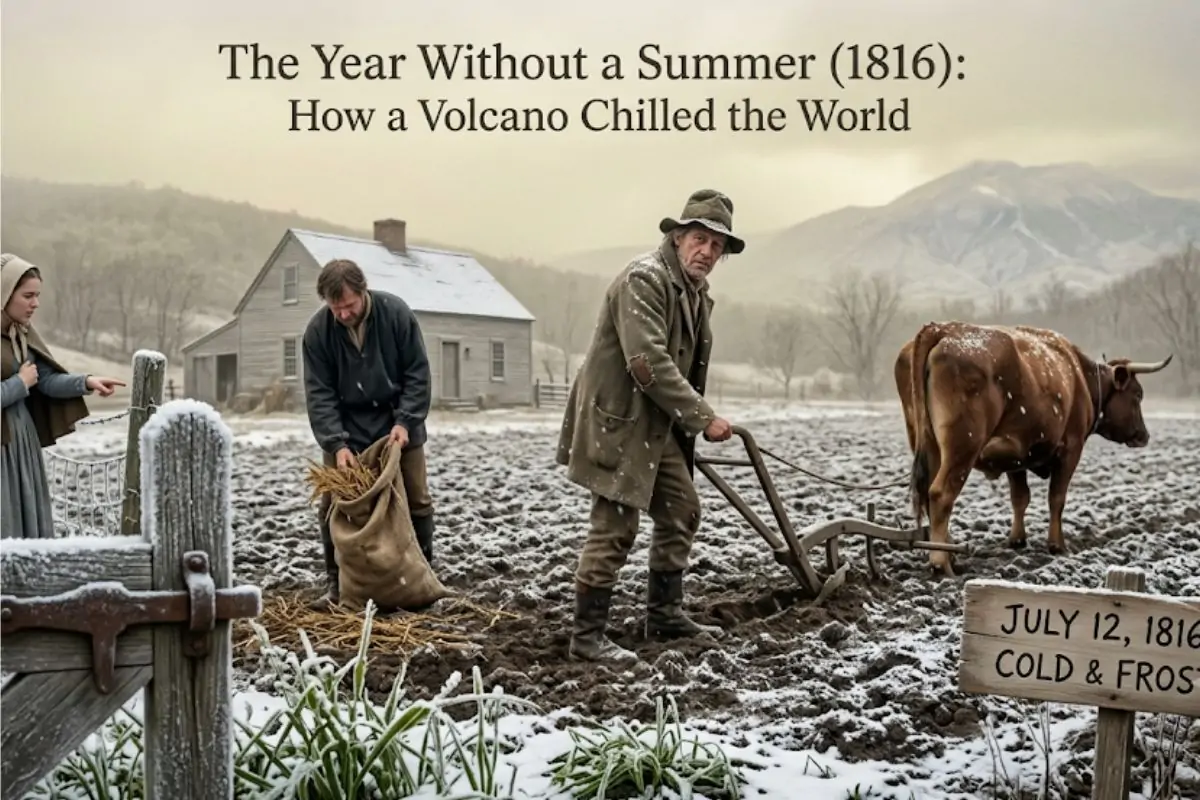
In June 1816, farmers in New England woke to find their crops covered in frost. In some places, snow fell. In Europe, rain drowned the fields for weeks on end, and bread prices climbed out of reach. Almost no one understood why. The answer lay thousands of miles away, in an eruption that had happened more than a year earlier.
The eruption

In April 1815, Mount Tambora, a volcano on the island of Sumbawa in present-day Indonesia, erupted with a violence unmatched in recorded history. The main explosions on April 10 and 11 were reportedly heard on islands more than a thousand miles away. The eruption killed thousands directly, and the death toll from the famine and disease that followed in the region is generally put in the tens of thousands, though estimates vary widely.
The effects didn’t stay local. The eruption blasted enormous quantities of sulfur-rich gas high into the stratosphere. There, the gas formed a haze of tiny droplets that spread around the planet, reflecting sunlight back into space.
The most dangerous part of a volcanic eruption can be the part you can’t see: a veil of gas that travels the world.
A cold, strange year
By 1816, the haze had cooled global temperatures by a fraction of a degree to roughly half a degree Celsius, according to common estimates. That sounds minor, but for farming, which depends on narrow margins of warmth and growing season, it was devastating.
In North America, the year earned the nickname “Eighteen Hundred and Froze to Death.” Cold snaps struck repeatedly through the spring and summer. Frosts hit in June, July, and August in parts of New England, and snow was reported in early June in places across the northeast. Corn, the staple crop, failed in many areas, and the price of grain and oats soared.
In Europe, the problem was less frost than relentless rain and cold. Harvests collapsed across the continent. Food riots broke out in several countries, and historians often describe the period as the last major subsistence crisis in the Western world.
A civilization that lives close to the edge of its food supply can be tipped over by a change too small to feel.
Hunger and migration
The crisis pushed people to move. In New England, the failed harvests are often cited as one factor in a wave of families leaving for the Midwest, where land was cheaper and the climate seemed kinder. Hardship also spread elsewhere: famine and epidemic disease followed in parts of Europe, and the disrupted weather patterns are linked by some historians to trouble in Asia, including famine in Yunnan, China, and cholera outbreaks in Bengal. The connections between the eruption and each of these events are debated, and some are better supported than others.
Another story, though speculative, is often repeated. German inventor Karl Drais is said to have been motivated to design his two-wheeled “running machine,” a forerunner of the bicycle, by the shortage of horse feed caused by failed oat harvests. Some historians find the idea plausible, while others consider it unproven.
The ghost story contest
The most famous consequence of the cold summer was literary. In June 1816, a group of English travelers sat out the miserable weather beside Lake Geneva in Switzerland. They included the poet Lord Byron, his physician John Polidori, the poet Percy Bysshe Shelley, and Shelley’s future wife, Mary Godwin, who would later become Mary Shelley.
With storms keeping everyone indoors, the group entertained themselves by reading German ghost stories aloud. Byron then proposed that each of them write a supernatural tale of their own.
Mary, then eighteen, struggled for days to come up with an idea. Eventually, an idea about the creation of life, and a scientist horrified by what he had made, took hold. It grew intoFrankenstein, published in 1818. Polidori, for his part, wrote a short story called “The Vampyre,” which helped lay the groundwork for the modern vampire tale in English literature. Byron wrote a bleak poem titled “Darkness,” imagining a sun that had gone out.
Great art is sometimes born in bad weather. The gloom that ruined a harvest also gave us the modern monster story.
Skies like paintings
The haze didn’t only chill the world. It also changed how the sky looked. Some art historians have suggested that the vivid reds and oranges in J.M.W. Turner’s skyscapes were influenced by the dust-laden sunsets of the period, though how much of his work reflects this is still debated.
A mystery solved long after
At the time, nobody connected the dots. People blamed sunspots, comets, or divine anger. A link to Tambora wasn’t widely recognized until the twentieth century, when climate researchers began studying how volcanic eruptions affect weather. The 1981 bookVolcano Weather, by Henry and Elizabeth Stommel, helped bring the story to a wider audience.
Today, scientists agree that Tambora was the primary driver of the cold. Other factors may have contributed: the early 1800s were a period of low solar activity, and the 1809 eruption of another, unidentified volcano had already added to the chill. Together they stacked the deck against the climate.
Understanding comes late. The people who lived through 1816 had the evidence in front of them for years before anyone could name the cause.
Why it still matters
The Year Without a Summer is a case study in how fragile our systems are. A single event on one island disrupted harvests on several continents within a year. Modern agriculture is far more productive and better connected than in 1816, but it also depends on stable weather patterns across a handful of key growing regions.
Volcanologists generally agree that eruptions on the scale of Tambora recur over the course of centuries, and that another one is a question of when rather than if. The 1816 crisis shows how much can ride on events we can’t predict or prevent, and why preparation, from food reserves to monitoring, matters.
Frequently asked questions
What was the Year Without a Summer?
The year 1816, when unusually cold and wet weather caused crop failures and food shortages across North America and Europe.
What caused it?
Mainly the April 1815 eruption of Mount Tambora in Indonesia, which put huge amounts of sulfur gas into the stratosphere and cooled the planet.
Did it really snow in June?
Yes. Snow and frost were reported in parts of New England and eastern Canada in June 1816.
How is it connected to Frankenstein?
Mary Shelley conceived the story during a stormy summer in Switzerland in 1816, when the group she was with was kept indoors by the weather and challenged each other to write ghost stories.
Could it happen again?
A large volcanic eruption could cool the climate again. Modern farming and trade would soften the impact, but a major eruption would still be disruptive.



:%20How%20a%20Volcano%20Chilled%20the%20World)