Bharatanatyam’s Real History: Renamed, Revived, And Still Being Argued Over
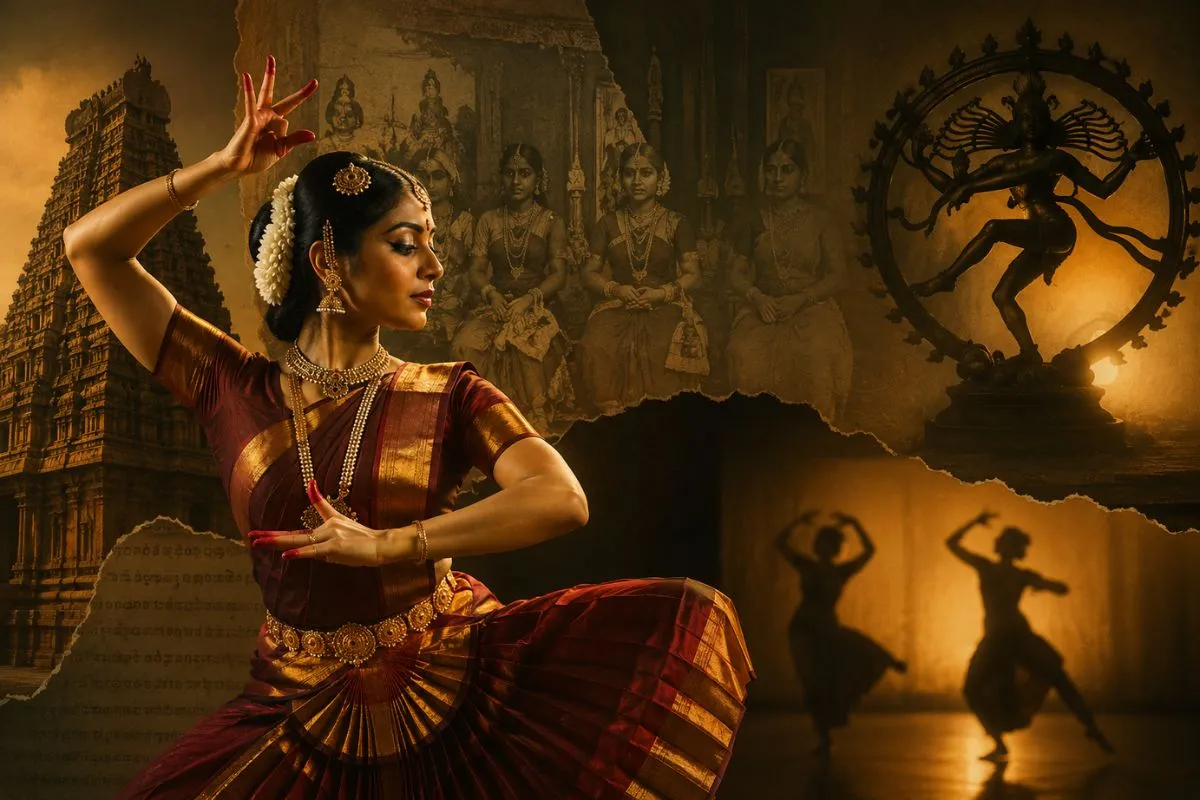
Watch a Bharatanatyam performance today, silk sarees, temple jewellery, precise footwork, devotional storytelling, and it presents itself as timeless, ancient, untouched. The actual history behind that polished image is considerably messier, and considerably more interesting, than the version usually told on a stage program. It involves a Brahmin woman who defied her own community to learn a dance her class considered scandalous, a community of hereditary temple dancers who were simultaneously being stripped of their livelihood by the same colonial and nationalist forces that eventually made the art form respectable, and a debate over who actually gets credit for saving it that has never fully settled, even a century later.
What The Dance Actually Was Before It Had This Name
The dance now called Bharatanatyam traces its roots back through temple sculpture and textual references stretching well over a thousand years, but the form most directly connects to Sadir, a repertoire performed by devadasis, women ceremonially dedicated to a temple deity, across Tamil Nadu and neighbouring regions. Between roughly the sixth and thirteenth centuries, devadasis held genuine social standing, supported by royal patronage, land grants, and a recognised role as custodians of both ritual and art. Sadir was inseparable from that role, performed as an offering within temple worship, passed down through hereditary teachers called nattuvanars who trained generations of women within their own community.
Colonial rule dismantled the system that had sustained this for centuries. As temple patrons lost political power under British administration, devadasis lost the institutional support that had defined their position, and by the nineteenth century the British colonial establishment, increasingly applying Victorian moral standards to practices it did not understand, began conflating devadasis broadly with prostitution. That conflation fed directly into an Indian reform movement of the early twentieth century, led by figures including Dr Muthulakshmi Reddy, that campaigned to formally abolish the devadasi system, culminating in legislation banning temple dedication across Madras Presidency in 1947. The women who had spent generations as the art form’s actual custodians lost both their traditional livelihood and, in the space of a single generation, most of their social standing along with it.
Rukmini Devi’s Debut, And What It Actually Meant
Into that environment stepped Rukmini Devi, born in 1904 into an educated Brahmin family with deep ties to the Theosophical Society. Inspired partly by a chance encounter with the Russian ballerina Anna Pavlova, who reportedly encouraged her to look toward India’s own classical traditions rather than Western dance, Rukmini Devi began learning Sadir under teachers connected to the devadasi lineage, a genuinely radical decision for a woman of her caste and standing at the time. Her public debut on 30 December 1935 at the Theosophical Society’s Adyar headquarters drew over a thousand attendees, many out of sheer curiosity that a Brahmin woman would perform an art form her own community still considered disreputable. The performance was, by nearly every account, a turning point, winning over much of Madras’s orthodox community and proving that the dance could be presented in a register respectable society was willing to accept.
Working alongside legal reformer and dance advocate E. Krishna Iyer, Rukmini Devi helped popularise a new name for the art form, Bharatanatyam, drawn from the Natya Shastra and the Tamil word for dance, deliberately invoking a classical, Sanskritic pedigree rather than the dance’s more recent temple and devadasi associations. She deliberately reworked its content too, removing shringara, the dance’s traditional erotic and romantic elements, in favour of bhakti, devotional themes she considered more spiritually elevated, alongside introducing new costumes, temple jewellery, structured stage lighting, and a dance drama format. In January 1936, she and her husband George Arundale founded Kalakshetra in Adyar, an institution built on a gurukul model that has since trained generations of dancers and remains one of the most influential dance academies in the country. Beyond dance itself, Rukmini Devi became the first woman nominated to India’s Rajya Sabha, founded the Animal Welfare Board of India, and was instrumental in passing the Prevention of Cruelty to Animals Act of 1960, a genuinely wide-ranging public life by any measure.
The Community That Was Already Reviving It
What often gets left out of the standard version of this story is that Rukmini Devi was not working in isolation, and the devadasi community itself was simultaneously organising to preserve the very art form being taken from it. An association of devadasi families and nattuvanars, including the eventual teacher who trained Rukmini Devi herself, argued from within the community that the art would not survive being separated from the people who had always practised it, and pushed to keep the tradition in hereditary hands rather than transfer it wholesale to outside custodians. The nattuvanars, the traditional dance masters, ultimately went on to train the new generation of upper class dancers who took up the art through Kalakshetra and similar institutions, meaning devadasi teachers were doing much of the actual technical instruction even as the social prestige attached to the art shifted decisively away from their own community.
Balasaraswati, born into a distinguished devadasi lineage, became the era’s other towering figure in the dance, and her approach stood in direct contrast to Rukmini Devi’s reforms. Rather than stripping the dance of its erotic and romantic content, Balasaraswati maintained that shringara was integral to the art form’s spiritual and aesthetic meaning, treating the dance’s traditional repertoire as something to preserve intact rather than sanitise. She went on to receive both the Padma Bhushan and the Padma Vibhushan, among India’s highest civilian honours, and remains, alongside Rukmini Devi, one of the two figures most credited with carrying Bharatanatyam into its modern form, via two genuinely different visions of what the art form was supposed to be.
A Legacy Still Being Actively Debated
The version of this history worth sitting with honestly does not end with Kalakshetra’s founding. Contemporary scholars and hereditary dancers, including several writing decades after both Rukmini Devi and Balasaraswati’s deaths, have argued that the “revival” of Bharatanatyam functioned simultaneously as a genuine act of preservation and as a form of caste based appropriation, one that transferred an art form’s prestige, patronage, and public respectability to upper caste practitioners while leaving many of the hereditary devadasi families who had actually sustained the tradition for centuries without either the livelihood or the recognition the reform promised to protect. Critics point out that names like Balasaraswati, Tanjore Papammal, and Venkatalakshamma, devadasi lineage dancers who preserved the art through genuine social stigma and hardship, remain far less widely known today than the reformist narrative that positioned figures from outside the community as the ones who “saved” it. This is not a settled argument, and it deserves to be presented as the genuinely contested history it is rather than flattened into either a simple triumph story or a simple appropriation story alone.
Why This History Still Matters On Stage Today
None of this complexity diminishes what Rukmini Devi actually built. Kalakshetra remains a genuinely serious institution, and the dance form she helped shape has carried Tamil classical culture to global stages for nearly a century. Real Shee Power’s own profile ofSonal Mansingh, whose Centre for Indian Classical Dances has trained generations of Bharatanatyam and Odissi dancers, sits inside exactly this lineage, an art form still actively being taught, reinterpreted, and passed forward by the institutions this history produced. What the fuller story does is complicate the easy version, reminding us that behind nearly every classical Indian art form presented today as timeless and untouched sits a specific, contested, and very human history, one where credit, dignity, and livelihood did not always flow to the same people, and where honouring the dance honestly means learning the names on both sides of that history rather than only the ones who happened to end up on the program cover.