Eating Your Way Through Thailand: The Dishes Worth Booking a Flight For
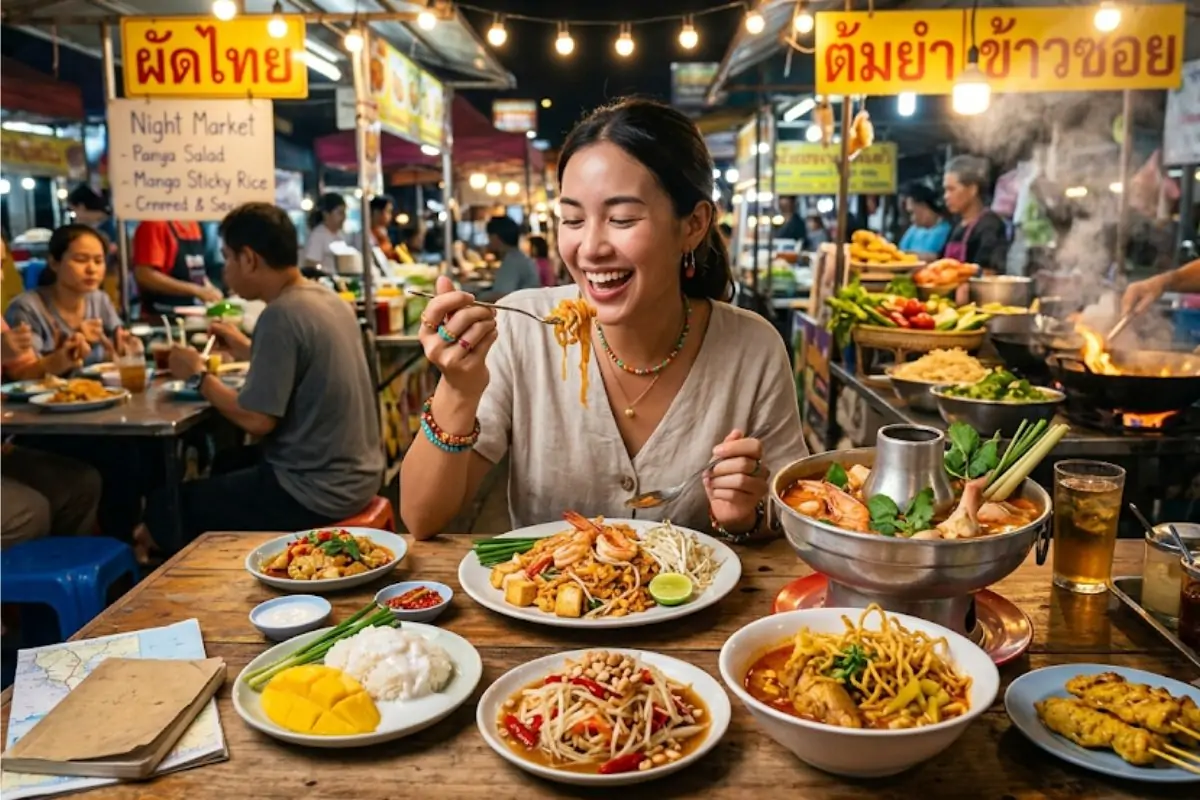
Ask a Thai person what makes a good meal and you’ll rarely hear about a single dish. You’ll hear about balance: sweet against sour, salty against spicy, rich against fresh, with texture and aroma layered on top. A proper Thai table has several dishes meant to be shared, spooned over rice, and mixed bite by bite.
Thailand’s food also changes dramatically depending on where you stand. The country has four broad culinary regions, and a trip that covers more than one will feel like visiting several different food cultures. This guide is organized by region, with the dishes most worth seeking out.
Thai cooking isn’t about any single flavor. It’s about making sweet, sour, salty, and spicy argue with each other until they agree.
Table of Contents
Central Thailand: Bangkok and the Heartland
Bangkok is where the whole country’s food converges, from humble street carts to elaborate royal-influenced cooking.
Pad kra paois arguably the most beloved everyday dish in the country. Minced pork or chicken is stir-fried hot and fast with holy basil, garlic, and fresh chilies, then served over rice, usually with a fried egg on top whose runny yolk mingles with the sauce. It’s cheap, fast, and everywhere. Many locals consider it their default lunch. Note that it uses holy basil, not the sweeter Thai basil, which gives it a peppery, almost clove-like punch.
Pad thaiis the dish most foreigners know, and it’s worth trying where it originated as a national project. It rose to prominence in the 1930s and 40s under the government of Plaek Phibunsongkhram, who promoted noodles as part of a push for Thai national identity. A good version, cooked over a screaming-hot wok, has smoky noodles, a tamarind-driven sweet-and-sour sauce, crushed peanuts, and a wedge of lime. Skip the tourist-heavy places and find a vendor who cooks each plate to order.
Tom yum goongis the famous hot-and-sour soup with shrimp, flavored with lemongrass, galangal, kaffir lime leaves, and chilies. The version with a splash of evaporated milk or roasted chili paste (nam khon) is creamier and richer, while the clear version (nam sai) is sharper and brighter. Try both if you can.
Gaeng keow wan, the green curry, is a coconut-milk-based curry with a paste made from green chilies, galangal, lemongrass, and shrimp paste. Despite the name, “sweet” refers to the color-and-richness profile more than sugar. It’s best with sticky rice or plain jasmine rice on the side.
Boat noodles (kuay teow reua)are tiny, intensely flavored bowls of noodle soup, historically served from boats along Bangkok’s canals. The broth is dark and rich, thickened in some versions with pork or beef blood. Bowls are small on purpose, so locals eat several in one sitting. If you try one stand, you’ll almost certainly end up ordering a stack.
The best meal of your trip will probably cost less than a coffee back home, and be eaten on a plastic stool.
Northern Thailand: Chiang Mai and the Hills
The north is cooler, more mountainous, and culturally distinct, with food influenced by neighboring Myanmar, Laos, and southern China.
Khao soiis the signature dish of Chiang Mai, a bowl of egg noodles in a rich, mildly spicy coconut curry broth, topped with a nest of crispy fried noodles. It’s served with pickled mustard greens, shallots, and lime on the side. Its origins are often linked to Chinese Muslim traders who traveled through the region, which would explain its resemblance to similar dishes in Myanmar. Eat it for lunch, then plan a nap.
Sai ouais the northern herb-packed pork sausage, grilled over charcoal and fragrant with lemongrass, galangal, kaffir lime leaf, and red curry paste. It’s coarser and more aromatic than most Western sausages and makes a perfect snack with sticky rice.
Nam prik ong and nam prik noomare chili-based dips that anchor northern meals. They’re served with raw and blanched vegetables and crispy pork rinds. Nam prik noom, made from roasted green chilies, is smoky, tangy, and a great way to taste the north’s love of bitter and sour notes.
Northeastern Thailand: Isan
Isan, the vast northeastern region, is one of the country’s poorest but arguably the most flavor-forward in its cooking. Its cuisine overlaps heavily with neighboring Laos, and many dishes now thought of as “Thai” actually come from here.
Som tamis green papaya salad, pounded to order in a mortar and pestle with chilies, garlic, lime, fish sauce, palm sugar, and peanuts. The classic Thai version is sweet-sour-spicy, while the Isan version,som tam pla ra, adds fermented fish sauce for an earthier, funkier edge. Always tell the vendor your spice tolerance; the default is often hotter than newcomers expect.
Larbis a minced meat salad, typically pork, chicken, or duck, dressed with lime juice, fish sauce, chilies, mint, and toasted ground rice that adds a nutty crunch. It’s served at room temperature with fresh herbs and lettuce, and it’s a great introduction to Isan flavors.
Gai yangis Thailand’s answer to grilled chicken: a whole bird or halved pieces marinated in garlic, coriander root, pepper, and fish sauce, then grilled slowly over charcoal. It’s typically paired with sticky rice and a sticky-sweet-spicy dipping sauce callednam jim jaew.
In Isan, the holy trinity isn’t a sauce or a spice. It’s grilled chicken, papaya salad, and sticky rice.
Southern Thailand: Coast and Curry
The south is lined with coastline on two seas, so seafood is abundant, and its food tends to be hotter and more heavily spiced than elsewhere. Muslim communities have also shaped its cuisine.
Gaeng massamanis a mild, rich curry with potatoes, onions, peanuts, and braised beef or chicken, perfumed with spices like cinnamon, cardamom, and cloves. Its roots are often traced to Persian and Muslim trade influence, and it’s a good choice if you want depth without heat.
Gaeng som, the southern sour curry, is a thin, orange, tamarind-sharp curry usually made with fish or shrimp and vegetables. It’s fiery and tart in equal measure.
Fresh seafoodalong the coast, from grilled squid to steamed fish with lime and chili, is a reason in itself to go south. Pick your fish from the ice at a seaside restaurant and have it cooked to order.
Rice Dishes Worth Knowing
Khao man gaiis Hainanese-style chicken rice, with poached chicken over rice cooked in the chicken’s own fat and broth, served with a punchy ginger-chili sauce and a clear soup. It’s humble and deeply comforting.
Khao pad, Thai fried rice, is simple but satisfying, typically served with a lime wedge, cucumber slices, and a side of chilies in fish sauce.
Sweets and Snacks
Mango sticky riceis the iconic Thai dessert: ripe, honeyed mango served with glutinous rice soaked in sweetened coconut milk. It’s best during mango season, roughly from March to June.
Khanom krokare small coconut-rice pancakes cooked in a special cast-iron pan, crisp at the edges and custardy in the middle, often sold hot from street carts.
Moo pingare skewers of marinated grilled pork, a classic breakfast or snack that’s often eaten with a small bag of sticky rice.
Eating Like a Local
A few practical tips make everything smoother:
- Use a fork and spoon.The spoon is your main utensil and the fork pushes food onto it. Chopsticks are for noodle dishes.
- Use the condiment caddy.Most noodle stalls provide fish sauce, sugar, dried chili, and chili-in-vinegar so you can adjust the flavor yourself. This is expected, not rude.
- Say your spice level.“Mai phet” means not spicy, and “phet nit noi” means a little spicy. Even so, Thai spiciness can surprise you.
- Follow the crowd.A busy stall with a quick-moving line of locals is usually a better bet than an empty restaurant with a laminated English menu.
- Eat at off-hours too.Street stalls often specialize, so a place may sell one dish and do it superbly.
- Stay hydrated and ease in.Bring tissues, drink bottled water, and give your stomach a day or two to adjust to the heat and richness.
The most memorable meals are rarely the fanciest ones. They’re the ones where you point, smile, and trust the person behind the wok.
A final thought
You can eat well in Thailand without ever opening a guidebook, but eating with some curiosity pays off. Order the thing you can’t pronounce. Try the dish the table next to you is raving about. Return to the stall that left you wondering what was in the sauce.
Thailand’s cuisine is a map, with each region a different chapter, and the best way to read it is to keep eating.