Every Week, Another Woman: What India’s Latest Crimes Against Women Reveal About a Nation Still Failing Its Daughters
Trigger Warning: This article discusses sexual violence, trafficking, and murder.
The Headlines Change. The Pattern Doesn’t.
Every Friday, the news cycle moves on.
A new political debate replaces yesterday’s outrage. A celebrity scandal overtakes a survivor’s story. Another hashtag trends.
But somewhere in India, another woman is filing an FIR.
Another family is identifying a body.
Another survivor is deciding whether the justice system is worth trusting.
The week between July 3 and July 10, 2026 was no different.
The states changed.
The victims were different.
The crimes varied.
The pattern remained painfully familiar.
West Bengal: A Girl Who Never Came Home
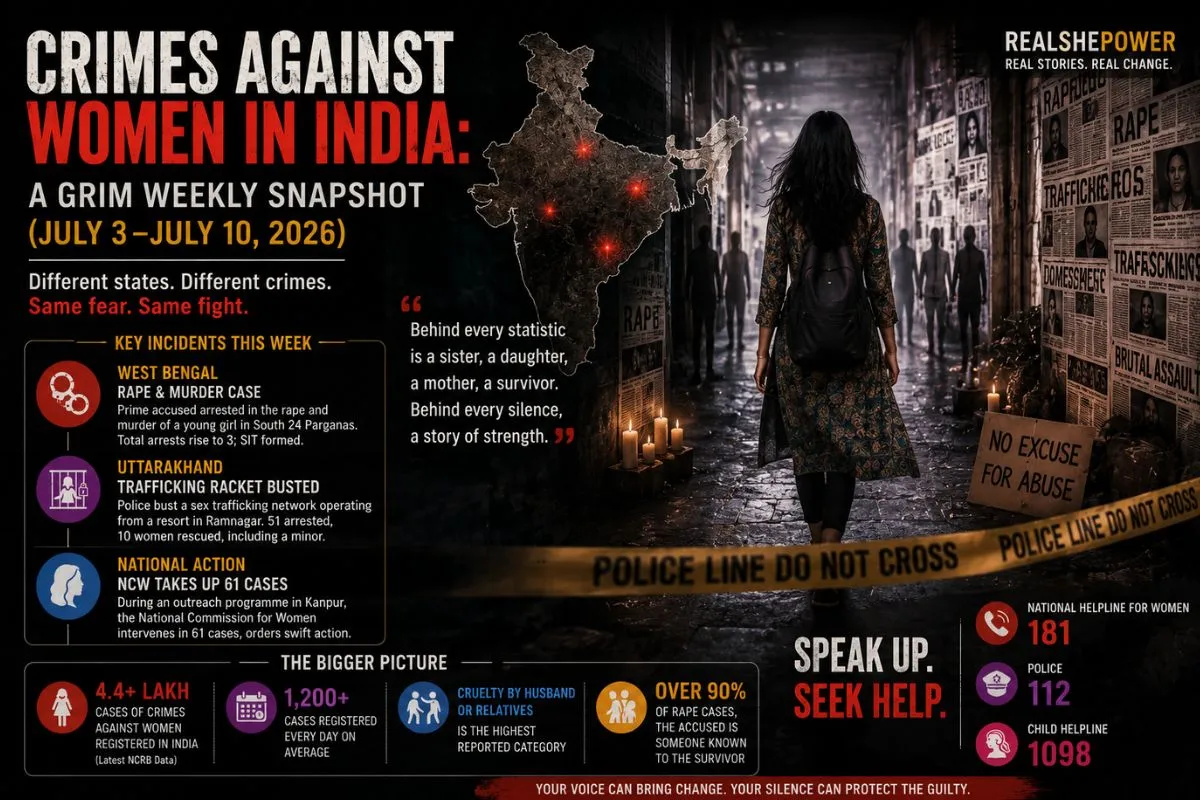
One of the week’s most disturbing developments came from South 24 Parganas, where police arrested the prime accused in the rape and murder of a young girl. With three arrests now made, investigators formed a Special Investigation Team (SIT) to pursue the case. (The Times of India)
The investigation continues.
For one family, however, justice will never undo what was taken.
Uttarakhand: Behind the Resort Walls
Holiday destinations are supposed to symbolize freedom.
Instead, authorities uncovered an alleged trafficking and commercial sexual exploitation network operating from a resort in Ramnagar.
Police arrested 51 people and rescued 10 women, including a minor, exposing how exploitation often hides behind seemingly ordinary businesses. (The Times of India)
Trafficking doesn’t always happen in dark alleyways.
Sometimes it happens where tourists are checking in.
Women Keep Reporting. Institutions Keep Playing Catch-Up.
During an outreach programme in Kanpur this week, the National Commission for Women heard 61 complaints ranging from domestic violence to harassment and other forms of abuse.
The commission directed authorities to act swiftly.
That single event offers another uncomfortable truth:
Women are speaking.
The system is still struggling to keep pace. (The Times of India)
The Real Story Isn’t Three Cases.
It’s Thousands.
These incidents dominated headlines because they were particularly shocking.
But most violence against women never becomes national news.
According to India’s latest crime data, crimes against women continue to number in the hundreds of thousands annually, with domestic cruelty, sexual assault, kidnapping, and rape remaining among the most frequently reported offences. (Wikipedia)
Behind every statistic is a person whose life has been permanently altered.
Violence Doesn’t Begin With Murder
When people discuss crimes against women, they often picture extreme violence.
But most cases begin much earlier.
They begin when harassment is dismissed as “boys being boys.”
When stalking is called romance.
When domestic abuse is labelled a family matter.
When complaints are withdrawn because neighbours might talk.
When survivors are asked what they were wearing before anyone asks what happened.
The crime rarely begins at the moment police become involved.
It begins long before that.
Why Are Women Still Unsafe?
There is no single answer.
But experts repeatedly point to overlapping problems:
- Slow investigations and court delays.
- Fear of reporting because of social stigma.
- Inadequate survivor support.
- Human trafficking networks exploiting economic vulnerability.
- Deep-rooted gender inequality that normalises violence before it criminalises it.
Punishment matters.
Prevention matters even more.
We Measure Progress Wrong
Every time a major case dominates national attention, leaders promise stronger laws.
India has strengthened several criminal laws over the past decade.
Yet headlines like these continue.
Perhaps the better question isn’t:
“Do we have enough laws?”
Perhaps it’s:
“Why do so many women still feel unsafe despite them?”
Justice delayed isn’t just justice denied.
It also weakens public confidence that reporting violence will change anything.
Another week has passed.
Another set of women became headlines.
But the real emergency isn’t the individual cases. It’s the repetition.
Until India treats violence against women as a national public safety crisis rather than a recurring news event, next week’s roundup may look painfully similar.
The Question We Should Ask Every Week
Instead of asking,
“How horrific was this week’s crime?”
Perhaps we should ask,
“What changed since last week that will prevent the next one?”
Until that answer becomes clearer, the weekly headlines will continue to read less like isolated tragedies and more like chapters from the same unfinished story.
If you or someone you know has experienced violence or abuse, seek immediate help from local law enforcement or trusted support services. Survivors deserve safety, dignity, and access to justice.
Related Reading on RealShePower
- The Cost Of Being A Woman In India: Crime Cases, Data & Justice In 2026 — A month-by-month look at dowry deaths and sexual violence cases, backed by NCRB data.
- India’s Persistent Rape Crisis: A Call For Deeper Societal And Systemic Reform — The structural failures behind why cases keep repeating with the same pattern.
- Will India’s Laws Ever Protect Its Girls? A Teen’s Rape Case Demands Change — On the POCSO backlog and what real legal reform would actually require.
- What Has Gone Wrong With Delhi? From Ranga Billa To An Epidemic Of Fear — Five decades of the capital’s crime rate against women, traced back to a single case.
- This Is Not Paranoia. This Is Digital Survival In India. — Practical tools for cyber blackmail, harassment, and non-consensual image threats.