Why Strong Women Are Feared, Not Loved
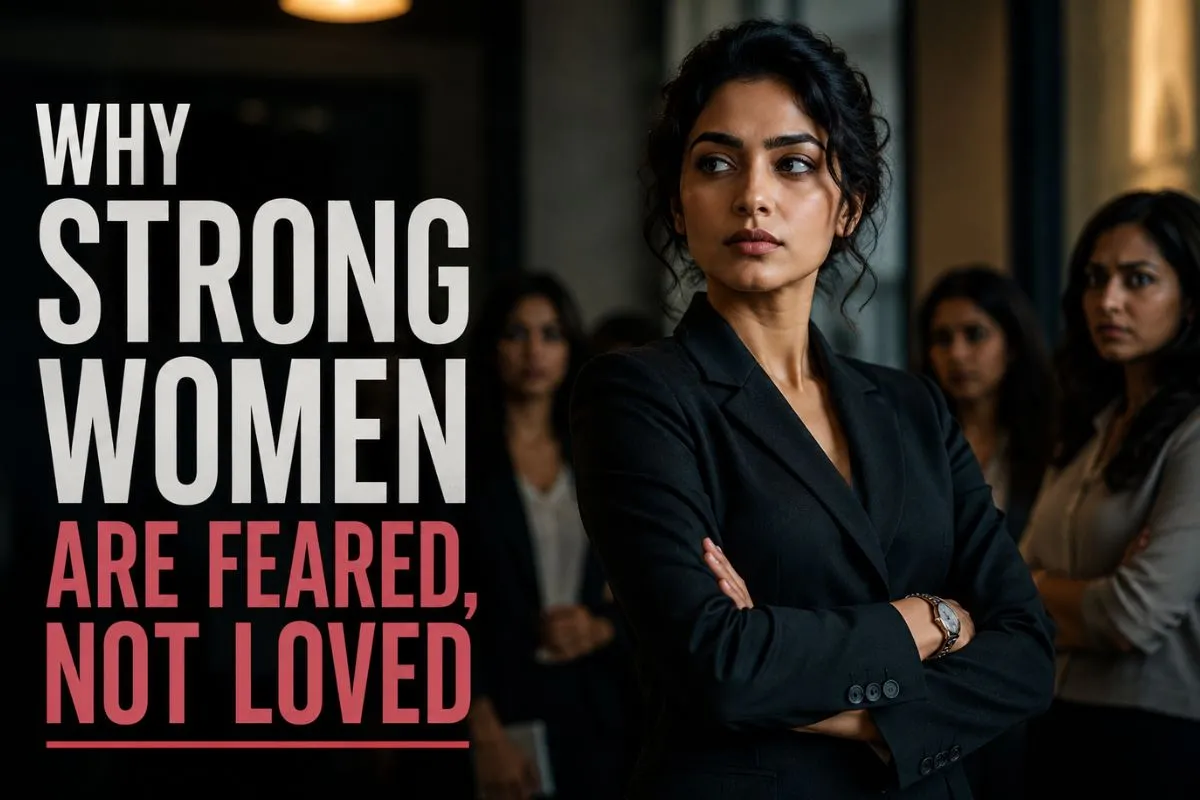
Society celebrates powerful women in speeches. It often punishes them in real life.
A little girl who speaks her mind is called bossy.
A little boy who does the same is called a leader.
The words are different.
The expectations are different.
The consequences are different.
Long before most women understand the politics of gender, they learn the politics of being liked.
Smile more.
Don’t argue.
Don’t intimidate people.
Don’t earn too much.
Don’t be “too ambitious.”
Don’t make men uncomfortable.
Don’t be emotional.
Don’t be cold.
Don’t be loud.
Don’t be quiet.
The rules are endless because they were never designed to be followed.
They were designed to make women constantly negotiate their own existence.
And perhaps that explains why one of the most misunderstood women in the world is not the weak woman.
It is the strong one.
Not because strength is unattractive.
But because strength changes power.
And power always makes existing hierarchies uncomfortable.
Strength Changes the Balance of Every Relationship
People often imagine strength as muscles, money, or titles.
Real strength is far quieter.
It is the woman who can walk away from disrespect.
The woman who earns enough to choose.
The woman who says “no” without apologizing.
The woman who refuses to shrink so other people can feel taller.
She changes every relationship she enters because she cannot be controlled by fear.
That changes the negotiation.
Many people mistake losing control for losing love.
They are not the same.
We Don’t Fear Powerful Women.
We Fear Losing the Roles We Were Taught.
Throughout history, societies have assigned identities before individuals had the chance to choose them.
Men were expected to lead.
Women were expected to support.
Even as laws evolved and opportunities expanded, many cultural expectations remained surprisingly intact.
When a woman becomes financially independent, emotionally secure, intellectually confident, or professionally accomplished, she quietly disrupts those inherited scripts.
The discomfort that follows is often less about her and more about the expectations others never questioned.
She becomes evidence that the old rules are no longer inevitable.
And change, even positive change, can feel unsettling.
Likeability Is Still a Different Standard for Women
There is an invisible contract many women are expected to sign.
Be competent.
But not intimidating.
Be confident.
But stay humble enough to reassure everyone else.
Lead.
But never appear controlling.
Speak.
But never dominate the conversation.
Succeed.
But never make anyone feel insecure.
These contradictions create what psychologists sometimes call a double bind: whatever choice a woman makes, she can be criticized from one direction or another.
The result is exhausting.
Many women spend years managing other people’s comfort instead of investing in their own growth.
Confidence Is Often Mistaken for Arrogance
Have you noticed how differently confidence is interpreted depending on who displays it?
A decisive man is often described as visionary.
A decisive woman may be called difficult.
A man who negotiates aggressively is ambitious.
A woman who negotiates with the same determination may be labeled demanding.
Language matters because language shapes perception.
Small differences in description become large differences in opportunity.
Over time, those perceptions influence promotions, leadership opportunities, media narratives, and even personal relationships.
Independence Removes Leverage
Control only works when someone depends on you.
A woman with financial stability has more freedom to leave unhealthy situations.
A woman with emotional resilience is less likely to tolerate manipulation.
A woman with supportive friendships is harder to isolate.
A woman who values herself is more difficult to guilt into accepting less than she deserves.
Her independence does not threaten healthy relationships.
It challenges relationships built on imbalance.
That distinction is crucial.
People who value equality often appreciate strong partners.
People who rely on control may experience that same strength as resistance.
The Burden of Being “Too Much”
Many accomplished women eventually hear some version of the same criticism.
You’re intimidating.
You’re intense.
You’re hard to approach.
You’re too career-focused.
You’re too opinionated.
You’re too independent.
Notice something.
Very few of these statements describe harmful behavior.
They describe visibility.
The underlying message is often not, “You’re wrong.”
It’s, “You’re making me rethink what I expected.”
Strong Women Are Often Expected to Carry More
Strength creates another paradox.
Once people believe you are capable, they may assume you need less care.
You become the one who solves problems.
The one everyone calls during a crisis.
The one who remains composed while everyone else falls apart.
People admire your resilience.
Sometimes they stop asking whether you’re tired.
The strongest women are often the least looked after because everyone assumes they will always be fine.
Strength can become its own invisible loneliness.
The Difference Between Respect and Affection
There is an old misconception that women must choose between being respected and being loved.
Healthy relationships prove otherwise.
Respect and affection reinforce one another.
Where problems arise is when affection depends on compliance.
If someone only appreciates you while you stay smaller than them, that is not love.
It is conditional approval.
Real love does not require self-erasure.
It makes room for both people to grow.
The Women History Remembered
Across politics, science, business, art, and social reform, influential women have often been praised and criticized in equal measure.
The criticism was rarely limited to their work.
It frequently extended to their personality, appearance, tone of voice, or family life in ways that their male counterparts were less likely to experience.
History repeatedly shows that when women challenge expectations, they often become symbols onto which societies project broader anxieties about change.
Yet those same women have also inspired generations that followed.
Their stories remind us that resistance is not always evidence of failure.
Sometimes it is evidence that new possibilities are emerging.
The Cost of Shrinking
Every time a woman hides an idea because she fears being called difficult…
Every time she accepts less pay because she doesn’t want to appear demanding…
Every time she apologizes for taking up space she has earned…
The world loses something.
Innovation.
Leadership.
Perspective.
Creativity.
Entire communities become poorer when capable women feel pressured to become smaller versions of themselves.
Strong Women Are Not Looking to Be Feared
Despite the stereotype, most strong women are not trying to dominate anyone.
They are trying to live honestly.
To contribute.
To build meaningful work.
To love without losing themselves.
To lead without pretending they don’t know what they’re doing.
To succeed without apologizing for success.
That is not intimidation.
It is authenticity.
A Different Question
Perhaps the question has never been:
“Why are strong women feared?”
Perhaps it is:
“Why has confidence in women so often been interpreted differently from confidence in men?”
The answer lies not in women’s strength, but in the expectations that strength quietly challenges.
The Real Measure of Love
The healthiest relationships do not ask women to become smaller.
They ask everyone to become freer.
A truly confident partner is not threatened by another person’s ambition.
A secure workplace does not punish competence.
A mature society does not confuse equality with competition.
Strong women are not difficult to love.
They are simply difficult to control.
And those are two very different things.
Explore More on RealShePower
- The Indian Woman’s Permission Problem — Why worry, when applied only to women, quietly becomes control.
- How Women Become Experts At Suffering, And Why It Must End With Us — On “adjust kar lo” and the conditioning mistaken for strength.
- Maa Behen: A Chaotic, Cathartic Ode To Women Who Refuse To Behave — A film review on why society fears women who won’t perform respectability.
- The Room Was Built Without Her In Mind. She Walked In Anyway. — Women who turned being underestimated into leadership nobody granted them.
- The Job No One Hired Her For, That She Cannot Quit — The invisible load strong women carry precisely because no one questions it.