The Two Leagues of Greatness: Federer, Dhoni, Messi and the Quiet Art of Mastery Versus Nadal, Ronaldo, Kohli and the Relentless Will to Conquer
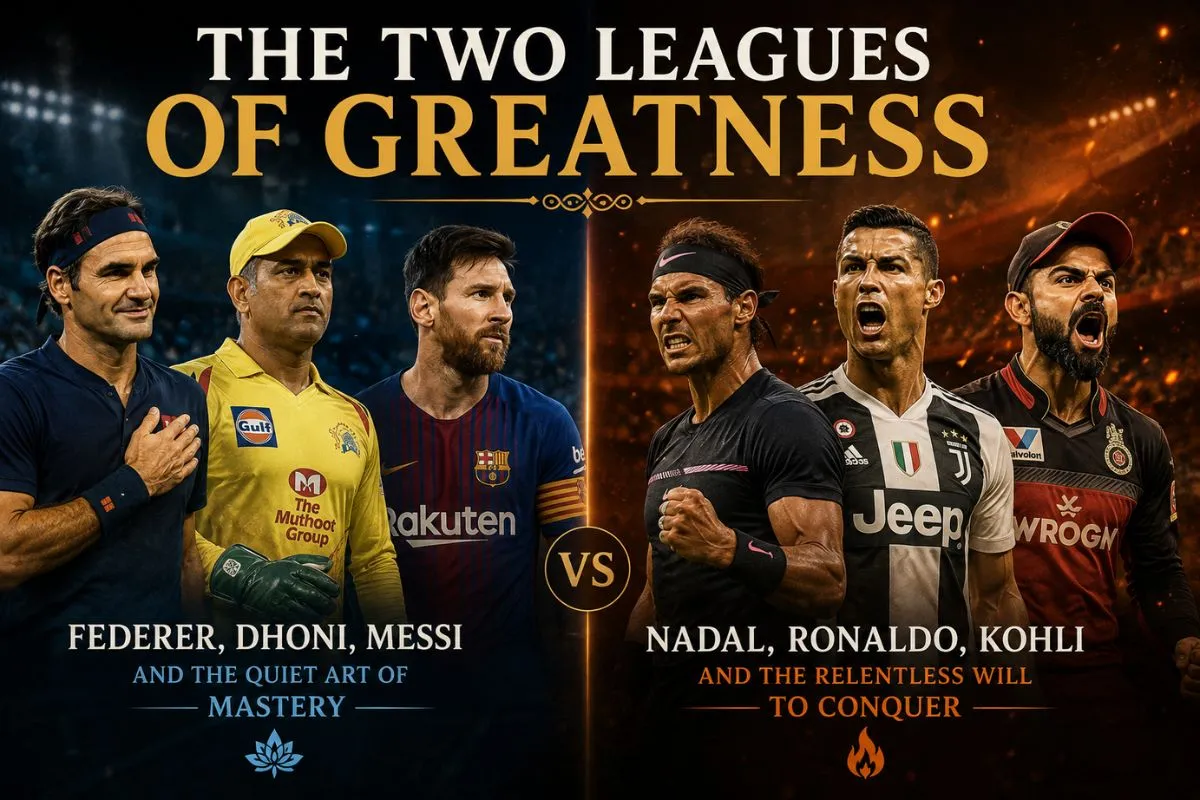
The parallels between Roger Federer, MS Dhoni and Lionel Messi on one side, and Rafael Nadal, Cristiano Ronaldo and Virat Kohli on the other, form one of the clearest patterns in modern sport. These six athletes dominate three different games yet fall into two distinct psychological and stylistic camps. The first group moves through competition with a quiet authority that often looks almost effortless. The second group attacks every moment with visible intensity and an unyielding will to impose themselves. The similarities within each trio, and the contrasts between them, reveal more than personal preference. They show how certain temperaments repeatedly rise to the top and how the people who follow them tend to mirror those same traits.
Federer, Dhoni and Messi share a rare capacity to make the extraordinary appear ordinary. Federer’s game was built on timing, balance and an almost architectural sense of the court. He rarely seemed hurried. Even in the fiercest exchanges he retained a classical economy of movement. Dhoni operated with the same unhurried clarity. Whether finishing a chase or standing behind the stumps, he projected an internal stillness that unsettled opponents more effectively than any outward display of aggression. Messi carries the same quality onto the football pitch. His dribbles and sudden changes of direction do not announce themselves with explosive effort. They simply happen, as if the ball and the space around him have already been solved in his mind before his body completes the action. Across tennis, cricket and football these three men embody a form of genius that privileges perception and precision over raw confrontation.
Nadal, Ronaldo and Kohli represent the opposite pole. Their greatness is inseparable from visible struggle and relentless self-assertion. Nadal’s tennis is a study in physical and mental refusal. Every point is treated as a battle that must be won through superior force of will. The fist pumps, the intensity of the stare, the willingness to chase balls that most players would concede all signal the same message: nothing is finished until he decides it is. Ronaldo’s career follows the same script. He has continually reinvented his body and his game through obsessive work, turning every match into a public test of superiority. Kohli brings the identical energy to cricket. His batting is aggressive by temperament, his fielding is charged, and his captaincy was defined by an insistence on constant intensity. These three athletes do not merely play; they impose. Their success is framed as the product of an unbreakable competitive hunger.
The differences between the two groups run deeper than style. Federer, Dhoni and Messi tend to keep emotion contained. Their celebrations are often understated, their public language measured. They give the impression of men who have already processed the moment internally before the rest of us see it. Nadal, Ronaldo and Kohli externalise emotion. Their reactions are larger, their motivation more openly declared, their presence more confrontational. One group seems to float above the contest; the other seems to wrestle it into submission. Both approaches produce excellence, yet they generate different kinds of drama and different kinds of loyalty.
Fan bases make the distinction unmistakable. Supporters of Federer, Dhoni and Messi often speak of beauty, purity and transcendence. They linger over the aesthetics of a backhand, a helicopter shot or a no-look pass. Their admiration carries a contemplative quality. They value the sense that these athletes elevate the sport beyond mere competition. Followers of Nadal, Ronaldo and Kohli respond to fire. They celebrate the fight, the refusal to yield, the visible cost of victory. Their attachment is more tribal and more vocal. Stadiums and social media become arenas where intensity is matched with intensity. The quieter fans of the first group and the louder fans of the second are not accidental. People are drawn to the version of greatness that resonates with their own emotional vocabulary.
Yet the two groups are not as distant as they first appear. All six men share an extraordinary capacity for focus under pressure and a professional longevity that borders on the unnatural. Federer and Nadal pushed each other to heights neither might have reached alone. Messi and Ronaldo defined an entire era of football through mutual excellence. Dhoni and Kohli, though different in temperament, both delivered for India at the highest level across formats. The surface styles diverge, but the underlying hunger for mastery is identical. One group simply expresses that hunger through serenity and the other through storm.
The pattern also reveals something about how greatness is narrated. The Federer-Dhoni-Messi narrative emphasises gift and grace. The Nadal-Ronaldo-Kohli narrative emphasises labour and will. Both stories are incomplete. Federer trained with meticulous care. Dhoni studied the game with quiet intensity. Messi works obsessively on the smallest details. Equally, Nadal possesses rare athletic gifts, Ronaldo has exceptional coordination and timing, and Kohli’s hand-eye coordination is extraordinary. The public stories simplify what is in reality a fusion of talent and temperament. Still, the dominant story each athlete attracts is telling. It shows which aspect of human excellence a culture or a fan community most wants to celebrate.
In the end the two leagues are less about hierarchy than about complementary ways of being exceptional. One league offers the pleasure of watching difficulty dissolved by clarity. The other offers the pleasure of watching difficulty conquered by force of character. Federer, Dhoni and Messi make the game look like an art form practised at the highest level. Nadal, Ronaldo and Kohli make it look like a war of wills that only the strongest survive. Fans choose the story that moves them, and in doing so they reveal as much about themselves as about the athletes they follow. The pattern holds because both forms of greatness are real, both are rare, and both continue to define what it means to stand at the summit of sport.