Rafael Nadal: The Boy Who Ran Toward The Ball
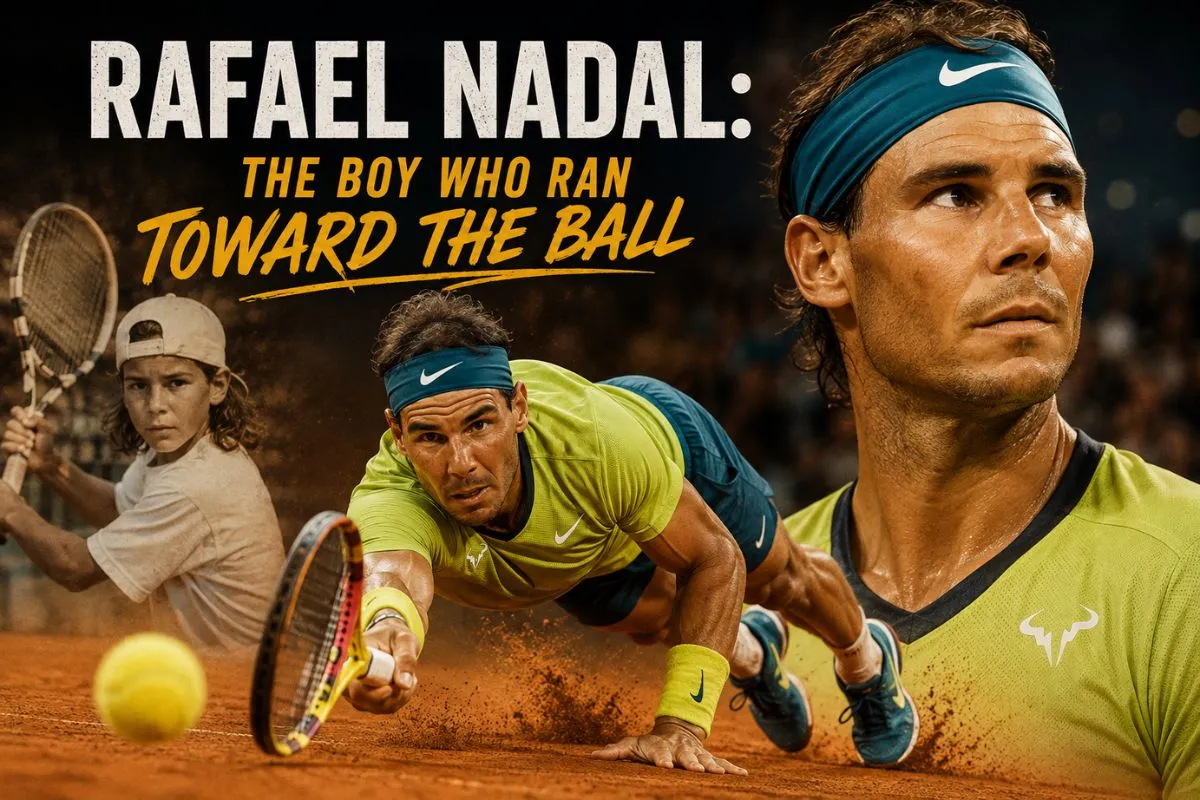
The first thing Toni Nadal noticed about his three year old nephew was not a swing or a serve. It was a habit. When Toni hit a ball across the court at Manacor Tennis Club, most small children simply stood and waited for it to arrive. Rafael went looking for it instead. “For me, this was special,” Toni later told the BBC, describing a moment from three decades before his nephew would retire as one of the greatest tennis players who ever lived, with 22 Grand Slam titles, a record 14 French Open championships, and 209 weeks spent as the world’s number one. What makes Nadal’s career genuinely inspiring, though, is not simply the trophy count. It is how many separate times his body, and at points his mind, gave him every reason to stop, and how specifically he kept going anyway.
Built On Mallorca, Under An Uncle Who Refused To Let Him Coast
Nadal was born on 3 June 1986 in Manacor, a small town on the island of Mallorca, into a close knit family that valued hard work and humility over spectacle. His uncle Toni, a former amateur player who had turned to coaching rather than chase a professional career of his own, took charge of Rafael’s development from the age of three and stayed as his primary coach for the next 27 years. Toni’s methods were, by his own later description, deliberately demanding. He would let a young Rafael build a lead to 19 points in practice games designed to run to 20, only to raise his own intensity and snatch the win away at the very end, forcing his nephew to sit with the discomfort of a near miss rather than the comfort of an easy victory. In one Spanish under 14 tournament, Rafael played through a broken finger rather than show any sign of weakness in front of his uncle, gritting through a match with what Toni later called a limp, lifeless digit rather than concede an inch. Toni has summarised his own coaching philosophy plainly, that a champion has to learn to endure, to push to the breaking point without ever giving in, a lesson he considered non negotiable for anyone hoping to compete at the top of the sport.
That foundation, mental toughness treated as a skill to be drilled with the same rigour as a forehand, became the single most identifiable trait of Nadal’s entire career, the one opponents across two decades struggled with more than his topspin or his footwork.
The Diagnosis That Nearly Ended It Before It Began
In late 2005, barely a year after winning his first French Open title at nineteen and finishing that season ranked world number two, Nadal felt a sharp crunch in his foot during a match. The diagnosis that followed was Mueller-Weiss syndrome, a rare degenerative condition affecting the navicular bone in the midfoot, one so uncommon that it is frequently missed by radiologists entirely, and serious enough that doctors raised the genuine possibility he might never play professional tennis again. He was nineteen years old, one Grand Slam into a career that had barely started, and being told the whole thing might already be over.
It was not over. Nadal and his team found a way to manage the condition well enough to keep competing, but it never fully went away, resurfacing repeatedly across the next two decades alongside a long list of other injuries, knee, wrist, hip, abdominal, that eventually cost him a combined 18 Grand Slam tournaments over the course of his career, a number that makes his 22 titles considerably more remarkable once you understand how much of his career he spent simply trying to get back onto the court at all. By his own count, he suffered 23 serious injuries across 19 professional seasons.
The Comebacks That Defined Him More Than The Titles
What separates Nadal’s story from a simple list of injuries is what happened directly after each one. In 2022, at thirty six years old, after serious doubts about whether his aggravated foot injury would even allow him to compete, Nadal won the French Open for a fourteenth time, beating four top ten players along the way while managing pain that, by his own admission, he understood could never be fully eliminated, only kept survivable enough to compete through. It made him the tournament’s oldest ever champion, a full seventeen years after his first title on the same court as a teenager who had just been warned his career might already be finished.
He did it again and again in smaller ways too, a hip flexor injury that cost him most of 2023, a muscle tear during his comeback attempt in early 2024, a ranking that had fallen to 644th in the world by the time he returned to competition that April, and still, at every stage, another attempt to get back on court rather than simply accept the ranking as the final word. His final professional appearance came at the 2024 Davis Cup Finals, representing Spain one last time before formally retiring, a quieter ending than a Grand Slam final, but one that let him close his career the way he had spent most of it, playing for something larger than his own individual result.
The Part Of The Story He Only Told Recently
For most of his career, the version of Nadal presented publicly was the warrior, indomitable, uncomplaining, defined by his refusal to show weakness. In a candid 2026 interview with CNN, well after his retirement, Nadal offered a considerably more honest account of what that refusal actually cost him privately. He described the genuine mental pressure and anxiety of competing at the highest level of a sport while his body kept breaking down beneath him, a period so difficult that he has said he struggled to leave his own house without carrying a bottle of water, a small, specific detail that says more about the private toll of those years than any trophy count ever could. It is a meaningful piece of the story precisely because it complicates the simpler, purely triumphant version, a reminder that the toughness Toni instilled in him from age three came with a real, largely private cost that took Nadal decades to describe openly.
What He Built Once He Stopped Playing
Nadal’s legacy was never going to be limited to his own results on court. In 2008, while still an active player near the peak of his career, he founded the Rafa Nadal Foundation, and in 2010 opened his first tennis school not in Spain, but in India, at the Anantapur Sports Village, giving disadvantaged children access to both education and sport in a setting far removed from Mallorca’s clay courts. In 2016 he opened the Rafa Nadal Academy in his hometown of Manacor, a full training campus spanning dozens of courts across multiple surfaces, built specifically to pass on the same foundation of technical skill and mental resilience his uncle had once drilled into him, to a generation of young players who will likely never fully grasp how close the man whose name is on the building came to never playing professionally at all.
Why This Story Is Worth Telling In Full
Nadal’s career resonates for reasons that go well beyond tennis, and it sits naturally alongside RealShePower’s own coverage of athletes who have rebuilt themselves after the sport nearly took everything from them. Vinesh Phogat’sown comeback, after a heartbreaking Olympic disqualification, into a new weight category built explicitly around protecting her mental health rather than chasing one more medal at any cost, echoes Nadal’s own late career recalibration in genuinely striking ways. So does Preeti Pawar’srecovery from Hepatitis A days before her Olympic debut, fighting through it anyway before returning to a gold medal streak across multiple tournaments. What connects all of these stories is not simply resilience as a buzzword, but the far more specific, far harder thing Nadal’s own account finally made explicit in 2026, that enduring through real pain, physical and mental both, was never actually free, and that telling the truth about what it costs does not diminish the achievement. If anything, it is the only version of the story honest enough to actually deserve the word inspiring.