The Indian Woman’s Permission Problem: Why Independence Still Needs Approval
Part 1 of The Invisible Tax Series
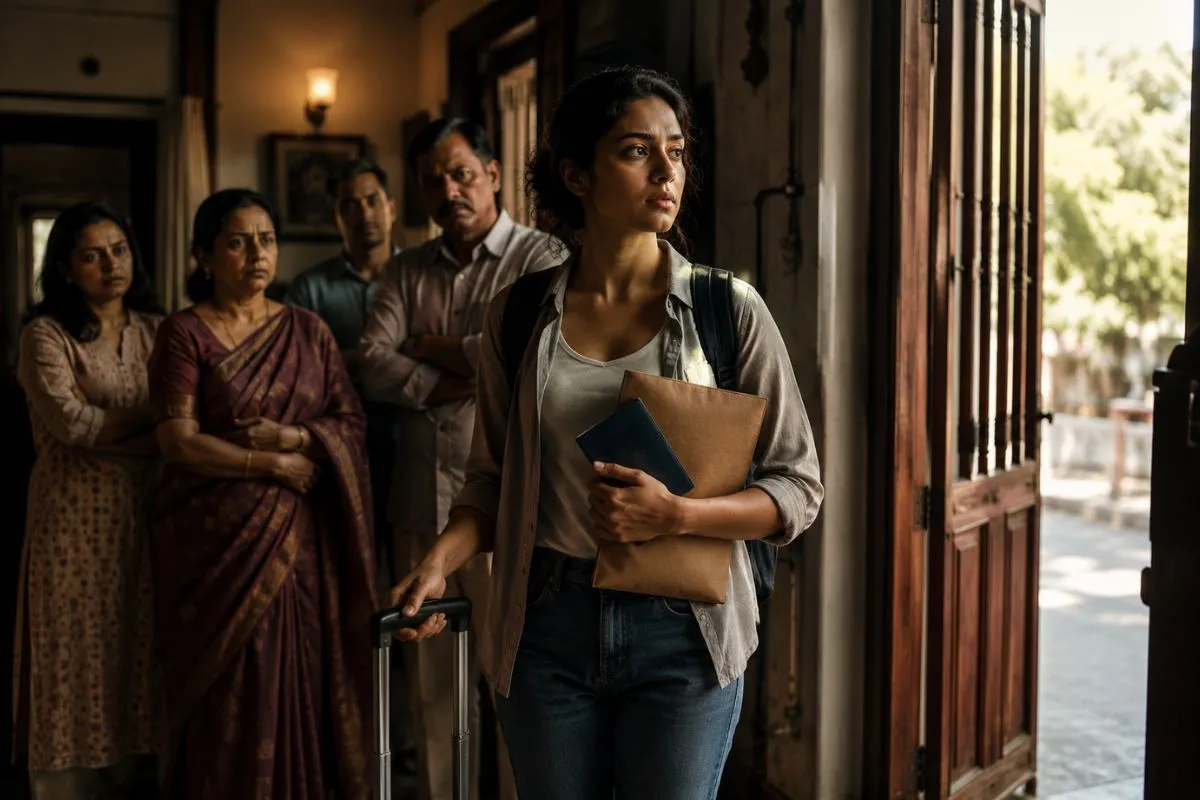
She has a job. She pays her own rent. She files her own taxes. She holds a postgraduate degree on a wall that she painted herself, in an apartment she chose herself, in a city she moved to herself.
And yet, last Diwali, she had to call her father to ask if it was okay to visit her friend instead of coming home.
She is 29 years old.
This is not a story about one woman. This is the story of millions of Indian women who have, by every measurable standard, built independent lives — and who are still, quietly, daily, asking for permission to live them.
We talk a lot about progress. And there has been progress. More Indian women are educated today than ever before. More are working, earning, travelling, leading. The numbers are real. The achievements are real. But there is something else that is also real — something we don’t talk about enough, because it is uncomfortable, because it lives not in policy papers but in kitchens, in WhatsApp messages, in the silences between what a woman wants and what she actually does.
It is the permission problem. And it is everywhere.
The Ask You Never Outgrow
Ask any Indian woman — urban, educated, employed — and she will tell you about the ask. The moment before she does something for herself, when she pauses, looks over her shoulder, and checks: Will this be okay? Will they mind? Should I tell them first?
It is not always a spoken question. Often it is a hesitation. A softening of language. A text that begins “I was thinking, if it’s okay…” when what she actually means is “I have decided.”
Priya, 32, a marketing manager in Bengaluru, describes it perfectly: “I earn more than my husband. I manage a team of fifteen people. But when I wanted to take a solo trip to Goa, I spent two weeks working up to asking him. Two weeks. For a four-day trip. And the worst part? I didn’t even realise how strange that was until my colleague — who is German — looked at me like I had said something bizarre.”
The ask follows Indian women from girlhood to grandmotherhood. As a teenager, it is can I go out? As a young adult, it is can I take this job in another city? After marriage, it is can I visit my parents? After children, it is can I go back to work? After fifty, it is can I cut my hair short?
The content of the question changes. The requirement to ask never does.
Marriage: Where Independence Goes to Negotiate
There is a particular kind of exhaustion that comes with being a modern Indian wife. It is not the exhaustion of housework, though that is real. It is the exhaustion of constantly translating yourself — of taking everything you know you are capable of, everything you have built, everything you want, and running it through the filter of what will work for everyone else.
Indian marriages — even the progressive ones, even the love marriages, even the ones between two people with matching LinkedIn profiles and matching views on climate change — often carry within them an invisible constitution. And in that constitution, the woman’s independence is always a negotiated term. Never a given.
“We don’t have rules,” said Meera, 35, a doctor in Mumbai, talking about her marriage. “We are equals. But somehow I am the one who rearranges her schedule when the in-laws visit. I am the one who skips the conference if the nanny cancels. I am the one who asks before making plans, while he just makes plans. We never agreed to this. It just… happened.”
This is everyday patriarchy at its most sophisticated. It doesn’t announce itself. It doesn’t come with a rule book. It seeps in through assumptions so old and so deep that even the people upholding them don’t always realise they are doing it. The husband is not a villain. The mother-in-law is not a monster. The family is not cruel. Everyone is, in fact, quite loving. And somehow, in the middle of all that love, the woman’s autonomy is the thing that keeps getting quietly, politely, compromised.
Sociologist Dr. Shilpa Phadke once wrote that Indian women are granted conditional public citizenship — their right to move, to choose, to be, is always contingent on behaving in ways that are acceptable to those around them. That observation was made over a decade ago. The conditions have become slightly more lenient. The conditionality has not gone anywhere.
The Control That Calls Itself Care
Here is what makes this particular problem so hard to fight: most of the time, the control doesn’t feel like control. It feels like love.
“My parents aren’t controlling,” a woman will say. “They just worry.”
“My husband isn’t possessive,” she will say. “He just likes knowing where I am.”
“My in-laws aren’t interfering,” she will say. “They just have strong opinions about how things should be done.”
And all of this may be true. The worry may be genuine. The love may be real. But worry, when it is applied only to women, when it is used to limit only women’s movement and choices and freedom, stops being just worry. It becomes a mechanism of control. Gentle, loving, well-intentioned control — but control nonetheless.
Fatima, 27, from Hyderabad, was offered a fellowship in Delhi. It was the opportunity of her lifetime. She turned it down. “My family said they were scared for me. A girl alone in Delhi. You know how it is. And I believed them. I told myself I was being responsible. It took me two years to admit to myself that I had given up something huge because I was afraid of disappointing people who love me. That’s not responsibility. That’s conditioning.”
The locations shift. Delhi is replaced by London or Pune or Singapore. The fellowships become promotions, or solo trips, or decisions about whether to have a second child, or whether to not have children at all. The mechanism stays the same. The woman’s desire is placed on one side of the scale. The family’s comfort is placed on the other. And the woman is the one who is expected — who expects herself — to balance it.
She Shrinks So Others Can Breathe
There is a phrase that keeps coming up when you talk to Indian women about this. Not in those exact words, but in that shape. She made herself smaller. She took up less space. She dialled herself down.
She stopped talking about her ambitions because it made her husband feel inadequate. She stopped wearing certain clothes because it made her mother-in-law uncomfortable. She stopped laughing too loudly, stopped expressing opinions too strongly, stopped wanting too openly — because wanting, in a woman, has always made people around her nervous.
This shrinking is not dramatic. It does not happen all at once. It happens in increments so small that by the time a woman looks up, she is not sure who she is anymore — only who she has learned to be in order to keep the peace.
Anjali, 41, a former journalist in Delhi, put it this way: “I used to have so many opinions. About everything. Politics, books, food, life. Somewhere in my thirties, I realised I had stopped sharing them. Not because I stopped having them. But because sharing them created friction, and I was tired of friction. I had traded my voice for a quiet house. And I didn’t even notice until my daughter started doing the same thing.”
That last line. A daughter watching her mother go quiet and learning that this is what women do. That is how it passes on. Not through cruelty. Through example.
The Permission Economy
Let’s call it what it is: a permission economy. Indian women operate in a system where their choices have currency only when they have been approved by others. The approvers change — father, husband, in-laws, society at large — but the process remains constant. She proposes. They decide. She adjusts.
And here is the cruelty of it: women are often made to feel that this system is for their own good. That the asking is humility, not humiliation. That the checking-in is respect, not restriction. That the deference is love, not loss.
But let’s be honest about what the permission economy costs. It costs women their time — the time spent waiting for approval, softening requests, managing reactions. It costs them their confidence — because when you have to justify your choices to others often enough, you begin to doubt them yourself. It costs them their careers — because the professional risks that build careers require a freedom to act that many Indian women simply do not have. And it costs them something harder to name: the deep, settled sense of being the author of your own life.
Read Part 2: The Salary She Hides From Her Family
This Is Not About Hating Men
Let’s be clear about this, because it always needs to be said. This is not about hating men. This is not about blaming husbands or fathers individually. Most of the men in these women’s lives are not bad men. Many of them are good men — kind, educated, well-meaning — who have simply never had to think about this, because the system works in their favour and systems that work in your favour are easy not to notice.
But good intentions do not neutralise bad outcomes. A cage is still a cage even if it is built with love.
The men in these women’s lives need to ask themselves an honest question: Do I require my wife, my daughter, my sister, to seek my approval for things I would never think to ask permission for myself? And if the answer is yes — even slightly, even sometimes, even in ways that feel natural and normal — then something is worth examining.
What We Are Really Asking For
Indian women are not asking to be reckless. They are not asking to abandon their families or their relationships or their culture. They are asking for something far simpler and far more radical at the same time.
They are asking to be trusted.
Trusted to know their own minds. Trusted to make their own decisions. Trusted to take their own risks, make their own mistakes, chart their own paths — without having to seek clearance first, without having to soften every desire into a request, without having to earn the right to their own lives over and over again.
The Indian woman of today is educated, capable, and aware. She is not waiting to be saved. She is waiting to be believed. Believed when she says she knows what she wants. Believed when she says she can handle it. Believed when she says — and she has been saying it forever, in a thousand ways — I don’t need your permission. I just need you to stop requiring it.
The Change That Starts at the Dinner Table
Policy matters. Laws matter. Workplace equality matters. But the permission problem does not live in law — it lives at dinner tables, in wedding conversations, in the unspoken rules of households across the country. And that means the change has to happen there too.
It starts with parents who raise daughters to own their decisions, not to apologise for them. It starts with mothers who stop teaching their girls to make themselves palatable. It starts with fathers who say you don’t need to ask me — you’re an adult, I trust you. It starts with husbands who take up their fair share of the invisible labour, so that their wives have the bandwidth to actually live. It starts with women themselves — with the quiet, difficult, ongoing work of noticing when they are asking for permission they do not need, and choosing, gently and firmly, not to.
None of this is easy. The conditioning is deep. The social costs of defying it are real. A woman who stops shrinking will make some people around her uncomfortable. That discomfort will be called many things — selfishness, attitude, too much, too loud, too bold, not how a good woman behaves.
She should do it anyway.
A Final Word
Independence that requires approval is not independence. It is performance.
The Indian woman has spent generations performing independence while actually living within very carefully managed limits. She has been celebrated for how far she has come while being quietly kept from going further.
She is done asking. Or she should be.
Not because asking is always wrong. But because the day a woman can act without the fear of disapproval — the day her choices need no stamp, no softening, no committee — is the day independence stops being a word we use and starts being a life we actually live.
That day is not here yet. But it is coming.
And it does not need anyone’s permission.
RealShePower — Because her story is not a subplot.
Read Next
Part of The Invisible Tax Series