The Real Science Of Imposter Syndrome, And Why “Just Be Confident” Was Never The Answer
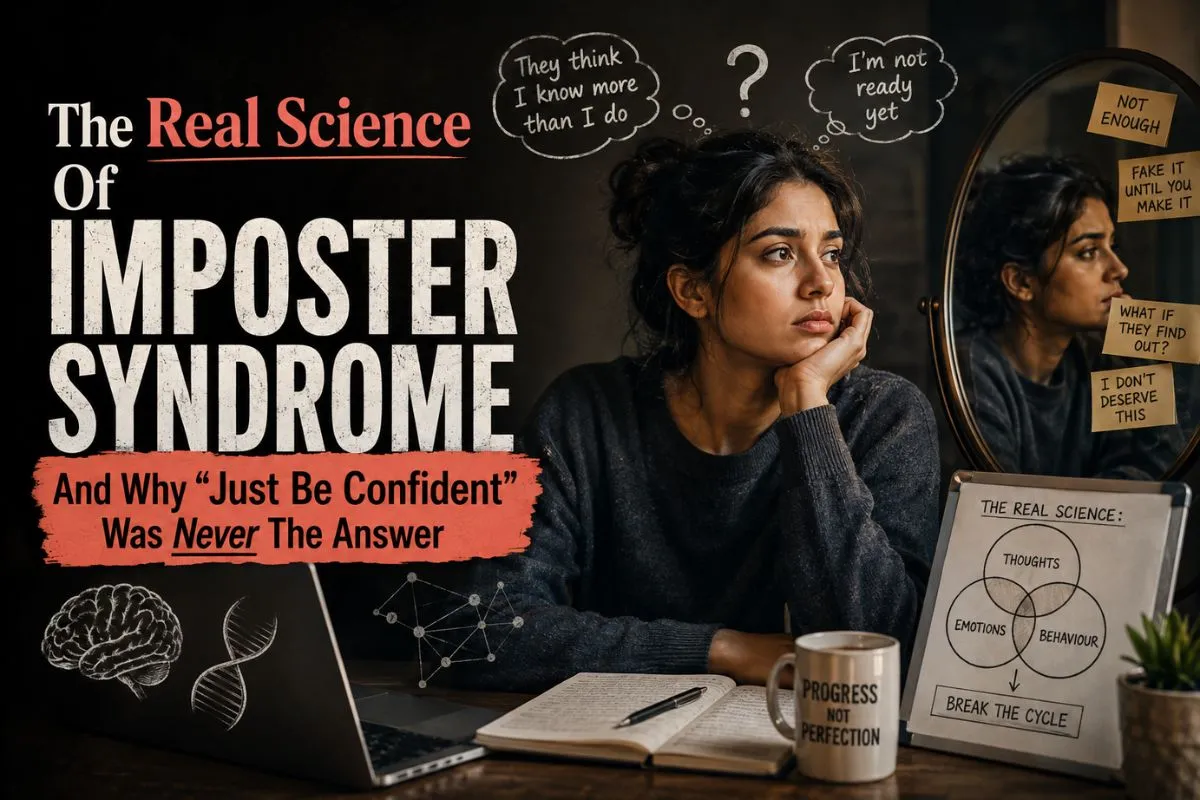
The Real Science Of Imposter Syndrome
Somewhere between a promotion and a panic, an enormous number of genuinely accomplished women land on the exact same thought, they got here through luck, timing, or other people’s mistaken belief in them, and it is only a matter of time before someone finally notices. That feeling has a name, a real research history behind it, and, contrary to how it usually gets discussed online, a considerably more specific set of causes and solutions than “practice more self love.”
Where The Term Actually Came From
The concept originates from a 1978 paper by psychologists Pauline Clance and Suzanne Imes, based on their work with more than 150 high achieving women across academia and the professions. Notably, they called it the impostor phenomenon, not impostor syndrome, and they were explicit that they were describing a documented experience pattern rather than a clinical diagnosis, a distinction that still holds today, the impostor phenomenon does not appear in either the DSM-5 or ICD-11 as a recognised disorder. Clance and Imes described the core pattern precisely, women who, despite genuinely outstanding academic and professional accomplishments, persisted in believing they were not actually bright, and that they had simply managed to fool everyone who thought otherwise. Crucially, the achievements themselves rarely changed the belief. A promotion, an award, or a glowing performance review tended to get filed away as luck, timing, or charm rather than treated as evidence of actual competence.
The Actual Mechanism, Not Just The Feeling
What later research clarified is that impostor phenomenon is not really about low self-esteem in general. It is a specific, identifiable misattribution pattern, success gets credited to external, unstable causes, luck, good timing, other people’s generosity, a fluke, while failure gets credited to something internal and stable, a genuine, permanent lack of ability. That asymmetry is the actual mechanism, and it means two people can have identical results, a passed exam, a landed client, a strong quarter, and walk away with completely different internal narratives about what that result actually proved about them.
The most rigorously validated tool for measuring this pattern, the Clance Impostor Phenomenon Scale, uses twenty statements rated on a five point scale to assess exactly this misattribution pattern rather than simply asking someone if they feel confident. Later research by Valerie Young refined the pattern into five recognisable subtypes worth knowing by name, because each one tends to respond to a slightly different intervention. The Perfectionist sets standards so high that even genuine success feels like falling short. The Superhuman pushes to excel in every single role simultaneously and treats any single area of struggle as proof of overall inadequacy. The Natural Genius expects competence to arrive quickly and easily, and treats the need to actually work hard at something as evidence of not really being good at it. The Soloist treats asking for help as an admission of failure rather than a normal part of working. The Expert never feels sufficiently knowledgeable, chasing one more certification or one more year of experience before finally feeling qualified to speak.
Why This Shows Up So Heavily In India Specifically
Real Shee Power’s own 2025 Freedom Survey found that 68.8 percent of Indian women surveyed reported self-judging their own decisions, a pattern the report linked directly to imposter syndrome, and notably higher, at 75 percent, among women over twenty one, suggesting the pattern compounds with age and experience rather than resolving on its own. That finding lines up with a broader thread in the original 1978 research, Clance and Imes traced the phenomenon partly to early family dynamics and to the internalisation of societal gender role expectations, meaning cultural messaging about what women are allowed to confidently claim credit for plays a direct, measurable role in how strongly this pattern takes hold, not just individual personality or genuine skill level.
This is also why impostor phenomenon research consistently finds it runs stronger among women, immigrants, and other groups historically underrepresented in a given field or level of seniority. It is not that these groups are objectively less competent and therefore more accurately self-aware. It is that a lack of visible representation at senior levels removes an important external correction, seeing enough people who look like you already succeeding at a given level, that would otherwise help override the internal misattribution pattern before it calcifies into a settled belief about yourself.
Why “Just Be More Confident” Fails As Advice
The reason generic confidence advice tends to bounce off impostor phenomenon specifically is that it is aimed at the wrong target. Confidence coaching usually tries to boost how good someone feels about themselves in general. Impostor phenomenon is not really a general self-esteem deficit, plenty of people with intense impostor feelings are otherwise fully functional, self-assured people in most areas of their life. It is a specific, situational misattribution error about the actual source of a specific success, and it needs a specific correction rather than a general confidence boost.
What actually works, according to the clinical and organisational research since Clance and Imes’s original paper, tends to fall into a few concrete categories rather than a single mindset shift. Naming the specific subtype matters, because a Perfectionist and a Soloist need genuinely different first steps, the Perfectionist benefits from deliberately lowering the bar for what counts as “good enough” on a specific task, while the Soloist benefits from deliberately asking for help on something they could technically handle alone, just to break the association between independence and worth. Tracking evidence in writing, keeping an actual running record of specific wins, specific praise received, and specific skills demonstrated, gives the misattribution pattern something concrete to argue against rather than letting it operate purely on vague, editable memory. Mentorship and visible representation genuinely help, seeing someone credible in your field openly admit to the same internal experience does more to correct the pattern than being told in the abstract that “everyone feels this way.” And naming the pattern out loud to a trusted colleague or mentor, rather than assuming the feeling is uniquely revealing about your own specific inadequacy, tends to break its isolating power fairly quickly, since a genuinely common experience, kept private, does most of its damage precisely because it feels secret.
The Uncomfortable Complication Worth Knowing
Recent critical scholarship has pushed back on how the term gets used in mainstream career advice, arguing that framing this pattern purely as an individual psychological quirk to be personally managed can quietly let structural problems off the hook, if women and underrepresented professionals are disproportionately affected because representation, mentorship, and equitable evaluation are genuinely thinner in senior roles, then the most complete fix involves changing those structural conditions, not only coaching individuals to reframe their internal narrative. Both things can be true at once, individual strategies genuinely help a specific person function better today, and the disproportionate prevalence of the pattern among underrepresented groups is itself evidence of a structural gap worth addressing directly rather than treating as purely a personal confidence project.
What This Actually Means, Practically
If a specific misattribution keeps recurring, crediting a win to luck, timing, or someone else’s generosity, rather than to your own actual skill and effort, that is worth noticing directly rather than dismissing as normal humility. It is not humility. It is a documented, measurable pattern with a fifty year research history behind it, disproportionately common among exactly the kind of high achieving women Real Shee Power’s own survey data describes, and considerably more responsive to specific, targeted strategies than to a single motivational pep talk. The next time a genuine accomplishment gets filed away as a fluke, it is worth asking the more precise version of the question Clance and Imes were actually studying, not “do I deserve this,” but “what is the actual evidence that I don’t.”