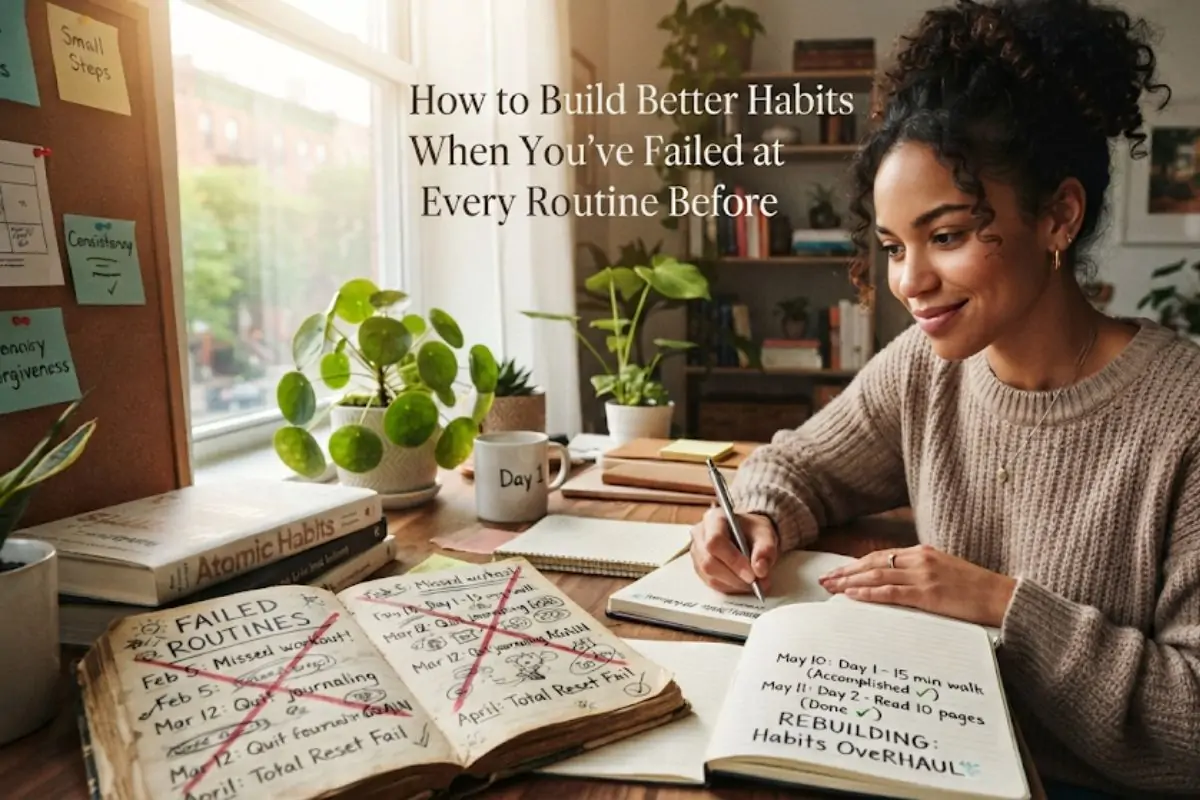
How to Build Better Habits When You’ve Failed at Every Routine Before
If you’ve started countless routines and abandoned almost all of them, you may have reached a frustrating conclusion:“I’m just not disciplined.”
That’s probably not true.
Most people don’t fail at building better habits because they lack willpower. They fail because they create routines that are too ambitious, too complicated, or completely disconnected from real life.
The solution isn’t another perfect routine.
It’s asimpler system you can actually repeat.
Also Read: How to Become the Kind of Person Who Actually Keeps Their Promises to Themselves
Start Smaller Than You Think
Don’t decide to exercise for an hour every morning if you currently exercise zero times a week.
Start with 10 minutes.
Don’t promise to read 30 pages every night. Read five.
Don’t decide to completely eliminate social media. Start by putting your phone away for 20 minutes.
The goal ofhabit formationis not to prove how much you can do. It’s to teach your brain that a behavior can become automatic.
Make the habit so easy that you have very little reason to skip it.
Stop Trying to Change Everything at Once
A new routine often collapses because it contains too many goals.
Wake up early. Exercise. Meditate. Meal prep. Read. Journal. Drink more water. Learn something new. Sleep early.
It sounds productive.
It is also exhausting.
Chooseone habit that matters mostand build around it.
Once it becomes consistent, add another.
Attach Your New Habit to Something You Already Do
One of the easiest ways tocreate a routineis to connect a new behavior to an existing one.
After brushing your teeth, stretch for two minutes.
After morning coffee, write your daily priorities.
After dinner, take a short walk.
Before getting into bed, read two pages.
This gives your new habit an existing trigger.

Make Failure Part of the Plan
You will miss days.
That’s normal.
The mistake is turning one missed day into a complete collapse.
Use thenever miss twicerule.
Miss Monday? Return Tuesday.
Skip your workout? Do a shorter one tomorrow.
Eat poorly today? Make the next meal better.
Consistency doesn’t mean never failing. It meansgetting back on track quickly.
Design Your Environment
Don’t rely entirely on self-discipline.
Make good habits easier and bad habits harder.
Keep your running shoes visible.
Put your book beside your bed.
Prepare healthy food in advance.
Keep distracting apps away from your home screen.
Put your phone in another room when you need to concentrate.
Your environment can quietly do much of the work your willpower struggles to do.
Track Consistency, Not Perfection
A habit tracker can help, but don’t become obsessed with perfect streaks.
Instead, ask:
“Did I show up today?”
Five minutes of exercise still counts.
Two pages of reading still counts.
Ten minutes of cleaning still counts.
Small actions repeated consistently are howhealthy habitsbecome part of everyday life.

Give Yourself a Minimum Version
Have a bad day?
Do the minimum.
If your normal workout is 30 minutes, your minimum might be five.
If your normal writing session is 1,000 words, your minimum might be 100.
If your normal cleaning session is 30 minutes, your minimum might be five.
This prevents the dangerous mindset of“If I can’t do it perfectly, I won’t do it at all.”
Don’t Start Over Every Monday
You don’t need a new week, new month, new planner, or new year.
You can restartat the next decision.
That’s one of the most important lessons in building better habits.
Your previous failures don’t predict your next attempt.
Maybe the old routine failed because it was unrealistic.
Maybe the timing was wrong.
Maybe you expected motivation to carry you.
Learn from what failed, simplify the system, and try again.
The Real Secret to Building Better Habits
You don’t need more motivation.
You needsmaller commitments, clearer triggers, fewer goals, and more repetition.
Forget the perfect morning routine.
Forget becoming a completely different person overnight.
Choose one meaningful habit.
Make it ridiculously easy.
Do it consistently.
Recover quickly when you slip.
Then build from there.
The habit you can repeat is far more valuable than the routine that looks impressive on paper.
And if you’ve failed at every routine before, you haven’t proven that you can’t change.
You’ve simply learned what doesn’t work for you.
Now build something you can actually keep.
FAQs
Can you build habits after repeatedly failing?
Yes. Previous failures don’t mean you’re incapable of building habits. They often reveal that your routine was too difficult, unrealistic, or poorly timed.
How long does it take to build a habit?
There is no universal number of days. Habit formation varies depending on the behavior, context, and individual. Consistent repetition matters more than chasing a specific deadline.
Why can’t I stick to a routine?
Common reasons include making too many changes at once, setting unrealistic goals, relying on motivation, having vague plans, and failing to account for difficult days.
How do I stay consistent with new habits?
Start small, attach the habit to an existing behavior, schedule it clearly, reduce friction, track your progress, and use a “never miss twice” approach when you slip.
What is the easiest way to build a new habit?
Choose one small behavior and repeat it in the same context. The easier the behavior is to start, the more likely you are to repeat it.
How do I get back on track after breaking a habit?
Don’t wait for Monday or the beginning of a new month. Resume at the next available opportunity and make the first step as easy as possible.