60 Wild Facts About the Human Body That Sound Made Up (But Aren’t)
Your body has been doing genuinely bizarre things this entire time without asking for your permission or your attention. It glows faintly. It rebuilds its own stomach lining every few days so it doesn’t digest itself. It makes you taller in the morning than at night. Most of this goes completely unnoticed, mainly because it would be exhausting to walk around marveling at your own pancreas all day.
This list pulls together 60 of the strangest, best-documented facts about the human body, grouped by system so it reads less like a random trivia dump and more like an actual tour. If a few of these facts about hair and skin make you want to look into your own hair health more seriously, Real Shee Power’shome remedies for hair fallis a solid next stop.
Brain and Nervous System (1 to 10)
- Your brain generates enough electricity while you’re awake to power a small LED light bulb.
- Because it takes a fraction of a second for your brain to process signals from your eyes, you’re technically always perceiving a tiny bit of the past, never a true, instantaneous present.
- The brain itself has no pain receptors, which is why neurosurgeons can operate on a conscious patient’s brain without the brain feeling the procedure directly.
- Information travels along some of your nerve cells at speeds of up to 268 miles per hour.
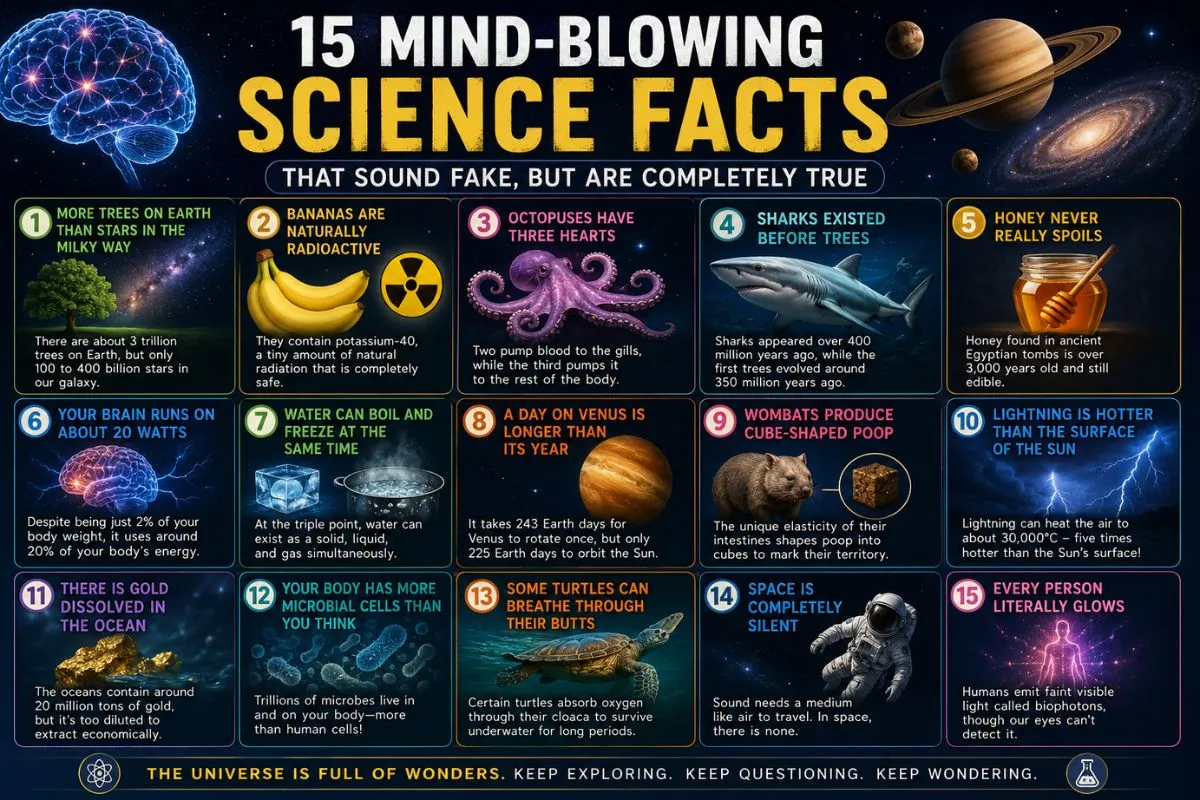
- Your brain uses about 20% of your body’s total energy, despite making up only about 2% of your body weight.
- Deep sleep triggers a cleaning process in the brain where cerebrospinal fluid flushes out metabolic waste built up during the day.
- Long-term memories are believed to be at least partly consolidated during sleep, which is one reason all-nighters before exams tend to backfire.
- The brain can’t multitask in the way people assume. What feels like multitasking is usually the brain rapidly switching attention between tasks, at a real cost to accuracy and speed.
- Emotional pain and physical pain activate some of the same regions of the brain, which is part of why heartbreak can produce genuine physical discomfort.
- Your sense of smell is directly wired to the brain’s memory and emotion centers, which is why a specific smell can trigger a vivid memory faster than almost any other sense.
Skin, Hair, and Nails (11 to 20)
- Skin is the body’s largest organ, and an adult’s skin covers roughly 20 square feet if laid flat.
- Your body sheds about 30,000 to 40,000 dead skin cells every hour, meaning you get an almost entirely new outer layer of skin roughly every month.
- Fingernails grow faster than toenails, and nails on your dominant hand grow slightly faster than on the other.
- Hair on your head grows at different rates depending on the season, typically growing a little faster in summer than in winter.
- Goosebumps are a leftover reflex from ancestors with thicker body hair, where the same muscle contraction would have puffed up fur for warmth or to look larger to a threat.
- The skin on your eyelids is among the thinnest on your entire body, while the skin on your heels and soles is among the thickest.
- Wrinkling in water isn’t simple water absorption. It’s an active nervous system response that constricts blood vessels under wet skin, and some researchers believe it improves grip on wet surfaces.
- Each hair follicle on your scalp has its own tiny muscle attached to it, the same one responsible for goosebumps elsewhere on your body.
- Human skin color evolved primarily as a balance between protecting folate from UV damage and allowing enough UV exposure to produce vitamin D, varying by ancestral distance from the equator.
- Fingerprints form in the womb and are believed to be shaped partly by pressure from the amniotic fluid, which is one reason even identical twins have different prints.
Heart, Blood, and Circulation (21 to 28)
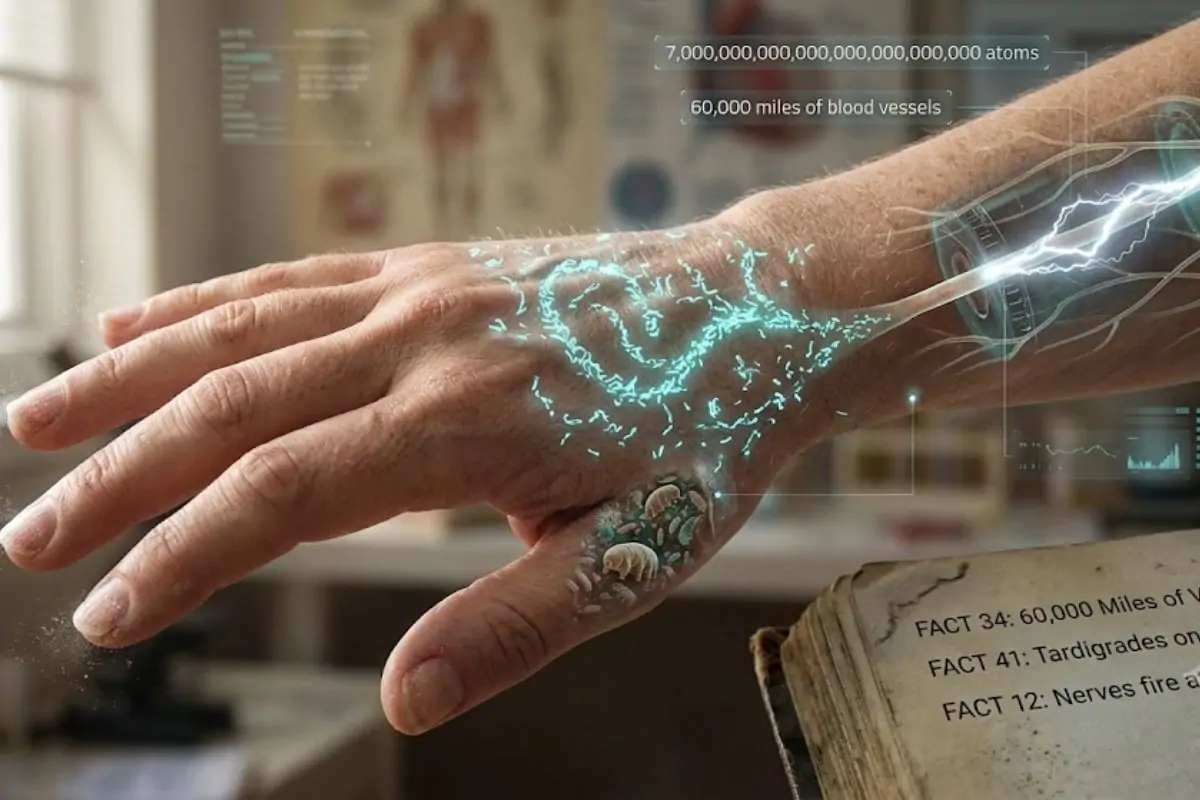
- If you laid out all of your blood vessels, capillaries included, end to end, they would stretch roughly 60,000 miles, enough to circle the Earth about twice.
- Your heart beats around 100,000 times a day and roughly 35 million times a year, without you ever consciously telling it to.
- Red blood cells are so small that around five million of them could fit on the head of a pin.
- A red blood cell completes a full loop through your entire circulatory system in about 20 seconds.
- Your heart is strong enough that, under experimental lab conditions, it has been shown capable of continuing to beat for a short period even when disconnected from the body, as long as it has a supply of oxygen and nutrients.
- Blood makes up roughly 7 to 8% of your total body weight.
- Blood appears blue through your skin due to how light wavelengths are absorbed and reflected, even though blood itself is always some shade of red, never actually blue.
- Women’s hearts beat slightly faster on average than men’s, generally by a few beats per minute.
Bones, Muscles, and Movement (29 to 36)
- Babies are born with around 300 bones, many of which fuse together as they grow, leaving adults with 206.
- The femur, your thigh bone, is stronger by weight than steel, able to withstand significant compressive force before breaking.
- The smallest bone in the human body, the stapes, sits inside your ear and is roughly the size of a grain of rice.
- Your tongue is made up of eight different muscles, and unlike most muscles in your body, it isn’t anchored to bone at both ends.
- Bones are living tissue and constantly remodel themselves, meaning your entire skeleton is gradually replaced roughly every ten years.
- You use more muscles to frown than to smile, though the exact numbers cited vary depending on how the movement is measured.
- Your body is very slightly taller in the morning than at night, since your spine compresses gradually under gravity throughout the day.
- Height in astronauts can temporarily increase by up to two inches in space, since the spine expands without gravity compressing it, though this reverses back on return to Earth.
Senses and Perception (37 to 44)
- You blink around 15 to 20 times a minute, adding up to roughly 10 million blinks in a year.
- The cornea, the clear front layer of your eye, has no blood supply at all and gets its oxygen directly from the surrounding air.
- Your sense of taste relies heavily on smell, which is why food tastes noticeably blander when your nose is blocked by a cold.
- Humans can distinguish an estimated one trillion distinct smells, a number far higher than older estimates once suggested.
- Your ears and nose never stop growing throughout your life, due to the ongoing effect of cartilage growth and gravity, even after your height stops increasing.
- Tears triggered by emotion have a different chemical composition than tears produced simply to lubricate your eyes.
- The human eye can detect a single photon of light under laboratory conditions, making it more sensitive than most manufactured light sensors.
- Your ability to sense where your own body parts are in space, called proprioception, functions essentially as a sixth sense operating constantly without conscious awareness.
Digestion and Internal Processes (45 to 52)
- Your stomach lining regenerates every few days, which is necessary because the acid inside it is strong enough to dissolve metal over time.
- The small intestine, uncoiled, would measure roughly 20 feet in an adult, longer than most people expect given how compactly it’s folded inside the body.
- Stomach growling, technically called borborygmi, happens from muscle contractions moving gas and fluid through your digestive tract, whether or not you’re actually hungry.
- The gut contains its own extensive network of neurons, sometimes referred to as the “second brain,” capable of operating somewhat independently of the brain in your skull.
- It takes food anywhere from 24 to 72 hours to fully pass through the digestive system, varying significantly by individual and diet.
- Your liver can regenerate a significant portion of its own tissue after injury or partial removal, one of the only internal organs capable of this.
- Saliva contains enzymes that begin breaking down starches the moment food enters your mouth, meaning digestion technically starts before you swallow anything.
- The body produces roughly one to two liters of saliva per day, most of which is swallowed without any conscious notice.
Sleep and the Body Clock (53 to 56)
- Your body temperature naturally drops in the evening as part of preparing for sleep, which is one reason a cooler room tends to help sleep quality.
- Dreaming occurs primarily during REM sleep, during which your body temporarily paralyzes most voluntary muscles, likely to prevent you from physically acting out your dreams.
- Night owls and early risers aren’t simply a matter of habit. Chronotype has a measurable genetic component affecting natural sleep and wake timing.
- A consistent sleep and wake time appears to matter more for long-term health outcomes than total hours slept alone, according to a growing body of circadian rhythm research.
Odd Numbers and Leftover Facts (57 to 60)
- The human body is made up of roughly 37 trillion cells, each one carrying out specific, specialized functions to keep the whole system running.
- Human DNA overlaps with banana DNA by roughly 60%, a reflection of how many basic biological processes are shared across most forms of life on Earth.
- Your body emits a faint amount of visible light as a byproduct of cellular metabolism, though it’s far too dim for the human eye to detect without specialized equipment.
- Newborn babies don’t have visible kneecaps in the way adults do. Instead, they have soft cartilage that gradually hardens into bone over the first several years of life.
Why Any of This Is Worth Knowing
None of these facts will change your day-to-day life, and that’s sort of the point. Most of what your body does happens completely outside your awareness, and it’s still worth pausing occasionally to notice just how much is going on underneath the version of yourself you actually experience.
Sources & Further Reading
- National Geographic Kids:Weird But True! Human Body
- Nectar Sleep:Fun Facts About the Human Body
- Science Kits:10 Surprising Science Facts That Will Blow Your Mind
- Real Shee Power:10 Home Remedies for Hair Fall Women Are Trying