15 Mind-Blowing Science Facts That Sound Fake, But Are Completely True
The universe is far stranger than fiction. From invisible forces shaping our lives to animals with unbelievable abilities, science is full of discoveries that challenge common sense. Here are 15 astonishing facts backed by scientific evidence that might make you see the world a little differently.
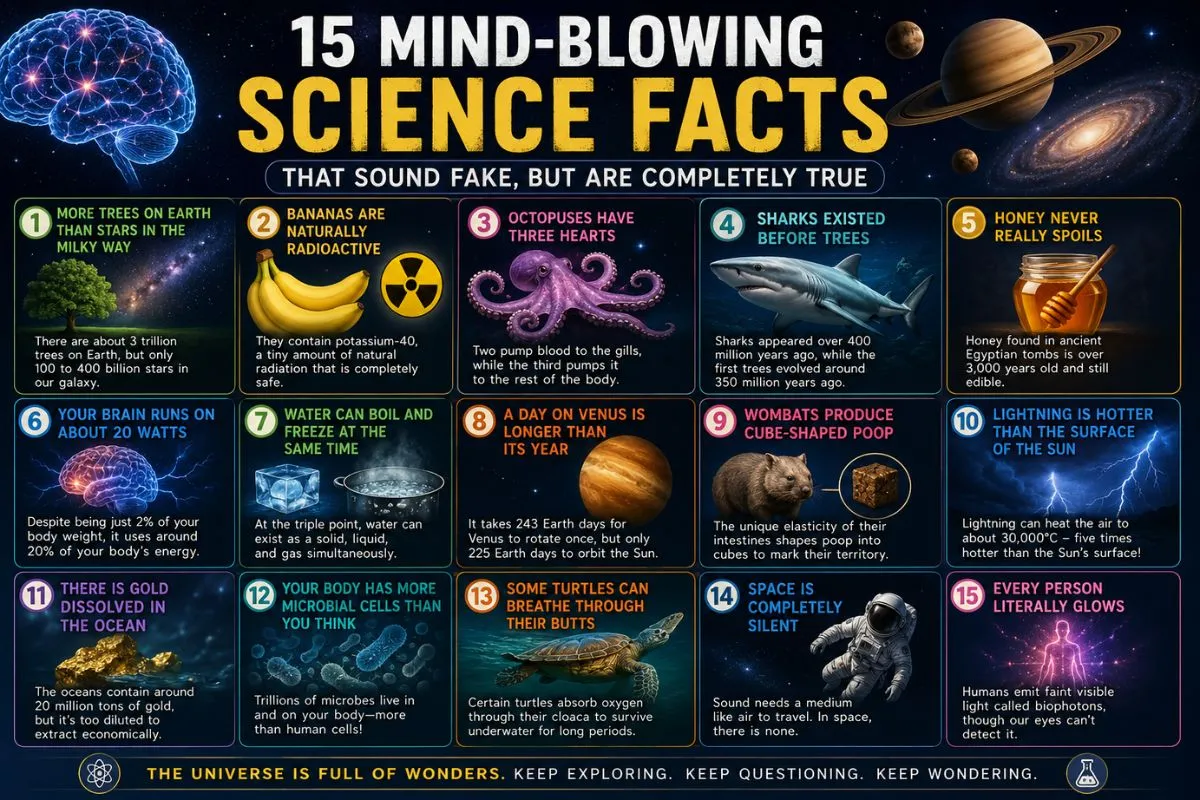
1. There Are More Trees on Earth Than Stars in the Milky Way
At first glance, this seems impossible.
Astronomers estimate that the Milky Way contains between 100 and 400 billion stars. Meanwhile, a landmark global study estimated that Earth is home to around 3 trillion trees. That’s roughly ten times more trees than stars in our galaxy.
While many forests have disappeared due to deforestation, our planet still hosts an astonishing number of trees.
2. Bananas Are Naturally Slightly Radioactive
Don’t panic, they’re perfectly safe.
Bananas contain potassium, and a tiny fraction of that potassium is a naturally occurring radioactive isotope called potassium-40. The radiation level is so low that you would have to eat millions of bananas in a short period for it to pose any health risk.
Scientists even jokingly use the “Banana Equivalent Dose” to explain very small amounts of radiation.
3. Octopuses Have Three Hearts
The octopus is one of nature’s most extraordinary creatures.
Two hearts pump blood to the gills, where oxygen is absorbed, while the third pumps oxygen-rich blood to the rest of the body. Even more fascinating, the main heart temporarily stops beating when the octopus swims, which is one reason these intelligent animals often prefer crawling along the ocean floor.
4. Sharks Existed Before Trees
Dinosaurs usually steal the spotlight, but sharks are much older than most people realize.
The earliest sharks appeared over 400 million years ago, while the first true trees evolved around 350 million years ago. That means sharks were already patrolling ancient oceans long before forests covered the Earth.
5. Honey Never Really Spoils
Archaeologists have discovered pots of honey in ancient Egyptian tombs that were thousands of years old and still chemically edible.
Honey’s low moisture content, acidic nature, and natural antimicrobial compounds make it one of the few foods that can remain preserved almost indefinitely if stored properly.
6. Your Brain Runs on About 20 Watts of Power
Despite weighing only about 2 percent of your body weight, your brain consumes roughly 20 percent of your body’s energy.
The electrical activity generated by billions of neurons is enough to power a small LED light bulb, although not all at once in a usable form.
7. Water Can Boil and Freeze at the Same Time
This isn’t magic.
Under a very specific combination of temperature and pressure known as the triple point, water can exist simultaneously as a solid, liquid, and gas.
Scientists use this unique property to calibrate highly precise scientific instruments.
8. A Day on Venus Is Longer Than Its Year
Venus rotates incredibly slowly.
It takes 243 Earth days for Venus to complete one rotation on its axis, but only 225 Earth days to orbit the Sun.
In other words, a single day on Venus lasts longer than an entire year there.
9. Wombats Produce Cube-Shaped Poop
It sounds like an internet myth, but it’s completely true.
Scientists discovered that the unique elasticity of a wombat’s intestines shapes its droppings into cubes. The unusual shape prevents them from rolling away, allowing wombats to mark their territory more effectively.
10. Lightning Is Hotter Than the Surface of the Sun
A lightning bolt can briefly heat the surrounding air to around 30,000 degrees Celsius, roughly five times hotter than the Sun’s visible surface.
This intense heat causes the air to expand explosively, creating the sound we hear as thunder.
11. There Is Gold Dissolved in the Ocean
The world’s oceans contain an estimated 20 million tons of dissolved gold.
The catch?
It’s spread so thinly throughout seawater that extracting it would cost far more than the gold is worth with today’s technology.
12. Your Body Contains More Microbial Cells Than You Might Expect
The human body is home to trillions of microorganisms, including bacteria, fungi, and viruses that make up the human microbiome.
Most of these microbes are not harmful. In fact, many play essential roles in digestion, immune function, and overall health.
You are, in many ways, an entire ecosystem.
13. Some Turtles Can Breathe Through Their Backsides
Certain freshwater turtle species can absorb oxygen through specialized tissues near their cloaca while underwater.
This remarkable adaptation helps them survive long winters beneath ice-covered lakes when surfacing for air isn’t possible.
14. Space Is Completely Silent
Movies often feature dramatic explosions in space.
In reality, sound requires a medium such as air, water, or another material to travel. Since outer space is nearly a vacuum, sound waves cannot propagate there.
Astronauts rely entirely on radio communication.
15. Every Person Literally Glows
Humans emit a faint form of visible light known as biophotons.
The glow is about 1,000 times too weak for the human eye to detect, but highly sensitive scientific cameras can measure it.
Your body is quietly producing light every second of your life.
Why Science Is So Fascinating
The beauty of science lies in its ability to reveal extraordinary truths hidden within ordinary life. Every tree, every ocean wave, every lightning strike, and even your own body tells a story shaped by billions of years of evolution, chemistry, and physics.
The more scientists explore our world and the universe beyond it, the more surprising discoveries emerge. Facts that once sounded impossible often become accepted scientific knowledge after careful observation and experimentation.
Curiosity has driven every major scientific breakthrough in history. Asking simple questions like “Why?” and “How?” continues to unlock mysteries that expand our understanding of the universe.
So the next time someone says science is boring, remind them that we live on a planet where water can freeze and boil simultaneously, sharks are older than trees, and every human quietly glows in the dark.
The universe has never needed science fiction to be extraordinary.
Quick Quiz
1. Which planet has a day longer than its year?
- Mercury
- Venus ✅
- Mars
- Jupiter
2. How many hearts does an octopus have?
- One
- Two
- Three ✅
- Four
3. Which food can last for thousands of years when stored properly?
- Rice
- Honey ✅
- Cheese
- Bread
4. What shape is wombat poop?
- Round
- Oval
- Cube ✅
- Triangle
5. Which is hotter for a brief moment?
- The Sun’s surface
- Lightning ✅
Did You Know?
Scientists estimate that humanity has explored less than 25 percent of the ocean floor in detail, meaning countless species and natural wonders may still be waiting to be discovered beneath the waves.