Reclaiming India’s Intellectual Sovereignty and the 2026 Knowledge Revolution
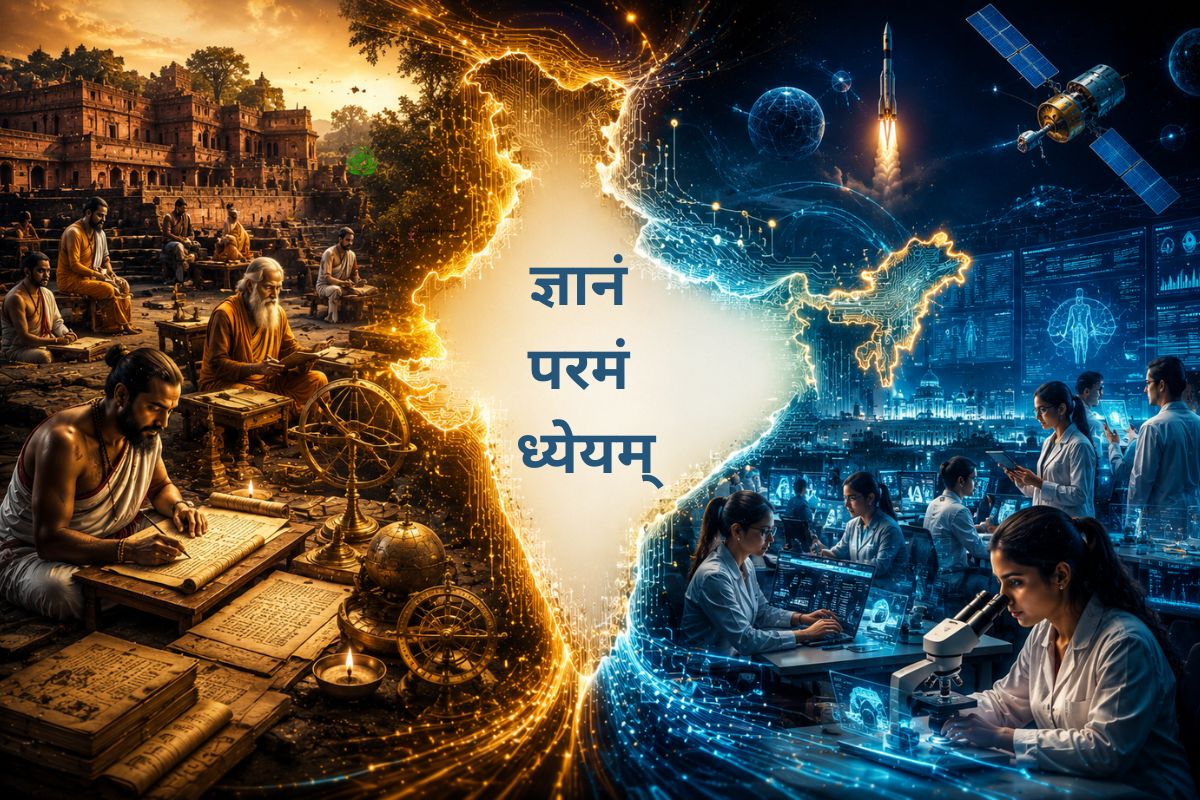
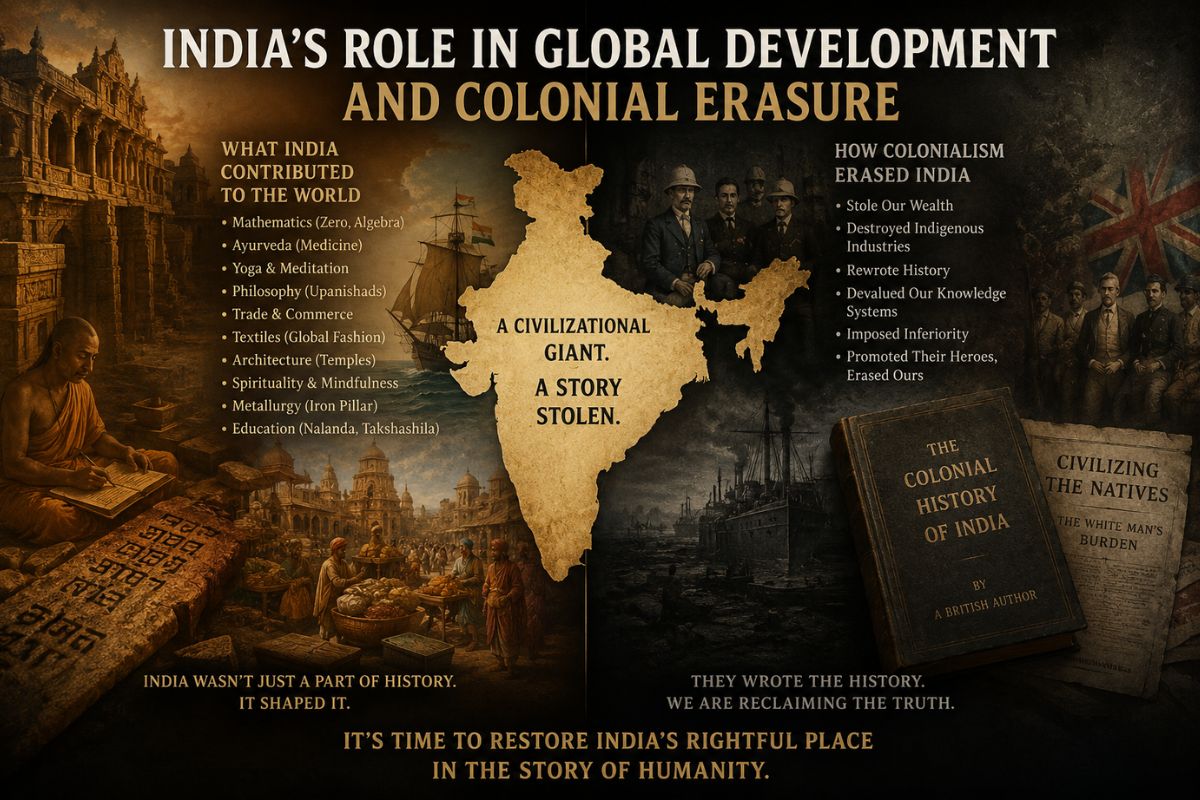
For centuries, the global narrative has credited the European Renaissance as the singular birthplace of modern science, mathematics, and philosophy. However, a rigorous historical audit reveals that this period of Western “awakening” was heavily subsidized by the absorption of Indian knowledge systems. In 2026, the world is finally witnessing the deconstruction of the “White Man’s Burden” narrative—the idea that the West brought enlightenment to a “backward” India. Instead, we are uncovering a history of intellectual extraction that mirrored the economic plunder of the Raj.
1. The Calculus of Erasure: Indian Mathematics and the Western Name
Perhaps the most significant intellectual “ripping” occurred in the field of mathematics. While the world honors names like Newton and Leibniz, many of the foundational principles they “discovered” were detailed centuries earlier in India.
The Kerala School of Astronomy and Mathematics
Between the 14th and 16th centuries, the Kerala School, led by figures like Madhava of Sangamagrama, developed the foundational concepts of calculus.
- The Power Series: The infinite series for sine, cosine, and tangent now often taught as “Gregory’s Series” or “Taylor’s Series” were documented in Kerala nearly 300 years before their European counterparts were born.
- The Logic of Discovery: Jesuit missionaries, who were among the first Europeans to reach the Malabar Coast in the 1500s, acted as the conduits. They translated Indian mathematical texts and sent them back to Europe, where they were integrated into the work of European scholars without attribution.
- 2026 Correction: In 2026, global mathematics curricula are beginning to acknowledge these as the “Madhava-Newton” or “Kerala School” foundations, restoring the intellectual agency of Indian scholars.
2. Medicine and the “Discovery” of Plastic Surgery
Colonial history often suggests that modern medicine was a Western gift to India. However, the reality is that the British medical corps spent the 18th and 19th centuries observing and documenting Indian surgical techniques that were thousands of years ahead of their own.
The Legacy of Sushruta
Sushruta, the “Father of Surgery,” lived in India over 2,500 years ago. His texts, the Sushruta Samhita, detailed over 300 surgical procedures and 120 surgical instruments.
- Rhinoplasty (Nose Reshaping): British surgeons in the late 1700s witnessed an Indian potter performing a skin graft to reconstruct a nose—a procedure that left them “amazed.” This “new” technique was published in the Gentleman’s Magazine of London in 1794, eventually becoming the basis for modern plastic surgery.
- The Inoculation Erasure: Long before Edward Jenner, Indian physicians practiced a form of smallpox inoculation. Colonial authorities, however, dismissed these practices as “superstition” even as they studied them to refine their own vaccines.
3. The “Subject” vs. The “Scientist”: Identity Erasure
The British Raj implemented a “Genealogical Template” that extended into the scientific world. Indians were categorized as “field assistants” or “laborers,” while the British supervisors were credited as the “scientists” and “discoverers.”
The Great Trigonometrical Survey
The measurement of Mount Everest is a prime example. While the peak is named after George Everest, a British Surveyor General, the actual mathematical calculations that proved it was the highest mountain in the world were performed by Radhanath Sikdar, an Indian mathematician.
- The 2026 Shift: Today, there is a global push to recognize the “Sikdar-Everest” peak, a symbolic move to undo the branding that suggests the mountains of Asia were “discovered” by the people of Europe.
4. 2026: The Knowledge Restoration
Today, India’s “Great Return” is not just about GDP; it is about the restoration of its status as the world’s intellectual capital.
- Digital Public Infrastructure (DPI): India’s modern “Digital Stack” is a spiritual successor to its ancient mathematical prowess—creating logic systems that are being adopted by the Global South as an alternative to proprietary Western models.
- Science Without Colonialism: In 2026, India is leading global research in space exploration and renewable energy, not by imitating the West, but by drawing on a civilizational tradition that values sustainable, universal knowledge.
RealShePower History Genie Takeaway
The History Genie reveals that the ‘enlightenment’ of the West was often a shadow of the sun that rose in India. For centuries, our formulas were stolen, our surgeries were copied, and our names were erased from the history of science. Reclaiming our intellectual sovereignty in 2026 means realizing that we aren’t just ‘catching up’ to modern science—we are returning to the house we built.
References
- Economic history of India. (2026, May 5). In Wikipedia.
- The Kerala School of Astronomy. (n.d.). In Encyclopædia Britannica.
- Maddison, A. (2007). India’s Historical GDP Contributions.
- Sushruta Samhita. (n.d.). National Library of Medicine.
- Swarajya. (2025, May 5). The Erasure of Indian Scientific Pioneers.
- The Gale Review. (2025, November 25). Terra Nullius and the Theft of Intellectual Land.