Why the Circular Economy is 2026’s Ultimate Power Move
For more than a century, the world ran on a deceptively simple formula: Take. Make. Waste.
Extract raw materials from the earth, manufacture products at scale, consume them quickly, and dump them when they lose value. This model—known as the Linear Economy—built modern civilization, powered industrial revolutions, and created unimaginable wealth.
But in 2026, the cracks in that system are impossible to ignore.
Landfills are overflowing. Supply chains are volatile. Critical minerals are becoming geopolitical weapons. Climate disasters are rewriting economic forecasts. And consumers are no longer impressed by brands that simply produce more—they are demanding brands that produce smarter.
Enter the Circular Economy: the most powerful economic redesign of the modern age.
This is not just a sustainability trend or a corporate PR exercise. It is a complete reimagining of how value is created, preserved, and regenerated. The circular economy challenges the old assumption that growth must depend on endless extraction. Instead, it proposes something radical:
What if waste never existed in the first place?
In 2026, the companies, cities, and nations that understand this idea are not merely “going green.” They are positioning themselves for long-term survival and dominance in a resource-constrained future.
What Exactly Is the Circular Economy?
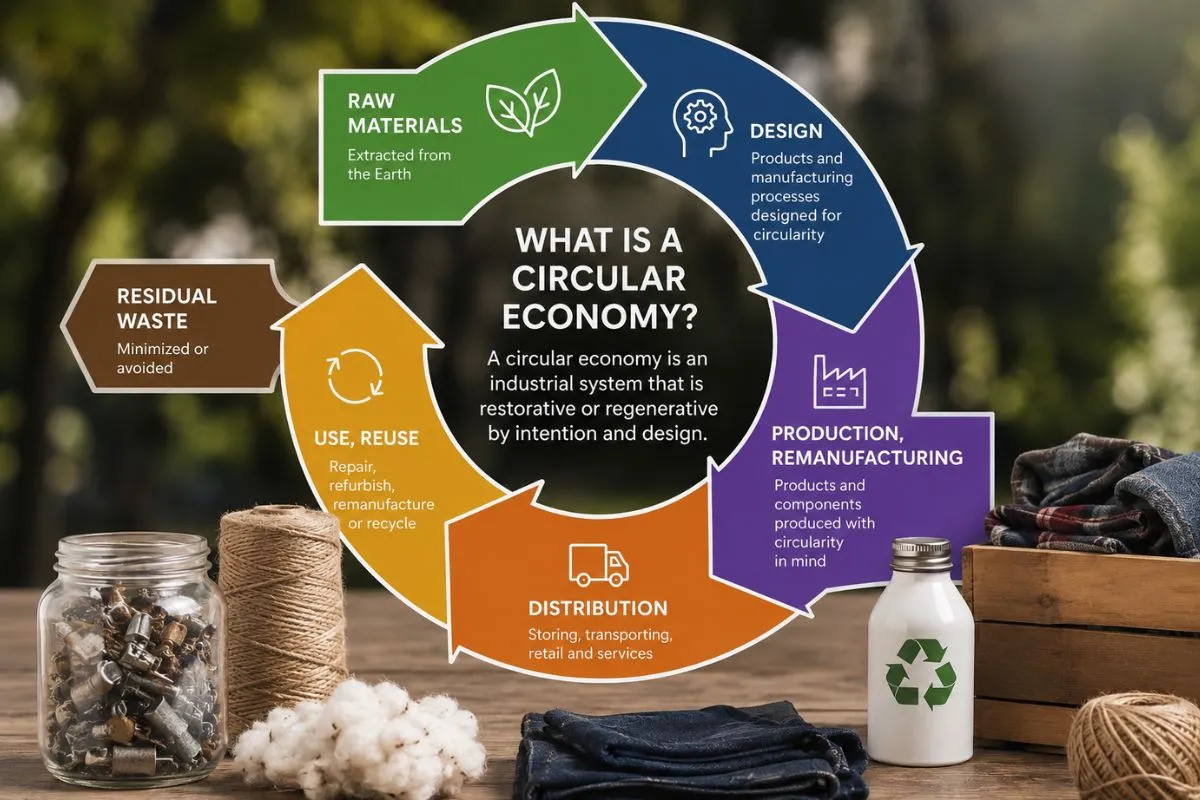
The Circular Economy is an economic system designed to eliminate waste and continuously reuse resources at their highest possible value.
Unlike the linear model, where products have a short lifecycle before disposal, the circular model creates closed loops where materials are repaired, refurbished, remanufactured, or regenerated instead of discarded.
Think of nature itself.
In forests, nothing is wasted. Fallen leaves become nutrients. Dead wood feeds fungi. Every output becomes an input for another system.
The circular economy attempts to replicate this biological intelligence inside human industry.
It shifts the focus from ownership to stewardship, from disposability to durability, and from extraction to regeneration.
And perhaps most importantly it transforms sustainability from a moral argument into a strategic advantage.
A circular economy means using things for as long as possible instead of throwing them away. Products are repaired, reused, recycled, or redesigned so waste becomes useful again.
The Three Pillars of Circular Strategy
The world’s leading circular frameworks in 2026 are built upon three core principles.
1. Design Out Waste and Pollution
In the circular economy, waste is not considered inevitable. It is considered a design failure.
This changes everything.
Products are now engineered to be:
- Easily repairable
- Modular and upgradeable
- Biodegradable or recyclable
- Durable enough to last decades
- Simple to disassemble for material recovery
This philosophy is already reshaping industries from electronics to construction.
Modern smartphones, for example, are increasingly being designed with replaceable batteries and standardized screws instead of permanent glue seals. Furniture companies are using modular systems that allow customers to replace damaged parts rather than discard entire products.
The message is clear:
If a product cannot survive beyond its first lifecycle, it is already obsolete.
2. Circulate Products and Materials
The second principle focuses on keeping materials in circulation at their highest utility and value.
This means avoiding “downcycling,” where valuable materials lose quality over time.
For instance:
- Repairing a washing machine is more valuable than shredding it for scrap.
- Refurbishing a laptop is smarter than melting it down.
- Reusing industrial steel preserves more value than recycling it into lower-grade products.
This has created entirely new business ecosystems around:
- Refurbishment
- Reverse logistics
- Product leasing
- Material recovery
- Remanufacturing
In 2026, “used” no longer means inferior.
In many industries, refurbished goods are now viewed as intelligent consumption.
3. Regenerate Natural Systems
The circular economy is not merely about reducing damage, it is about actively restoring ecosystems.
This principle includes:
- Regenerative agriculture
- Compostable biomaterials
- Renewable energy systems
- Water restoration projects
- Carbon-sequestering supply chains
The ultimate goal is not sustainability alone, but regeneration.
Forward-thinking companies now measure success not only through quarterly profits but also through:
- Soil health
- Biodiversity impact
- Water positivity
- Material recovery rates
- Energy circularity
The future economy is increasingly becoming one where environmental restoration itself generates financial value.
The Great Shift: From Ownership to Access
One of the most revolutionary aspects of the circular economy is the transformation of ownership itself.
In 2026, many companies have realized something profound:
Selling a product once is less profitable than maintaining a long-term relationship with the customer.
This has accelerated the rise of Product-as-a-Service (PaaS) models.
The Lighting Revolution
Instead of selling lightbulbs, companies now sell illumination.
Businesses purchase “lux levels” rather than physical hardware. The manufacturer retains ownership of the lighting system and becomes responsible for:
- Maintenance
- Upgrades
- Repairs
- End-of-life recovery
This completely changes incentives.
If the company owns the product, it benefits from making it:
- Longer lasting
- More energy efficient
- Easier to repair
- Cheaper to maintain
Waste suddenly becomes expensive.
Fashion’s Circular Reinvention
Fashion—one of the world’s most wasteful industries—is undergoing a dramatic transformation.
Following major 2026 regulations banning the destruction of unsold inventory in several regions, brands have pivoted toward:
- Take-back programs
- Clothing rental platforms
- Fiber-to-fiber recycling
- Repair workshops
- Resale marketplaces
Luxury brands now actively encourage customers to return old garments so materials can re-enter production cycles.
The old prestige model centered on exclusivity and excess.
The new prestige model centers on longevity, craftsmanship, and traceability.
In 2026, true luxury is no longer disposable.
Why the Circular Economy Is Becoming a Geopolitical Power Strategy
This movement is not just environmental it is deeply geopolitical.
Countries are realizing that dependence on virgin raw materials creates dangerous vulnerabilities.
Critical resources such as:
- Lithium
- Cobalt
- Rare earth metals
- Copper
- Nickel
have become strategic assets tied to national security and technological supremacy.
Circular systems reduce dependency on unstable global extraction networks by recovering materials already in circulation.
Urban mining—the recovery of metals from discarded electronics—is now viewed as a strategic industry.
In many cases, cities contain more accessible rare metals than natural mines.
The future resource war may not be fought underground.
It may be fought in recycling facilities and material recovery labs.
The Rise of Digital Product Passports (DPPs)
One of the biggest circular economy breakthroughs of 2026 is the emergence of Digital Product Passports (DPPs).
Every product increasingly carries a digital identity that records:
- Material composition
- Carbon footprint
- Repair history
- Supply chain origin
- Recycling instructions
- Ownership lifecycle
This creates unprecedented transparency.
Consumers can now scan products and instantly learn:
- Where materials came from
- Whether labor practices were ethical
- How repairable the product is
- How recyclable it truly is
For businesses, DPPs are becoming essential infrastructure.
And for governments, they are rapidly evolving into regulatory requirements.
The age of anonymous products is ending.
India’s Hidden Circular Genius
Ironically, many of the world’s most celebrated circular economy principles are not new at all.
India has practiced forms of circular living for centuries.
Traditional Indian households perfected resource efficiency long before sustainability became a global buzzword.
Examples include:
- Reusing glass jars and containers
- Repair-first culture
- Community sharing systems
- Cloth recycling into household textiles
- Organic composting
- Banana leaves as biodegradable serving plates
- The legendary Kabadiwala ecosystem
The Kabadiwala network was essentially one of the world’s earliest grassroots reverse logistics systems—recovering value from waste long before Silicon Valley discovered the concept.
The future may actually belong to societies that remember what industrial modernity forgot.
Final Thoughts: The Infinite Loop of Power
The Circular Economy is not a passing environmental movement. It is the next operating system of civilization.
The linear economy was built for a world that believed resources were infinite.
The circular economy is designed for a world that finally understands they are not.
And perhaps that is the greatest irony of all:
The future will not be built by endless consumption.
It will be built by intelligent continuity.
In 2026, the ultimate luxury is no longer excess.
It is permanence.
GET THE BEST TRIED AND TESTED REVIEWS ONLY ON RealShePower.
Realshepower world’s best women empowerment portal