
NVIDIA Tug of War as AI Spending Drives Stock to Record Frontiers
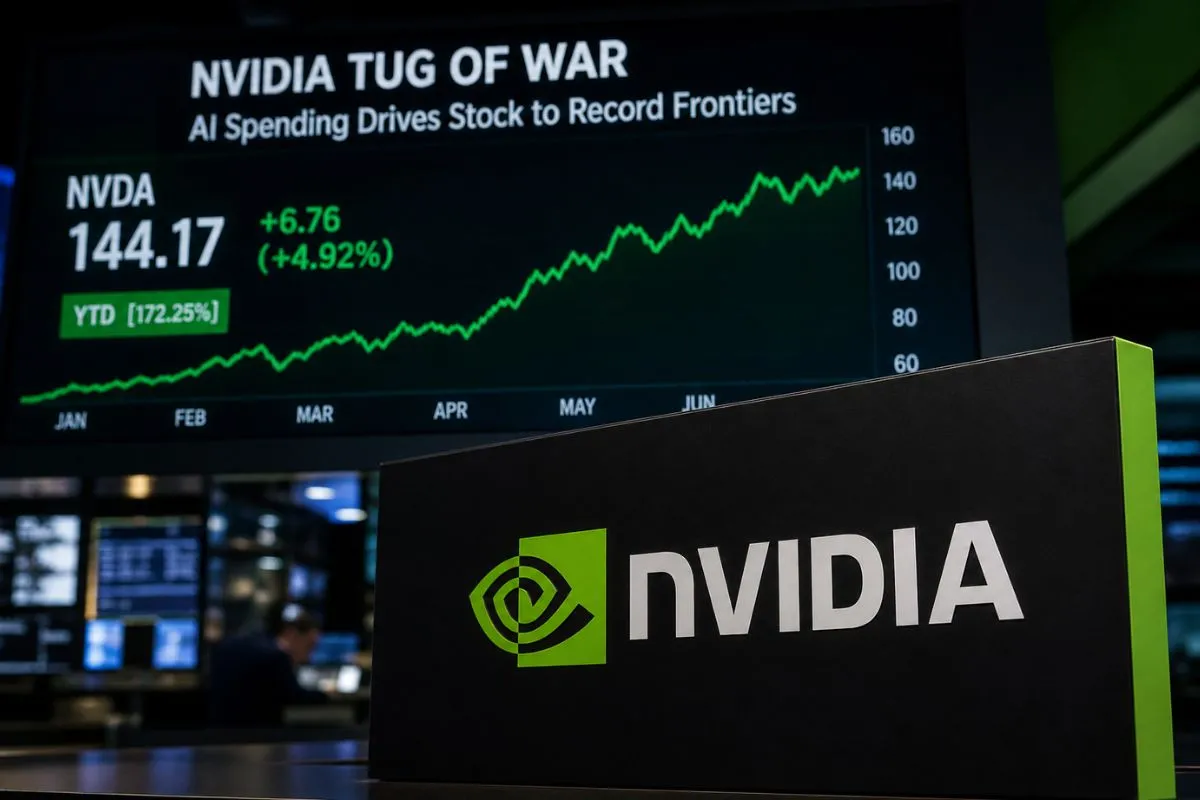
| Quick Summary: NVIDIA remains the pulse of the market, with its stock fluctuating near record highs of $198.45. Driven by Big Tech’s projected $725 billion AI capital expenditure for 2026, the company is navigating a transition from pure GPU dominance to diversified sovereign AI and defense deals, even as traders weigh geopolitical risks in China. |
The financial world is currently fixated on NVIDIA, the undisputed king of the AI revolution. As of early May 2026, traders and institutional investors are locked in a high-stakes vigil as the company’s stock price hovers near all-time record highs. This volatility at the peak isn’t just market noise; it represents a fundamental debate over the sustainability of the current “AI gold rush.”
Breaking Now: You’re in the right place. RealShePower is your news genie granting your wish for the latest trending stories before they even hit the mainstream.
The Infrastructure Engine
The primary catalyst behind NVIDIA’s relentless ascent remains the insatiable appetite for AI infrastructure. Tech giants and sovereign nations alike are pouring billions into data centers, seeking the Blackwell and subsequent-generation architecture to power everything from LLMs to autonomous robotics.
Analysts point to several key drivers:
- Hyperscaler Commitments: Companies like Microsoft, Meta, and Google continue to signal that under-investing in AI hardware is a greater risk than over-investing.
- Sovereign AI: A new trend where nations are building their own domestic AI computing power to ensure data sovereignty and economic competitiveness.
- Software Monetization: As AI software begins to generate tangible ROI for enterprises, the demand for the underlying chips—NVIDIA’s bread and butter—remains inelastic.
Trader Sentiment: The “Peak” Anxiety
While the long-term narrative remains bullish, short-term traders are navigating a “minefield of success.” Trading near record highs often triggers profit-taking, leading to the fluctuations currently observed. There is a palpable tension between those who believe NVIDIA is still undervalued relative to the future of the “Agentic AI” economy and those who fear a cyclical correction in semiconductor spending.
Technical analysts are watching key support levels closely. Any dip is currently being met with aggressive “buy the dip” behavior, suggesting that the market’s conviction in the AI super-cycle has not yet wavered.
Market Implications
NVIDIA’s performance is no longer just a “tech story”; it is the primary engine of the broader indices. Its fluctuations dictate the movement of the S&P 500 and the NASDAQ, making its stability a matter of concern for even the most conservative diversified investors. As the company approaches its next quarterly earnings report, the focus will shift from “how much they sold” to “how much more they can possibly produce.”