The Rise of India’s ‘Builders’: How Women Borrowers Are Rewriting the Credit Playbook
The Rise of Women Borrowers
In the corridors of India’s top financial institutions, a quiet but powerful shift has reached a crescendo. For decades, the “ideal borrower” in the eyes of risk assessment algorithms was predominantly male. But as of March 2026, the data tells a different story.
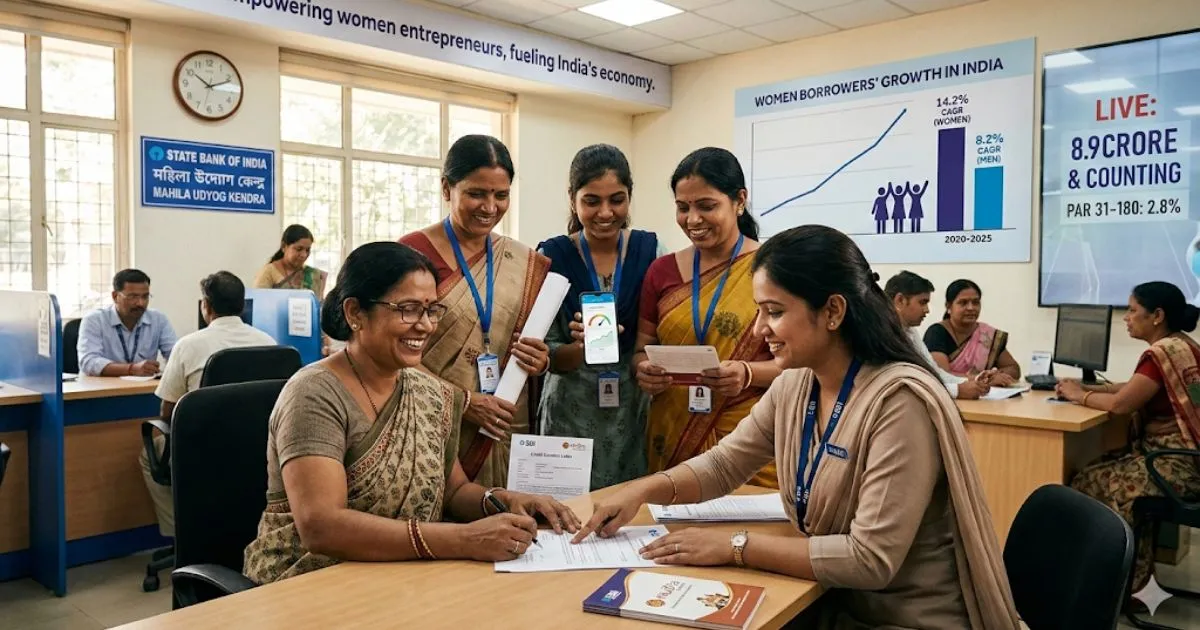
According to the latest “The Credit Goes to Her” report by CRIF High Mark, the number of women borrowers in India has surged to 8.9 crore, growing at a 14.2% Compound Annual Growth Rate (CAGR) over the last five years. This pace significantly outstrips the 8.2% CAGR recorded for men, signaling that women are no longer just passive participants in the economy they are its primary growth engine.
The New Math of Indian Credit
Lenders are pivoting toward women not out of social altruism, but because of a hard-nosed realization: Women are better at paying back.
| Metric | Women Borrowers | Male Borrowers |
| Portfolio Growth (YoY) | 23.4% | 16.7% |
| Active Loan Growth (YoY) | 14.8% | 7.2% |
| Delinquency Rate (PAR 31–180) | 2.8% | 3.3% |
| Home Loan Avg. Ticket Size | ₹33.9 Lakh | ₹30.7 Lakh |
This “repayment edge” is reshaping risk models. With lower delinquency across almost every product category from gold loans to housing, banks are rolling out “gender-smart” financial products tailored to this high-performing demographic.
From Consumption to Capital: The Strategic Shift
While personal loans remain a major entry point, the most gripping trend of 2026 is the migration toward asset-building and enterprise.
1. The Real Estate Revolution
In a stunning reversal of traditional property ownership patterns, women now account for 33.2% of home loan originations by value. More impressively, their average ticket size of ₹33.9 lakh is nearly 10% higher than that of men. This suggests that women aren’t just buying “starter homes” they are investing in premium real estate as independent professionals and co-owners.
2. The Gold Standard
Gold loans remain the bedrock of female credit participation, with women holding a dominant 43.5% share of the total portfolio. For many, this is the “bridge” that brings them into the formal banking system for the first time.
3. Scaling the Business Dream
Perhaps the most transformative shift is in Business Loans. Women now represent over 50% of business loan volumes. While the average ticket size for women-led enterprises (₹5.3 lakh) still trails behind men (₹11.6 lakh), the 61.1% YoY growth in secured business loans suggests that female entrepreneurs are moving away from micro-credit and toward scaling medium-sized enterprises.
➤ Don’t miss reading: 10 Women Leaders Define What Power Means To Them
The Rural-Digital Convergence
This financial awakening isn’t restricted to the skyscrapers of Mumbai or Bengaluru. A remarkable 60% of women borrowers now hail from semi-urban and rural areas.
Fuelled by the “From Borrowers to Builders” initiatives and digital literacy programs, women in non-metro regions are self-monitoring their credit scores at a growth rate of 48% surpassing their urban counterparts (30%). In states like Maharashtra, Tamil Nadu, and Uttar Pradesh, the “New-to-Credit” (NTC) share for women has hit 41%, proving that the formal financial net is finally widening to include those previously underserved.
“When women are given the right tools, they don’t just borrow; they build, innovate, and drive lasting economic change.”
— NITI Aayog, 2025 Report
Looking Ahead: The Multiplier Effect
The economic implications of this 14.2% CAGR are staggering. Experts project that promoting women’s entrepreneurship through these credit channels could create between 150 to 170 million jobs in India by the end of the decade.
As we move through 2026, the challenge for the industry shifts from inclusion to scale. The “Rs 4 Problem” where women founders still receive a fraction of startup venture capital remains a hurdle. However, in the retail and MSME lending sectors, the verdict is clear: the future of Indian finance is increasingly female.