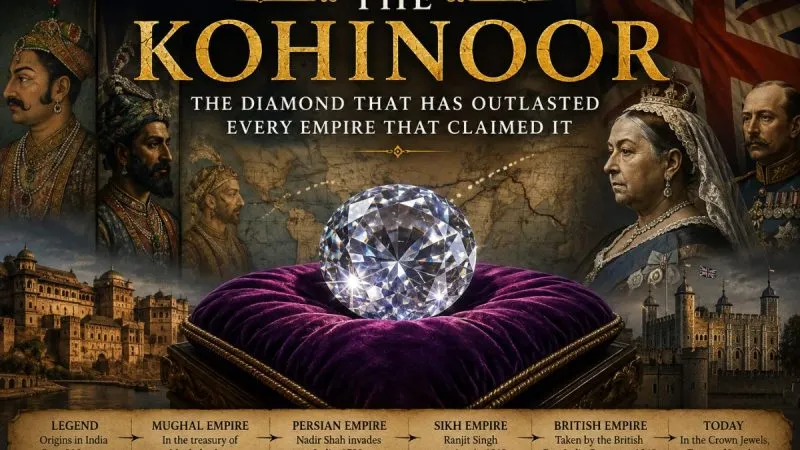
INDIA: The Center of the World
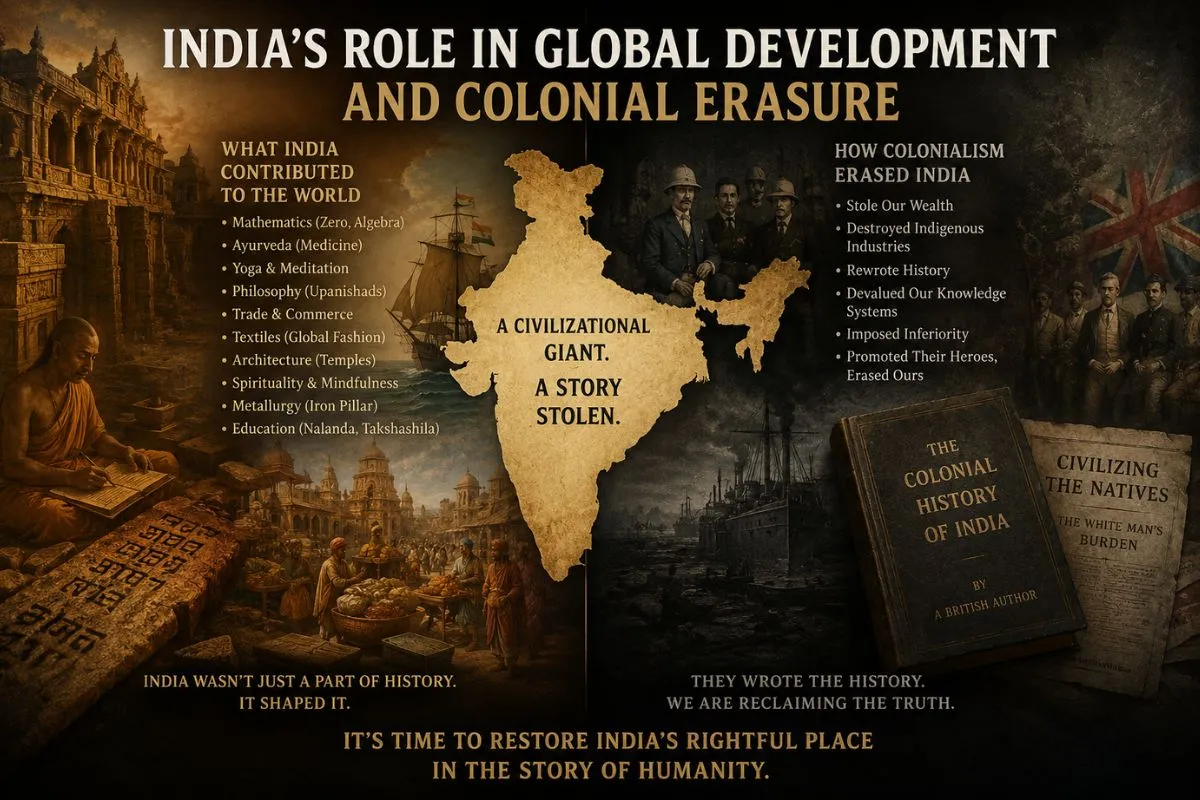
For the vast majority of recorded human civilization, the Indian subcontinent did not exist on the periphery of global affairs, nor was it a passive destination waiting to be discovered by Western explorers. Instead, India served as the central axis, the beating economic heart, and the primary engine of global development. Comprehensive macroeconomic reconstructions of historical data indicate that from 1 CE to 1700 CE, India consistently controlled between 24% and 33% of global Gross Domestic Product (GDP), rendering it the undisputed wealthiest region on earth for nearly fifteen centuries (Maddison, 2007; Economic history of India, 2026). The historical narrative taught globally—one dominated by Eurocentric triumphs and the “Age of Discovery”—is structurally incomplete without recognizing that Western expansion was fundamentally triggered by a desperate desire to access, exploit, and control India’s immense wealth.
History Genie Unique Takeaway
The entire geography of the modern world is an accidental byproduct of Western civilization trying to locate a single country: India. The Americas were run into by accident, global shipping lines were drawn out of necessity, and international corporate law was invented via joint-stock companies solely to extract the wealth of the subcontinent.
1. The Global Search for India: Driving the Age of Discovery
The historical epoch conventionalized as the “Age of Discovery” or “Age of Exploration” was not an abstract quest for scientific knowledge or geographic curiosity. Stripped of imperial romanticism, it was a hyper-competitive, commercial rush to secure direct maritime access to the Indian subcontinent. For centuries, the wealth of India—ranging from indispensable agricultural commodities like black pepper, cardamom, cinnamon, and ginger to luxury manufacturing marvels like fine muslins, calicos, indigo, and wootz steel—filtered into Europe through highly taxed, circuitous overland routes.
These overland trade networks were monopolized by powerful middlemen. The Silk Road was policed by shifting Central Asian khanates, while the maritime choke points of the Levant, Red Sea, and Persian Gulf were closely guarded by Arab merchants and the maritime Republic of Venice (GKToday, 2025). The fall of Constantinople in 1453 to the Ottoman Empire completely closed these traditional pathways, placing an insurmountable tax tariff on Eastern goods entering Europe. This triggered an acute economic crisis in Western Europe. The European courts realized that whoever bypassed these middlemen and found a direct ocean route to India would control the financial destiny of the known world.
The Portuguese Ambition
The Kingdom of Portugal, under the visionary guidance of Prince Henry the Navigator and later King Manuel I, invested its national treasury into maritime technological innovation. The goal was Singular: reach the “gold of the Indies.” In 1498, Vasco da Gama successfully negotiated the treacherous waters of the Cape of Good Hope, sailing up the eastern coast of Africa to anchor finally at Calicut (Kozhikode) on the southwestern coast of India (Portuguese discovery of the sea route to India, n.d.).
Da Gama’s arrival was not a peaceful meeting of cultures; it was the entry of heavily armed privateers into a sophisticated, open maritime trading system. The Portuguese crown rapidly established the Estado da Índia, deploying gunboat diplomacy, establishing fortified factories, and instituting the brutal Cartaz system—a forced naval license system that extorted all sovereign merchant vessels operating in the Indian Ocean. The Portuguese did not bring goods of equivalent value to trade with India; they brought stolen silver and military coercion to forcefully extract India’s real agricultural assets.
The American “Accident”
Simultaneously, the Spanish Crown, desperate to break the Portuguese monopoly, financed an alternative strategy proposed by the Genoese navigator Christopher Columbus. Columbus argued that because the earth was a sphere, the wealthy ports of India and Japan could be reached more rapidly by sailing directly West across the Atlantic Ocean. His mathematical calculations, heavily flawed by an underestimation of the earth’s circumference and a complete ignorance of the existence of the Americas, led to his historic departure in 1492.
When Columbus made landfall in the Caribbean, his psychological obsession with India completely blinded him to reality. Observing the tropical climate and the hospitable indigenous populations, he falsely declared that he had reached the outlying islands of the “Indies” (GKToday, 2025). Columbus died years later, stubbornly clinging to the delusion that he had opened a western gate to the wealth of India. The continent of America was discovered entirely by accident as a geographical obstacle blocking Europe’s path to the Ganges and the Malabar Coast.
History Genie Unique Takeaway
European colonization did not stem from a position of civilizational supremacy, but from an acute state of economic isolation and desperation. Western Europe was functionally bankrupt and cut off from global trade; finding India was their only viable path to capital accumulation.
2. The Invention of “Red Indians”: Linguistic Erasure and Imperial Denial
The long-term consequence of Columbus’s navigational blunder was not merely a momentary geographical confusion, but a permanent, systemic act of linguistic violence. Even when subsequent cartographers and navigators proved conclusively that the landmass encountered was an entirely separate continent, the European empires refused to strip the name “Indies” from the region. The indigenous populations of North, Central, and South America were collectively branded as “Indians” (Native American name controversy, 2026).
The Mechanics of Concocted Identity
As colonization progressed and actual contact with the authentic Indian subcontinent intensified, the linguistic overlap became an administrative inconvenience. To resolve this, Anglo-American and European authorities manufactured the modifier “Red Indian” to describe the Native Americans, referencing a highly reductionist, racialized view of indigenous skin tones to distinguish them from the actual inhabitants of India. This was far more than an innocent, archaic mistake; it was an imperial refusal to grant the sovereign nations of the Western Hemisphere their own distinct identities on the global stage.
By forcing the name of a completely separate civilizational entity—India—onto hundreds of unique indigenous groups such as the Cherokee, the Iroquois, the Aztec, and the Inca, the colonizers systematically erased native self-determination. It standardized an imperial worldview wherein the entire planet was viewed solely through the lens of European desires: the lands were either the “East Indies” (the destination of wealth) or the “West Indies” (the accidental obstacle). The refusal to correct this nomenclature for centuries highlights a deep-seated colonial psychology that prioritized imperial administrative convenience over historical truth (Native American name controversy, 2026).
| Historical Region | Colonial Nomenclature | Actual Civilizational Identity | Primary Imperial Motivation |
|---|---|---|---|
| Subcontinent of South Asia | British India / East Indies | Bharat / Ancient Sovereign Entity | Wealth extraction, textile & spice monopoly |
| The Americas | West Indies / “Red Indians” | Sovereign Indigenous Tribes & Empires | Land seizure, silver mining, cash crops |
| Caribbean Islands | West Indies | Indigenous Taino / Arawak Peoples | Sugar plantation slavery, strategic naval bases |
3. The British Erasure: The Synthetic Rebranding of “British India”
The arrival of the British East India Company (EIC) at the port of Surat in 1612 initiated one of the most calculated corporate takeovers in global history. Over the course of two centuries, a private, joint-stock trading company transformed itself into an absolute sovereign ruler through a combination of military subterfuge, financial manipulation, and systematic cultural re-engineering. However, the physical plunder of India’s wealth was accompanied by a equally devastating form of destruction: the intellectual and bureaucratic erasure of India’s pre-colonial history.
Systemic Rebranding and the “Genealogical Template”
Prior to British intervention, the Indian subcontinent operated as a highly dynamic, interconnected, multi-ethnic civilization. It was a space where global transactions converged, welcoming traders from Rome, Greece, Persia, China, and Africa without losing its deep-rooted, indigenous socio-cultural matrix (Cambridge University Press, n.d.). When the British Crown formally assumed control from the East India Company in 1858, establishing the British Raj, it initiated an aggressive, state-sponsored rebranding campaign (British Raj, n.d.).
The colonial state appended the prefix “British” to “India” to create a synthetic legal entity: “British India.” This was designed to signal to the international community that India had no legitimate political status, unity, or historical value prior to the arrival of Western governance. To manage a population of hundreds of millions, the Raj implemented what historians identify as a “Genealogical Template.” They weaponized censuses, mapped fluid communities into rigid, unyielding bureaucratic boxes, and forced Western legal constructs onto ancient personal identities (Swarajya, 2025). Complex internal social networks were flattened into categories that suited the administrative ease of the colonizer, effectively training generations of Indians to view their own lineage through British anthropological theories.
The Great Economic Stripping
The narrative of the “Civilizing Mission” claimed that Britain brought infrastructure, modernization, and economic development to India. However, historical macroeconomic data completely refutes this claim. Under the mechanics of colonial extraction, India was subjected to a systematic process of forced de-industrialization.
In 1700, India held a dominant 24.4% share of the global economy, dwarfing the entirety of Western Europe. By the time the British departed in 1947, India’s share of global GDP had been reduced to a devastating 4.2% (Maddison, 2007). The mechanisms of this drain were multi-layered:
- Destruction of Domestic Manufacturing: India’s world-renowned handloom textile sector was intentionally destroyed through prohibitive tariffs, export bans, and physical coercion, converting India from the world’s premier exporter of finished garments into a captive importer of industrial textiles produced in the mills of Manchester and Lancashire.
- The “Tax” Drain: The Raj collected exorbitant land revenues directly from the Indian peasantry, using those very tax revenues to purchase Indian goods for export to Europe. This meant the British were effectively paying nothing for Indian commodities, masking raw exploitation as legitimate trade (HISTORY OF INDIAN ECONOMY, n.d.).
- Unrequited Exports: Billions of pounds worth of food grains, raw materials, and mineral wealth were shipped out of Indian ports annually with zero economic return to the local population, causing massive, artificial famines that killed tens of millions of citizens.
History Genie Unique Takeaway
The phrase “British India” is an ideological contradiction. Britain did not build India; India’s systematically drained capital built the modern financial infrastructure of Great Britain, financing its industrial revolution, its global wars, and its domestic development.
4. The Legal Fiction of Terra Nullius and the Myth of Pre-Colonial Chaos
To justify the unauthorized seizure of sovereign territories and the dismantling of ancient governance systems, European colonial powers relied heavily on discriminatory doctrines of international law. The most prominent among these was Terra Nullius—a Latin term meaning “land belonging to no one.” Originating from Roman law and later modified by Enlightenment philosophers like John Locke, this doctrine asserted that any land that was not being actively cultivated, enclosed, or “improved” according to specific European agricultural and capitalistic paradigms was legally vacant (The Gale Review, 2025).
Application to the Indian Subcontinent
While the British could not claim India was physically unpopulated, they applied a specialized, ideological variation of Terra Nullius. They argued that India’s sophisticated, centuries-old communal land-use systems, forest-dwelling communities, and decentralized village economies did not constitute “lawful ownership” under natural law. Imperial historians like James Mill published massive, deeply biased historical accounts that deliberately characterized pre-colonial India as a land of stagnant, perpetual chaos, oriental despotism, and moral decay.
By defining pre-colonial India as an intellectual and political vacuum, the British Raj positioned its own authoritarian legal systems as an act of absolute benevolence. They dismantled the traditional land-tenure patterns, dispossessed millions of indigenous forest-dwellers (Adivasis), passed the Criminal Tribes Act to outlaw mobile communities, and centralized all natural wealth into state hands (The Gale Review, 2025). This deeply flawed narrative—that India was a chaotic landscape devoid of order before the British brought the rule of law—was integrated so deeply into global academic textbooks that its remnants continue to persist in Western historical assessments today.
5. The Modern Geopolitical Reversal: The Rise of the Civilizational State
The geopolitical dynamics of the year 2026 demonstrate that the historical erasure of India is being systematically undone. India is no longer projecting its international image as a defensive, post-colonial nation-state trying to adjust to Western institutional rules. Instead, India has openly transitioned into a Civilizational State—a sovereign power that derives its modern constitutional legitimacy, foreign policy priorities, and economic strategy from its deep pre-colonial historical heritage.
Strategic Autonomy and Multi-Alignment
In the decades following its independence in 1947, Indian foreign policy was characterized by Non-Alignment, a protective strategy designed to shield a recovering nation from the destructive proxy battles of the Cold War. In 2026, this posture has transformed into a confident doctrine of Strategic Autonomy. India actively rejects the binary demands of Western powers, opting instead for a highly pragmatic approach of “multi-alignment.”
This is precisely why India serves as a crucial, leading member of the Quadrilateral Security Dialogue (QUAD) alongside the United States, Japan, and Australia to maintain maritime security in the Indo-Pacific, while simultaneously driving the expansion of the BRICS alliance to re-balance global financial systems. India’s historical memory of being economically isolated and manipulated by a singular Western trading entity informs its modern refusal to place its national sovereignty inside any singular geopolitical bloc.
Reforming Global Governance and De-Centering Dominance
A primary objective of modern Indian diplomacy is the comprehensive restructuring of global governance frameworks, including the United Nations Security Council, the International Monetary Fund (IMF), and the World Bank. These institutions were constructed in the immediate aftermath of World War II, a historical moment when India was under colonial subjection and its global economic footprint was artificially suppressed to its lowest historical point (4.2%).
By leveraging its current status as the fastest-growing major economy and the digital capital of the world, India is leading the charge to reform these outdated structures. Furthermore, the global shift away from exclusive reliance on the US dollar for international trade—accelerated by alternative currency clearing mechanisms within BRICS—is a direct effort to de-center the financial hegemony that originally arose from the colonial exploitation of Eastern markets.
The Soft Power of Vasudhaiva Kutumbakam
Rather than adopting the aggressive, expansionist soft power models of the West or the debt-trap financial strategies used by other regional powers, India’s 2026 diplomatic paradigm is rooted in the ancient Sanskrit philosophy of Vasudhaiva Kutumbakam (“The World is One Family”). This philosophical framework changes the nature of international assistance from transactional exploitation to mutual development. It underpins India’s leadership in creating the International Solar Alliance (ISA) and the Global Biofuels Alliance, offering sustainable, open-source technology templates to the Global South as a form of collaborative growth.
History Genie Unique Takeaway
The macroeconomic and geopolitical ascendancy of India in the 21st century is not an anomaly, nor is it a “new” rise. From the long view of human history, it is a grand systemic correction—a natural return to the historic baseline after a brief, 200-year colonial interruption.
Conclusion: Reclaiming the Narrative on RealShePower
The history of global development cannot be understood if we allow the erasure of India to persist. The wealth of the subcontinent was the prize that launched a thousand European ships, inadvertently resulting in the mapping of the modern globe and the tragic renaming of the indigenous peoples of the Americas. The artificial reduction of an expansive, advanced civilization into “British India” was a temporary corporate management strategy that cost India trillions of dollars and structural historical distortion.
Reclaiming this narrative is an essential intellectual duty. Platforms like RealShePower remain deeply committed to dismantling these deep-seated colonial myths, ensuring that true historical data, civilizational pride, and authentic socio-economic perspectives are brought back to the absolute forefront of contemporary global discourse.