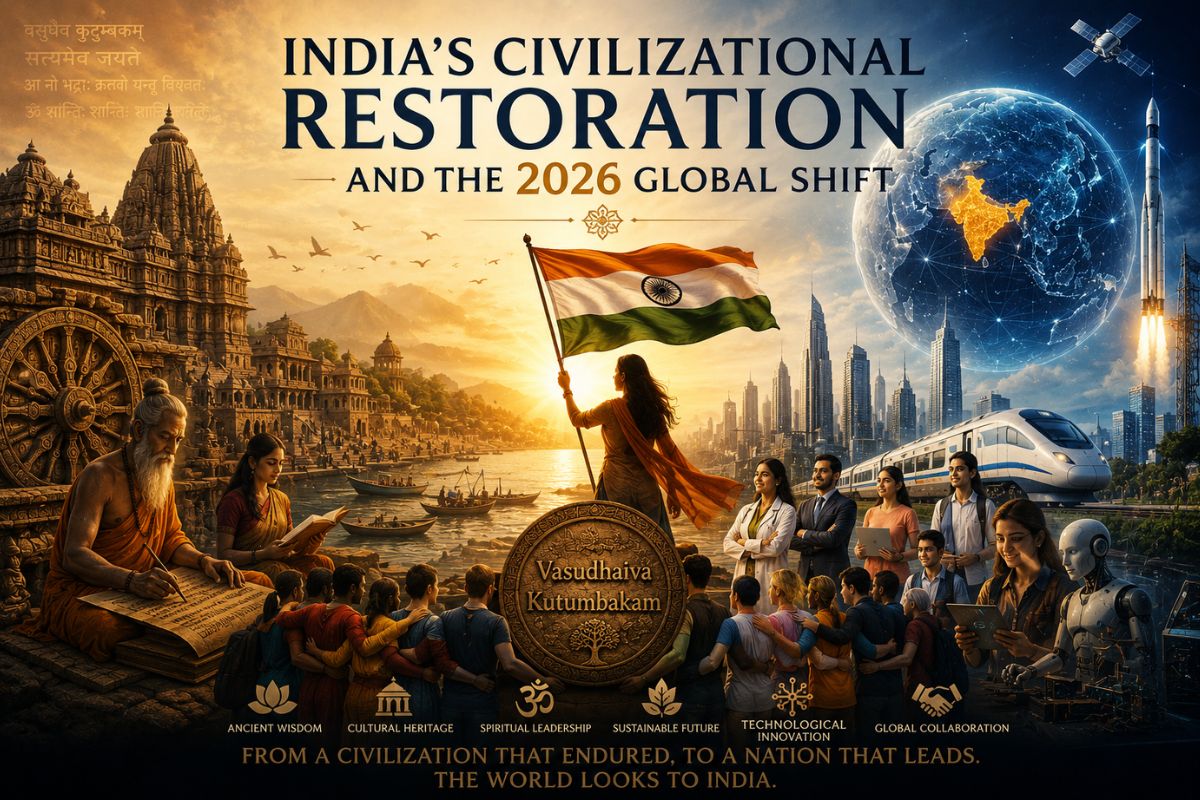
India’s Civilizational Restoration and the 2026 Global Shift
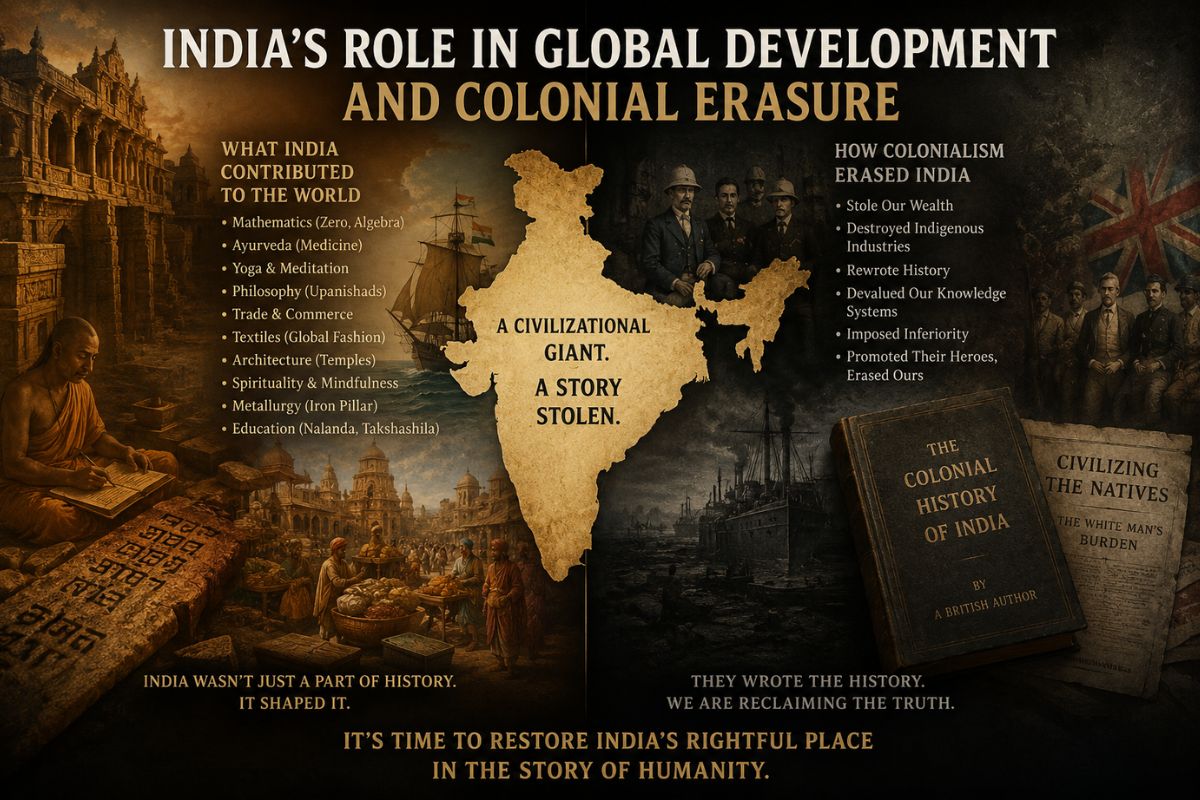
For nearly two centuries, the prevailing global narrative suggested that progress was a linear journey from West to East. However, a deeper look at the long arc of human history reveals that the current era is not a “rise” of a new power, but the restoration of a historical constant. From 1 CE to 1700 CE, India was the unrivaled central axis of the global economy, consistently controlling between 24% and 33% of the world’s GDP.
In 2026, the world is witnessing the reversal of colonial-era “ripping” a systematic process where India is reclaiming its status as the world’s gravitational center. This article explores the mechanics of this restoration across economy, diplomacy, and identity.
1. De-Colonizing the Global Ledger: The End of Economic Extraction
The colonial era succeeded not just through military force, but by turning India into a “captive market”. Under British rule, India was forced to export raw materials while importing finished goods from the West, a process that saw its global GDP share plummet from 24.4% in 1700 to a mere 4.2% by 1950.
The Reversal: Digital Public Infrastructure (DPI)
In 2026, India is reversing this extraction by building its own sovereign technological foundations.
- The New “Gold”: While the 15th-century “Age of Discovery” was driven by the quest for physical Indian spices and silk, the modern era is defined by India’s digital “stack”.
- Financial Sovereignty: By creating independent, scalable payment and data systems, India is breaking the monopoly of Western-centric financial models. These models were largely designed during the mid-20th century when India’s economic influence was at its historical nadir.
- Infrastructure as Empowerment: Unlike the colonial railways designed to extract wealth, modern Indian infrastructure—from AI data centers to renewable energy grids—is designed for domestic empowerment and South-South cooperation.
2. From “British India” to Civilizational Leadership
The term “British India” was a deliberate bureaucratic tool used by the colonial administration to delegitimize ancient Indian identity and suggest that the nation’s history began with European “discovery”.
The Shift to “Rule-Shaping”
In 2026, the resurgence is fueled by a return to Civilizational Diplomacy.
- Reclaiming the Narrative: India has transitioned from being a “rule-taker” under post-colonial international laws to a “rule-shaper”.
- The Voice of the Global South: Leveraging its history of overcoming colonial erasure and the doctrine of Terra Nullius (the legal fiction that land not “improved” by European standards was vacant), India now advocates for a world order that reflects civilizational diversity rather than a singular Western template.
- Heritage Diplomacy: By rooting its modern interactions in ancient philosophies like Vasudhaiva Kutumbakam (The World is One Family), India provides a collaborative alternative to the zero-sum geopolitical games of the past.
3. The Reverse Brain Drain: Reclaiming Human Capital
The British Raj implemented a “Genealogical Template” to categorize and manage Indians as subjects, often stripping them of their professional and cultural agency. For decades after independence, the “Brain Drain” saw India’s best minds fueling Western economies.
The 2026 “Brain Gain”
Today, this trend has officially reversed.
- The World’s Workshop Returns: India is reclaiming its historical role as a premier innovation hub. High-value manufacturing and AI-driven sectors are replacing the low-value raw material exports that were forced upon the nation in the 19th century.
- Restoration of Wealth: Modern economists observe that India’s share of global GDP is steadily climbing back toward the 24% mark it held in $1700$. This is not “growth” in the traditional sense; it is the undoing of a 200-year economic anomaly.
- Educational Sovereignty: India is rebuilding its intellectual centers to focus on indigenous innovation, moving away from the colonial education systems designed to produce “clerks” for the empire.
4. Correcting the “Age of Discovery” Narrative
For centuries, the search for India was buried under stories of “heroic” European explorers. We are finally acknowledging that the settlement of the Americas and the rise of European maritime power were side effects of a global obsession with Indian wealth.
- Linguistic Clarity: The world is moving past the confusion of “Red Indians” and “West Indies”—concocted labels used by colonizers who refused to admit they had failed to reach the real India.
- A New Global Curriculum: In 2026, global history is being rewritten to place India back at the start of the modern story, recognizing that the “New World” was built on the desire to own India’s riches.
RealShePower History Genie Takeaway
The History Genie observes that what we call ‘progress’ today is actually a return to the natural order. For 1,500 years, India was the anchor of the world. The colonial period was a temporary deviation—a 200-year interruption in a 5,000-year story. In 2026, as India reclaims its economic and cultural sovereignty, it is simply stepping back into a role it never truly lost in spirit: The Central Axis of Human Civilization.
References
- Economic history of India. (2026, May 5). In Wikipedia.
- British Raj. (n.d.). In Wikipedia.
- Maddison, A. (2007). India’s Historical GDP Contributions.
- Swarajya. (2025, May 5). British-Imposed Indian ‘Surnames’: The Colonial Construct In Personal Identity.
- The Gale Review. (2025, November 25). Terra Nullius: The Legacy of “The Land of No One”.
- Native American name controversy. (2026, April 6). In Wikipedia.
- GKToday. (2025, October 27). Search for New Trade Routes by Europeans.