Dismantling the Colonial ‘Genealogical Template’ and the Restoration of Indian Civilization
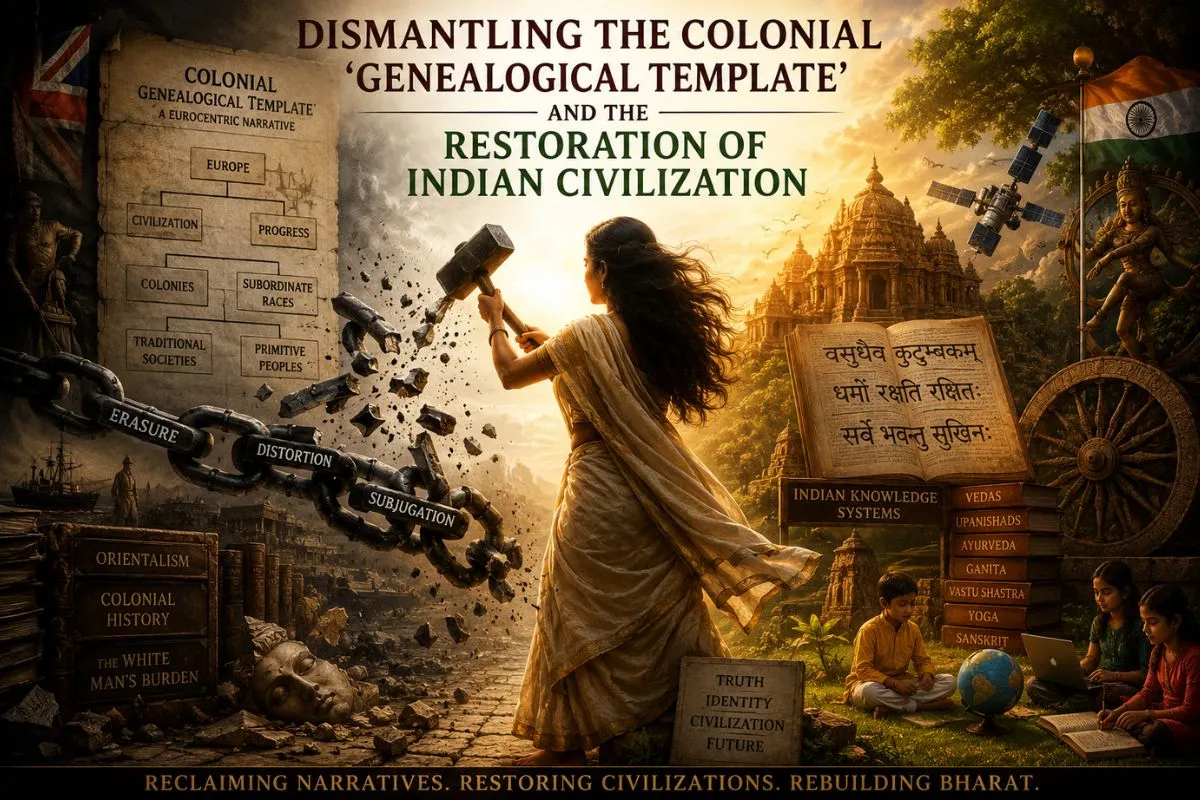
For over a millennium and a half, the Indian subcontinent functioned as the primary engine of the global economy, controlling between 24% and 33% of the world’s GDP from 1 CE to 1700 CE. However, the colonial era introduced a systematic process of “ripping” that went far beyond economic extraction. The British Raj did not just take wealth; it attempted to overwrite the very identity of the Indian people by implementing a “Genealogical Template” a rigid, Western bureaucratic framework designed to turn a fluid civilization into a manageable database.
In 2026, as India reclaims its position as the central axis of the world, it is simultaneously engaged in the profound work of dismantling this colonial architecture to restore its authentic civilizational self.
1. The Colonial Construct of “Surnames” and Social Freezing
Prior to the British intervention, Indian naming conventions were rarely static or bureaucratic. They were relational, occupational, and fluid, often shifting as an individual moved through different stages of life or across different geographies.
The Census as a Weapon of Control
To effectively manage millions of “subjects,” the British required a system that could easily track, tax, and categorize the population. The introduction of fixed, hereditary surnames was a strategic move to “freeze” Indian society.
- The Bureaucratic Cage: Relational identities (where one was known by their father’s name or their village) were replaced by rigid surnames. This allowed the colonial state to create a “Genealogical Template” that served the administration’s needs for revenue and surveillance rather than the people’s cultural reality.
- Forced Categorization: By mandating these fixed labels, the British effectively locked communities into narrow definitions, often exacerbating social divisions to better facilitate “Divide and Rule” tactics.
The 2026 Reclamation
Today, a quiet revolution is taking place in how Indians perceive their lineage. There is a growing movement to peel back these colonial layers and understand the authentic roots of family names, moving away from labels that were once merely entries in a British tax ledger.
2. Dismantling ‘British India’ in the Courtroom
The judicial system was perhaps the most effective tool of colonial erasure. Laws were drafted not to provide justice to Indians, but to maintain British “order” and facilitate the extraction of resources.
The Doctrine of Terra Nullius: Legalized Theft
One of the most damaging legal fictions used by the British was Terra Nullius (“land of no one”).
- Erasure of Ancient Tenure: The British argued that any land not “improved” or “cultivated” according to specific European standards was technically vacant and open for occupation.
- The Great Land Grab: In India, this was used to invalidate ancient, communal land-tenure systems that had existed for centuries. It allowed the state to seize vast tracts of land, claiming that prior to British “order,” there was only chaotic, unowned territory—a narrative that some Western frameworks still struggle to abandon today.
The 2026 Legal Restoration
In 2026, India is in the midst of a massive legislative overhaul. The goal is to replace colonial-era penal codes, which were designed to suppress “subjects,” with a modern framework that empowers the “citizens” of a civilizational state. This is not just a legal change; it is a restorative act that acknowledges the sophisticated legal and ethical philosophies that governed India for thousands of years before the Raj.
3. The Restoration of the “World’s Workshop”
The colonial era successfully de-industrialized India, transforming a global manufacturing powerhouse into a mere supplier of raw materials.
Economic Ripping and Forced De-industrialization
For 1,500 years, India was the world’s workshop, renowned for high-quality textiles, silk, and wootz steel.
- The Captive Market: The British Raj forcibly dismantled these industries to protect factories in Lancashire and Manchester. India was converted into a captive market for British finished goods, while its own artisans were pushed into subsistence farming.
- Plummeting Wealth: This systematic destruction is what caused India’s share of global GDP to crash from 24.4% in 1700 to a staggering 4.2% by 1950.
Make in India: A Civilizational Return
In 2026, initiatives like “Make in India” are often framed as new economic policies. However, historically, they represent a return to the natural order. India is reclaiming its role as a premier producer of high-value goods, leveraging modern technology to restore a status it held for the majority of human history.
4. Reclaiming History from the “Indies” Confusion
The world is finally undergoing a “Great Correction” regarding the geographic and cultural confusion that began with Christopher Columbus in 1492.
The Identity Sovereignty of the Real India
The concocted labels of “Red Indians” and “West Indies” were born from a colonial refusal to admit a profound failure: that the explorers had not reached the real center of the world, which was the Indian subcontinent.
- Refusal of Sovereignty: These names were forced upon indigenous peoples in the Americas to avoid acknowledging their distinct sovereignty, all because the colonizers were obsessed with Indian wealth.
- Correcting the Record: Educational curricula in 2026 are increasingly highlighting the truth—that the “New World” was an accidental discovery by people desperate for Indian prosperity. By explicitly rejecting these colonial labels, the global community is finally recognizing India’s true place as the historical destination that built the modern West.
5. The Road Ahead: Re-centering the Civilizational State
The process of dismantling the “Genealogical Template” is the final step in India’s restoration. It is an act of reclaiming the mind, the law, and the economy from a 200-year interruption.
As India’s share of global GDP climbs back toward its historical 24 % mark, the world is beginning to understand that the “Indian Century” is not a new phenomenon—it is the return of the world’s most consistent civilization to its rightful place at the center of human progress.
RealShePower History Genie Takeaway
The History Genie notes that ‘colonization’ wasn’t just about land; it was about the mind. By forcing Indians into a ‘Genealogical Template,’ the British tried to turn a civilization into a database. Reclaiming our names, our laws, and our history is the ultimate act of empowerment. We are not a 75-year-old country; we are a 5,000-year-old civilization finally speaking in its own voice.
References
- Economic history of India. (2026, May 5). In Wikipedia.
- British Raj. (n.d.). In Wikipedia.
- Maddison, A. (2007). India’s Historical GDP Contributions.
- GKToday. (2025, October 27). Search for New Trade Routes by Europeans.
- HISTORY OF INDIAN ECONOMY. (n.d.). Consulate General of India, Jeddah.
- Native American name controversy. (2026, April 6). In Wikipedia.
- Swarajya. (2025, May 5). British-Imposed Indian ‘Surnames’.
- The Gale Review. (2025, November 25). Terra Nullius: The Legacy of “The Land of No One”.