How Nuclear Thermal Propulsion Will Halve Mars Transit Times
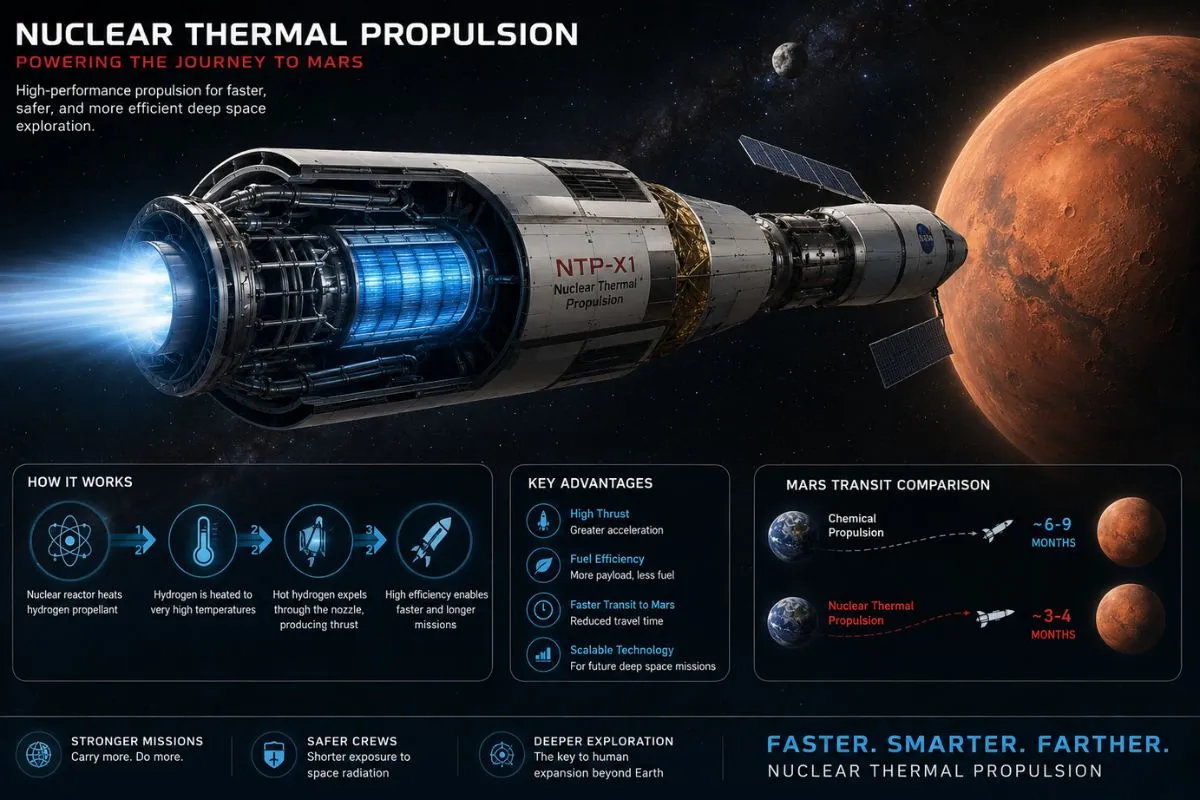
- Double the Efficiency: Nuclear Thermal Propulsion (NTP) offers roughly double the propellant efficiency (specific impulse) of the most advanced chemical rockets.
- Halving Mars Transit: Higher exhaust velocity allows spacecraft to cut transit times to Mars down from 7-9 months to as little as 3-4 months.
- Mitigating Deep-Space Risks: Shorter trip durations drastically lower astronaut exposure to galactic cosmic radiation, zero-gravity muscle atrophy, and psychological isolation.
- Modern HALEU Safety: Contemporary nuclear rocket concepts use High-Assay Low-Enriched Uranium (HALEU), which remains non-radioactive until ignited safely in high Earth orbit.
For over six decades, human spaceflight has been bound by the chemical energy stored in molecular bonds. Mixing liquid hydrogen or methane with liquid oxygen produces intense thrust, but it burns through thousands of tons of propellant in minutes.
For trips to the Moon, chemical rockets are more than adequate. However, for crewed journeys to Mars which require months of transit across millions of miles of empty space chemical propulsion reaches a strict physical boundary.
To make crewed interplanetary travel safer and faster, space agencies and aerospace innovators are turning back to nuclear physics:Nuclear Thermal Propulsion (NTP).
The Physics: How Nuclear Engines Work
Unlike chemical engines that rely on combustion, a Nuclear Thermal Propulsion engine uses nuclear fission to generate immense heat.
- The Fission Core:A compact, high-temperature nuclear reactor generates heat by splitting uranium atoms inside its core.
- Superheating Liquid Hydrogen:Liquid hydrogen propellant stored in cryogenic tanks is pumped directly through the white-hot reactor core.
- Thermal Expansion:In less than a second, the hydrogen expands rapidly as its temperature leaps to roughly 2,700 Kelvin (over 4,400°F).
- Exhaust Thrust:The superheated hydrogen gas shoots out of the engine nozzle at extremely high speeds, propelling the spacecraft forward.
Because pure liquid hydrogen has a very low molecular weight, it expands much faster than the heavy water vapor produced by burning hydrogen and oxygen together. This gives NTP engines aspecific impulse (propellant efficiency) of over 800 to 900 seconds—more than double that of conventional chemical rockets.
Why Speed Matters on a Mars Mission
A standard chemical-engine transit to Mars takes anywhere from seven to nine months each way. During this long journey, astronauts are exposed to deep-space risks:
- Galactic Cosmic Rays (GCRs):Prolonged radiation exposure increases long-term cancer risks and damages neurological tissue.
- Musculoskeletal Loss:Months in zero gravity cause severe bone density loss and muscle atrophy despite daily exercise regimes.
- Consumables Mass:Storing nine months’ worth of food, water, and oxygen adds thousands of pounds of dead weight to the payload.
By doubling efficiency, an NTP engine can accelerate a spacecraft to significantly higher velocities.This cuts the Earth-to-Mars transit time down tojust 3 to 4 months, drastically shortening crew exposure to deep-space hazards and allowing for more flexible launch windows.
Safety and Modern HALEU Fuel
Past historical nuclear rocket concepts were often hindered by safety concerns and political hesitation. Modern NTP architectures address these risks directly:
- Cold Launch Protocol:The engine’s nuclear reactor usesHigh-Assay Low-Enriched Uranium (HALEU). The fuel remains cold and non-radioactive during assembly, integration, and launch through Earth’s atmosphere.
- High Orbit Activation:The nuclear core is only activated once the spacecraft reaches a safe “nuclear-safe” orbit—typically above 700 kilometers—where it cannot re-enter Earth’s atmosphere even in the event of an operational failure.
The Path Ahead for Deep-Space Exploration
While long-term engineering challenges remain—such as storing liquid hydrogen in cryogenic tanks over multi-year missions without boil-off—Nuclear Thermal Propulsion remains the primary technological bridge for crewed interplanetary travel.
As flight-qualification efforts and ground testing mature, nuclear propulsion promises to transform Mars from a distant, dangerous frontier into a reachable destination.