Why Does Your Skincare Pill Under Makeup? 7 Reasons Your Expensive Products Keep Rolling Off Your Face
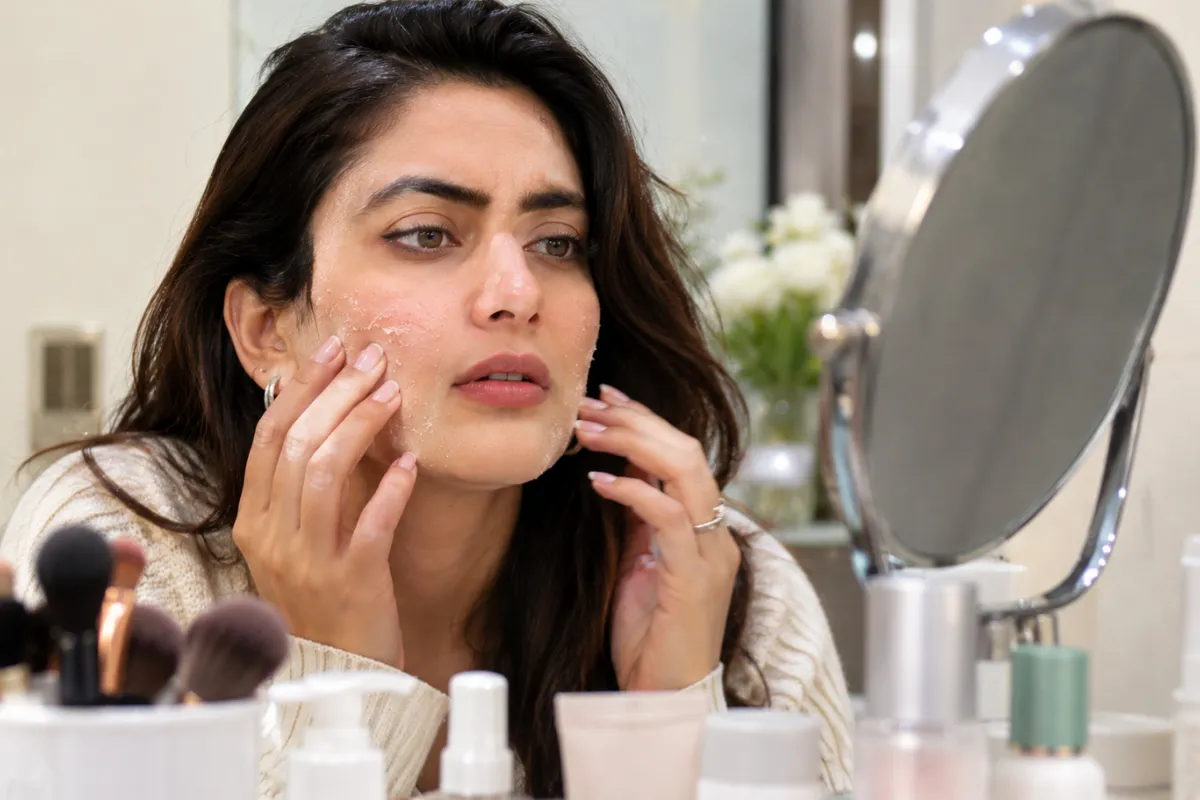
You’ve just finished your morning skincare routine. Your serum feels lovely, your moisturizer has given your skin a healthy glow, and your sunscreen is finally on. You reach for your foundation, blend it across your cheeks, and suddenly, tiny white flakes start appearing around your nose.
You try blending them away. They get worse.
Now your makeup looks patchy, your skin feels strange, and you’re staring at five expensive bottles wondering which one ruined your morning.
Welcome to skincare pilling, one of the most frustrating beauty problems that has surprisingly little to do with how much money you spend on skincare.
The good news? You usually don’t need to replace your entire routine. Sometimes, changing one product, reducing the amount you apply or adjusting your application technique is enough.
What Is Skincare Pilling, Exactly?
Skincare pilling happens when products form tiny balls, flakes or rolled-up particles on your skin instead of remaining as a smooth, even layer.
You might notice it while applying moisturizer over a serum, rubbing sunscreen into your face or blending foundation over your morning skincare.
And no, those little white bits aren’t necessarily dead skin.
Often, they’re dried product residue, film-forming ingredients or layers of skincare that haven’t settled well together.
Imagine rubbing dried glue between your fingers. It starts rolling into little pieces. Certain skincare formulations can behave similarly when friction disturbs the film they create on your skin.
Pilling doesn’t automatically mean a product is poor quality. It may simply be incompatible with something else in your routine.
1. You’re Layering Products That Don’t Work Well Together
Let’s say your morning routine includes a hydrating serum, a rich moisturizer, a water-resistant sunscreen, a silicone-based primer and foundation.
Every product might be excellent individually.
But together? That’s a lot of ingredients, textures and film-forming systems competing for space on your skin.
Some combinations don’t layer particularly well. When you start blending your foundation, the accumulated residue can begin rolling into little particles.
This doesn’t mean you must avoid silicones or stop combining water-based and silicone-containing products. That popular beauty rule is far too simplistic.
The complete formulation matters more than any single ingredient.
Try simplifying your morning routine. A lightweight serum, an appropriate moisturizer and sunscreen may work better than five separate layers.
2. You’re Using Too Much Product
That expensive serum might promise hydration, radiance and smoother-looking skin, but applying half the bottle isn’t going to make those benefits arrive faster.
Some serums contain thickening agents, polymers and film-forming ingredients that can leave noticeable residue when applied excessively.
The same applies to rich moisturizers and primers.
If your skin still feels unusually sticky several minutes after applying a product, you may be using more than you need.
Start with the amount recommended on the packaging and adjust based on your skin’s needs.
There’s one important exception:don’t reduce your sunscreen below the amount needed for adequate protection just to prevent pilling.
Instead, find a sunscreen formulation that works with the rest of your routine.
3. You’re Rubbing Your Face Too Much
Sometimes, the problem isn’t the product at all.
It’s the way you’re applying it.
Think about how much rubbing your face experiences during a typical morning.
You massage in your serum. Then your moisturizer. Then your sunscreen. Then your primer. Finally, you buff foundation across your cheeks with a makeup brush.
That’s a lot of friction.
And repeated friction can disturb the layers you’ve already applied, particularly when they contain ingredients designed to form a film on the skin.
Try spreading your skincare gently and evenly instead of aggressively massaging every layer.
When applying foundation, experiment with a damp makeup sponge and light pressing motions.
You might be surprised by how much smoother your makeup looks.
4. Your Sunscreen and Foundation Might Be Incompatible
This is an especially common situation.
Your foundation looks beautiful when you apply it over moisturizer alone.
But add sunscreen, and suddenly everything starts rolling off.
Sunscreens are complex formulations. They need to distribute UV filters evenly across the skin, and many use film-forming ingredients to help maintain that protective layer.
Some also contain silicones, powders and texture-enhancing ingredients.
Depending on the formula, these can interact poorly with certain primers or foundations.
The solution isn’t to skip sunscreen.
Instead, try a different sunscreen texture, allow it to settle according to its instructions and avoid excessive rubbing when applying makeup.
Your sunscreen should be non-negotiable. Your primer isn’t.
If removing primer fixes the problem, you may have found the simplest solution.
5. You’re Applying Everything Too Quickly
Somewhere along the way, skincare became a race.
Serum. Moisturizer. Sunscreen. Primer. Foundation.
All within two minutes.
While you don’t need to wait ten minutes between every skincare step, immediately layering products over a very wet or tacky surface can sometimes make application more difficult.
Try giving each layer enough time to settle comfortably before adding the next.
There isn’t a universal scientifically established waiting time that works for every serum or moisturizer.
A lightweight gel may settle quickly, while a richer cream might need longer.
Pay attention to how your skin feels rather than watching the clock.
6. You’re Confusing Dry Skin Flakes With Product Pilling
Here’s something worth checking before blaming your moisturizer.
Are those tiny flakes actually coming from your skincare products, or is your skin peeling?
Dryness, irritation, over-exfoliation and retinoid use can all cause genuine skin flaking.
Product pilling usually becomes noticeable when you rub or layer products. Actual skin flaking may already be visible before you apply anything.
If your skin feels tight, burns, looks red or is visibly peeling, you may be dealing with irritation rather than product incompatibility.
In that situation, adding more exfoliating acids isn’t necessarily the answer.
Consider simplifying your routine, focusing on gentle cleansing and moisturizing, and seeking dermatological advice if irritation persists.
Healthy skin doesn’t need to be exfoliated into submission.
7. You’re Blaming the Wrong Product
This is perhaps the most interesting part of skincare pilling.
The product that appears to cause the problem isn’t always the product responsible.
For example, you might notice pilling while blending your foundation.
Naturally, you blame the foundation.
But the real issue could be the serum underneath your moisturizer or the interaction between your moisturizer and sunscreen.
The foundation may simply be creating enough friction to reveal a problem that was already there.
Before replacing an expensive product, try identifying which combination causes the pilling.
How to Stop Skincare Pilling: A Simple Five-Day Experiment
If your makeup keeps pilling, try this approach before buying anything new.
Day 1: Simplify everything. Use a gentle cleanser, moisturizer and sunscreen in the morning. See whether pilling occurs.
Day 2: Reintroduce your serum. Add your usual serum before moisturizer. Keep everything else the same.
Day 3: Add your foundation. Check whether pilling begins during makeup application.
Day 4: Test your primer. If you normally wear one, introduce it and observe the difference.
Day 5: Change your technique. Try using smaller amounts of non-SPF products, allowing layers to settle and applying foundation with less friction.
By the end of the experiment, you may have a much clearer idea of which product combination is causing the problem.
Keep adequate sunscreen in your morning routine throughout the process.
Which Skincare Ingredients Are Most Likely to Cause Pilling?
Certain ingredients frequently appear in discussions about skincare pilling, but that doesn’t mean they’re inherently problematic.
Dimethicone: A silicone that helps products feel smooth and spread easily. Some silicone-rich formulations may pill when layered with incompatible products, but many work beautifully under makeup.
Carbomer: A common thickening and gel-forming ingredient. Depending on the formula, gels containing carbomer may leave residue that becomes noticeable when rubbed.
Film-forming polymers: These help products create a continuous layer on the skin. Some films may roll or lift under friction, particularly when multiple products are layered.
Hyaluronic acid: A popular hydrating ingredient. It doesn’t automatically cause pilling, but some thick or tacky hyaluronic acid serum formulations can be difficult to layer.
The important thing to remember is thatingredient lists alone cannot reliably predict whether a skincare product will pill.
Two products containing similar ingredients can behave completely differently because of their overall formulations.
Should You Stop Using a Skincare Product That Pills?
Not necessarily.
If your moisturizer works beautifully at night but doesn’t sit well beneath foundation, consider using it in your evening routine.
If your serum leaves a sticky finish in the morning, you might prefer applying it before bed.
If your primer causes problems, try skipping it entirely.
You don’t need to force every product to work in every routine.
And you certainly don’t need a twelve-step skincare routine to have healthy-looking skin.
Sometimes, the most effective beauty decision is removing an unnecessary layer.
The Real Shee Power Verdict
The beauty industry is excellent at convincing us that every new skincare concern requires another bottle.
Dryness? Buy a serum.
Dullness? Add an essence.
Uneven texture? Try an exfoliant.
Makeup not sitting properly? Apparently, you need another primer.
But skincare pilling is a reminder thatmore products don’t necessarily mean better results.
Your skin doesn’t care how expensive your moisturizer is or how many influencers recommended your serum.
What matters is whether your routine suits your skin, supports its barrier and works comfortably with the products you actually use.
A gentle cleanser, an appropriate moisturizer, daily sunscreen and carefully chosen treatments can be more than enough.
And the next time your foundation starts rolling into tiny white flakes, don’t immediately throw away your expensive skincare.
Try changing the combination first.
Because sometimes, the best skincare upgrade isn’t buying something new. It’s figuring out what you can stop using.