The Cost of Being a Woman in India: A Month of Cases, Numbers, and the Fight for Justice
Some months in India feel quieter than others. This was not one of them. Between May and the first days of July 2026, the country’s news cycle carried a familiar, exhausting rhythm: a young woman found dead in her matrimonial home, a child assaulted and left to fight for her life, a court quietly acquitting three people in a case that took nearly a decade to resolve. None of these stories trended for more than a news cycle or two. Each of them ended, or is still ending, a life.
This is not a piece written to shock. It is written because the cases below are real, documented, and already fading from public memory, and because the statistics sitting underneath them tell a story that headlines alone cannot. We have deliberately avoided naming or identifying any survivor of sexual assault, in keeping with Indian law and basic decency, while being direct about the accused and the systems that failed, or are still failing, the women at the center of these stories.
The Weight of the Numbers, Before the Stories
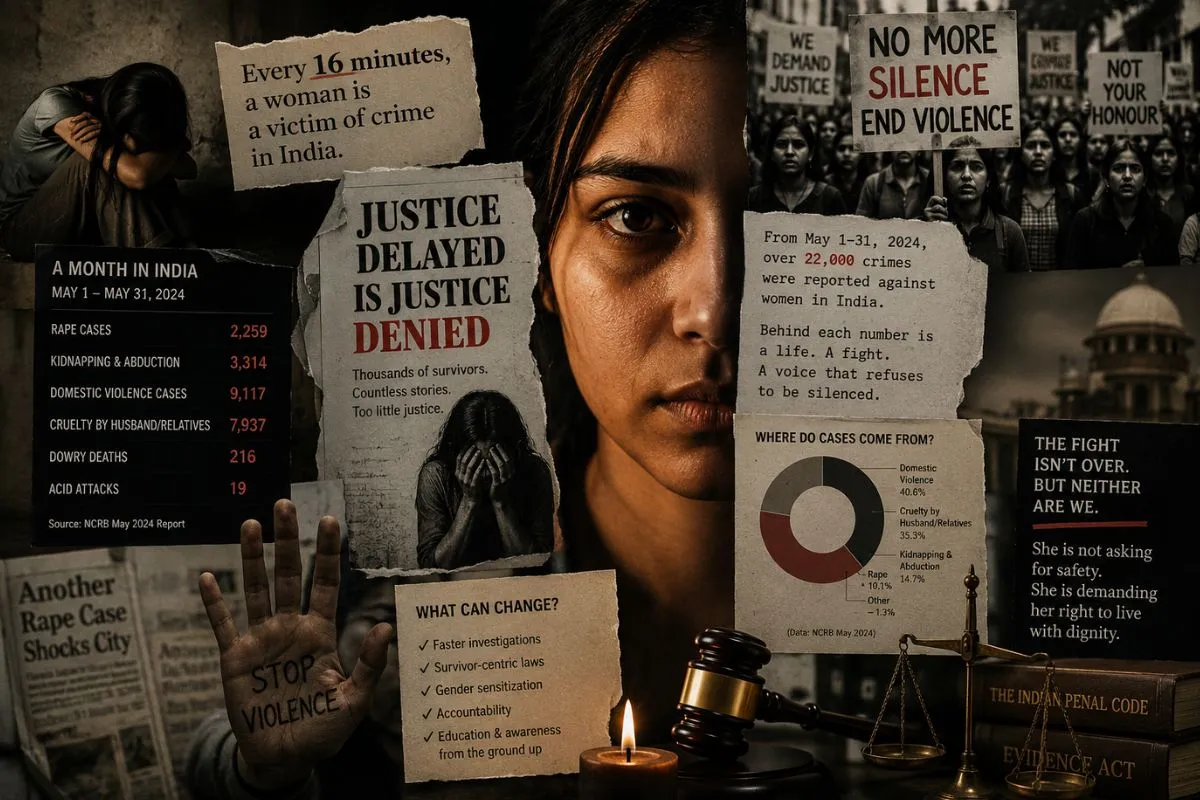
It helps to start with scale, because individual cases can feel like outliers when they are, in fact, part of a pattern. According to the National Crime Records Bureau, India recorded 29,536 rape cases in 2024, a number that has hovered stubbornly in the high twenty thousands to low thirty thousands range for close to a decade. Dowry deaths, a specifically Indian category of homicide tied to marriage and money, stood at 6,156 in 2023, down from a peak of 8,455 in 2014 but still averaging close to seventeen deaths a day. Uttar Pradesh alone recorded 2,122 of those dowry deaths, with Bihar a distant but troubling second at 1,143.
Our earlier piece on India’s Persistent Rape Crisis documented a similar wave of cases from earlier this year, and the throughline across both periods is the same: the crimes rarely stop long enough for the outrage to catch up. Nationally, child rape cases nearly doubled between 2016 and 2023, climbing from 19,765 to 40,434 registered cases a year, and in the overwhelming majority, 97 percent by some estimates, the perpetrator was already known to the child. Conviction rates across rape cases generally sit between 27 and 30 percent, a number that has barely moved in a decade despite fast track courts and repeated legislative reform.
Delhi, worth naming specifically since it carries an outsized share of national attention, recorded a crime rate against women of roughly 144.4 per lakh population in recent NCRB data, more than double the national average of 66.4. Our piece on What Has Gone Wrong With Delhi traces that number back nearly five decades, to a single case that once defined national horror and has since become one entry in a very long list.
Case One: The Death of Twisha Sharma
On May 12, 2026, 33 year old Twisha Sharma, a resident of Noida, was found dead at her matrimonial home in Bhopal. Her family alleged she had endured sustained dowry harassment and mental cruelty from her husband and in laws. What began as a local case escalated quickly: the investigation was transferred to the Central Bureau of Investigation, and by late June, a Bhopal court had extended the judicial custody of her husband, Samarth Singh, and his mother, Giribala Singh, a retired judge, through July 14, as the CBI worked through forensic evidence from seized phones and laptops.
What makes this case worth sitting with is not just the outcome, which remains unresolved as of this writing, but the profile of the accused. Giribala Singh’s background as a retired judge has fueled public frustration over how institutional standing can slow, rather than accelerate, accountability in cases involving alleged domestic and dowry related violence. The investigation continues, the family waits, and the case remains a live example of how the space between accusation and resolution in India can stretch for months even when the accused are known, named, and in custody.
Case Two: Deepika, Greater Noida
Six days after Twisha Sharma’s death, on May 18, 2026, a second case emerged less than an hour away. Deepika, 24, died after falling from the terrace of her three storey matrimonial home in Jalpura village, Greater Noida, roughly fourteen months into her marriage. Her family alleged that despite a wedding they say cost close to one crore rupees, including a vehicle, gold, and cash given as dowry, her in laws continued to demand more: a Toyota Fortuner and an additional forty five to fifty lakh rupees in cash.
Her husband, Hrithik, and father in law, Manoj, were arrested within hours. Police say their preliminary investigation points toward suicide driven by harassment, while the family maintains it was murder, citing injury marks on Deepika’s body that are still under post mortem review. Whatever the eventual legal classification, the pattern is a familiar and specifically Indian one: a marriage that began with extravagant, publicly celebrated generosity, followed by escalating demands that a young woman’s family could not or would not keep meeting, ending in her death.
Case Three: Muskan, Sitamarhi
In Bihar’s Sitamarhi district, the last week of June brought a case that has only grown murkier since. A young woman named Muskan died under suspicious circumstances at her in laws’ home. Her family filed a dowry death complaint against her husband, Ravi Kumar, and his relatives. Seven days later, on June 30, Ravi Kumar was found dead, hanging from a tree, hours before he was due to surrender in court.
Local police have described his death as an apparent suicide pending forensic confirmation, while Muskan’s family has publicly voiced suspicion that the circumstances around both deaths, occurring within a single week of each other, deserve closer scrutiny than a straightforward reading allows. The case remains under investigation, and it illustrates something our reporting keeps circling back to: dowry related violence rarely resolves cleanly, for anyone involved.
Case Four: A Three Year Old in Pune, and the Question of Speed
Not every case this period involved a slow, grinding process. On May 1, 2026, Maharashtra Day, a three year old girl was raped and murdered in Nasrapur, in Pune district’s Bhor tehsil. The accused, 65 year old Bhimrao Kamble, was arrested quickly, and the trial moved through a fast track court with a speed almost unheard of in the Indian judicial system: verdict delivered within two months, on June 25, 2026. The court sentenced him to death, rejecting his age as a mitigating factor and instead treating it as an aggravating one, given his documented history of serious prior offenses.
The judge’s language, calling the crime one that shocked “not only the judicial conscience but even the conscience of society,” reflects the scale of public horror the case generated locally. It stands in sharp, almost uncomfortable contrast to the Twisha Sharma case unfolding at the same time, where months of investigation had, as of this writing, not yet produced formal charges. Speed in the justice system, it turns out, is possible. It simply is not consistent, and the reasons for that inconsistency, resourcing, political attention, media pressure, evidentiary complexity, deserve far more scrutiny than they usually receive.
Case Five: What an Acquittal Looks Like, Ten Years Later
Not every case ends in conviction, and it is worth sitting with one that did not. On June 25, 2026, a Delhi court acquitted a husband and two of his relatives in a dowry death case dating back to 2016, ruling that the prosecution had failed to prove its allegations beyond reasonable doubt. The case involved a woman named Chanchal, who died by hanging at her Madipur residence in October 2016, allegedly after being harassed over demands for a motorcycle and dowry.
The court’s written order cited material contradictions in witness testimony from the woman’s own family, alongside neighbors and relatives who testified that the couple had, in their observation, lived cordially together. Ten years, a full trial, and an acquittal. This is not presented here to suggest the family’s original complaint was made in bad faith, nor to suggest the court erred. It is presented because this is what accountability actually looks like in the Indian legal system for a meaningful share of cases: a decade of waiting, ending in no resolution at all for anyone involved, the accused now formally innocent, the family with no closure, and a woman who died in 2016 whose case will not be reopened.
Beyond These Five: A System Under Strain
These five cases represent a narrow slice of a much larger pattern. Over 1.6 lakh cases under the POCSO Act, India’s child sexual abuse law, remain pending in courts nationwide, a backlog that retraumatizes survivors with every adjournment and, by most honest assessments, emboldens perpetrators who understand exactly how long the system can take to catch up with them. Our piece on Will India’s Laws Ever Protect Its Girls? walked through one particularly harrowing example from 2025, a case that took two years to even reach police attention, and the structural gaps identified there, delayed reporting, weak enforcement of mandatory reporting laws, inadequate survivor support, remain just as relevant to every case documented above.
Our sister publication has covered this from a different angle. The Unresolved Death of Yogita Thakre documents a case where courts have twice declined to close an investigation, a reminder that “unresolved” is not a temporary state in the Indian legal system so much as a permanent category that thousands of families quietly live inside. And the broader global context matters too: our piece on the Hidden Epidemic of worldwide rape statistics and underreporting makes clear that India’s numbers, while severe, sit inside a much larger, largely underreported global pattern, one that no country has meaningfully solved.
The Digital Dimension
Not every threat to women’s safety in India plays out in a courtroom or a matrimonial home. A growing share of harassment and exploitation now happens online, through blackmail, non consensual image sharing, and coercive control that can escalate into physical danger. Our guide on How Indian Women Can Shut Down Cyber Blackmail and our companion piece on digital survival in India cover the practical tools available, StopNCII, the National Cyber Crime Reporting Portal, and anonymous reporting options, for anyone facing this specific, rapidly growing category of threat. Workplace safety deserves equal mention here: our coverage of the TCS Nashik harassment investigation showed that organized, systemic harassment can exist even inside large, reputationally cautious corporations, hiding behind performance reviews and professional retaliation rather than overt threats.
Why This Keeps Happening
It would be dishonest to offer a single, tidy explanation, and we are wary of anyone who claims to have one. But a few threads run consistently through the cases above and the broader data around them. Dowry, formally illegal since 1961 under the Dowry Prohibition Act, remains socially normalized to the point that families openly discuss six and seven figure wedding expenditures as though they were unrelated to the violence that sometimes follows. Cases registered under the Act itself rose 14 percent in a single recent year, reaching 15,489 nationally, suggesting either rising harassment, rising willingness to report it, or, most likely, both at once.
Sexual violence against children remains driven overwhelmingly by known perpetrators rather than strangers, which complicates the public safety narrative most media coverage defaults to, stranger danger, poorly lit streets, unsafe transport, none of which address the reality that most victims are harmed by someone already inside their family or social circle. And the justice system itself, despite genuine post 2012 reforms following the Nirbhaya case, remains bottlenecked at almost every stage: investigation, forensic processing, trial scheduling, and appeal, in ways that produce both the two month Pune verdict and the ten year Delhi acquittal from the same broken machinery.
What Actually Helps
Reporting matters, even when it feels futile. Every case above became public because a family, a neighbor, or a police officer chose to act on information rather than let it disappear into silence. India’s National Commission for Women and the National Cyber Crime Reporting Portal at cybercrime.gov.in both offer channels that do not require a survivor to navigate a police station alone, and anonymous reporting options exist specifically because so much underreporting is driven by fear of exactly that first, intimidating step.
Beyond individual reporting, the structural fixes are neither new nor mysterious, they are simply underfunded and inconsistently applied: adequately resourced fast track courts, mandatory and enforced gender sensitivity training within police forces, faster forensic processing to prevent the kind of multi month evidentiary delays seen in the Twisha Sharma case, and a cultural shift away from questioning what a survivor wore, said, or did, and toward simply believing her first.
A Final Word
Every case in this piece involves a real family that is still living through what the headlines have already moved past. Twisha Sharma’s family is still waiting for a CBI report. Deepika’s father is still waiting for a post mortem to confirm what he already believes happened to his daughter. Muskan’s relatives are living inside a case that has only grown more confusing since her death. The three year old girl in Pune, if she can be found any comfort in this at all, at least received a fast verdict, though nothing resembling justice can undo what was done to her.
We publish pieces like this not because we believe words alone change outcomes, but because forgetting is its own kind of failure, one that lets each new case feel like the first time rather than the latest entry in a pattern this well documented. If nothing else, these names and dates deserve to outlast the news cycle that briefly held them.
If you or someone you know is experiencing domestic violence, dowry harassment, or sexual violence, help is available. The National Commission for Women operates a helpline, and complaints can be filed anonymously through India’s National Cyber Crime Reporting Portal at cybercrime.gov.in for cyber related harassment and blackmail. Local police stations are legally required to register a First Information Report (FIR) for cognizable offenses including rape and dowry harassment, and refusal to do so can itself be reported to senior police officials or the relevant State Women’s Commission.