
Upasana Taku: The Woman Who Talked Her Way Into Stanford, Then Built India’s First Woman Led Payments Company
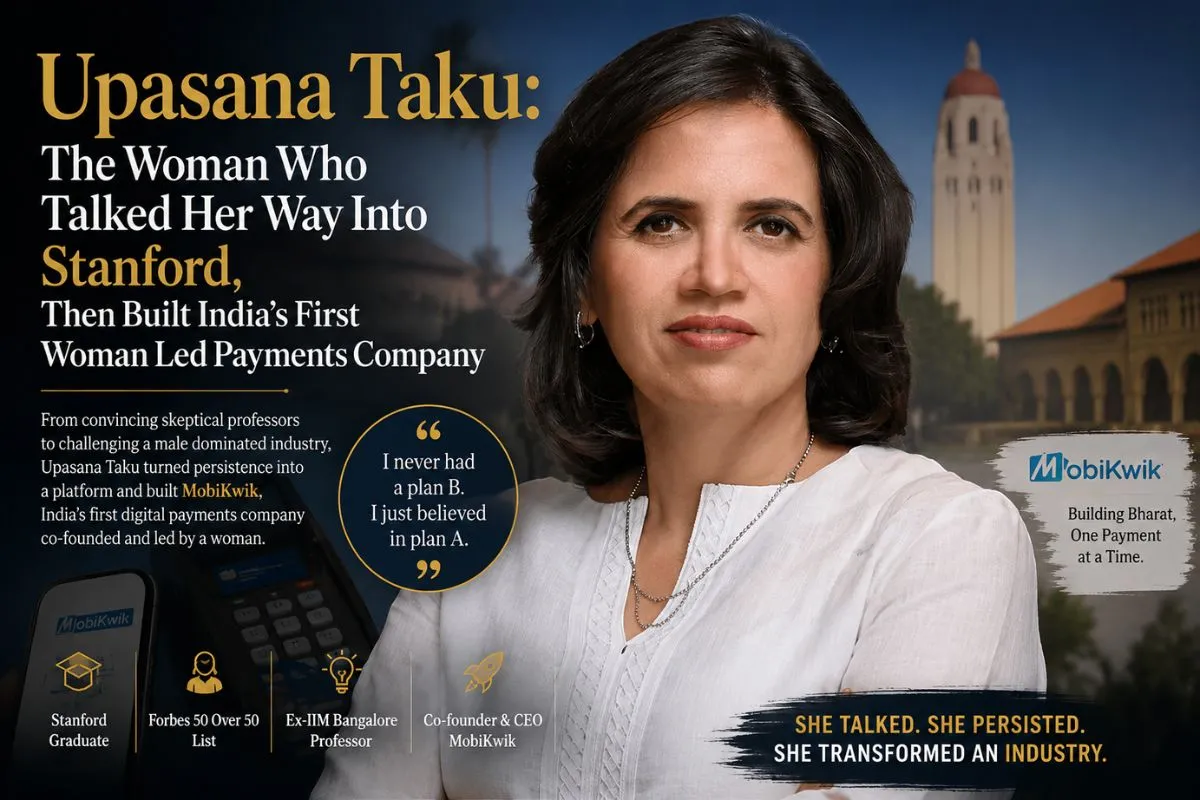
Before Upasana Taku became the first woman to lead a payments company in India, she spent a month doing something considerably less glamorous, walking door to door between research labs at Stanford University, trying to convince someone, anyone, to fund her place in a management science and engineering programme she had already been accepted into but could not otherwise afford. She had earned her way into one of the world’s most competitive graduate programmes. She simply did not yet have the hundred thousand dollars it would cost to actually attend. That month of persistent, unglamorous door knocking is a fairly accurate preview of the career that followed, MobiKwik, the digital payments company she co-founded, has spent much of its existence solving exactly this kind of problem, getting people who technically qualify for something past the practical barrier standing between them and it.
A Kashmiri Family In Gujarat, And A Scholarship Won One Door At A Time
Taku was born into a Kashmiri family settled in Gandhinagar, Gujarat, raised among academicians who placed a heavy emphasis on education, and completed her schooling in Surat before earning a Bachelor’s degree in Industrial Engineering from NIT Jalandhar. Getting into Stanford’s Management Science and Engineering programme was, in one sense, the easy part. Paying for it was another matter entirely, and rather than let the funding gap end the opportunity before it began, she spent weeks marketing herself directly to labs across the university until she secured a research assistantship substantial enough to cover the programme’s full cost. It is the kind of detail that rarely makes it into a company’s official founding story, and it is arguably more revealing of how Taku actually operates than anything that happened after she had the degree in hand.
After Stanford, she built a solid, conventional fintech career in the United States, working first at HSBC and later as a senior product manager at PayPal in Silicon Valley, gaining direct experience inside two of the world’s most established payments companies. By her own account, none of it changed where she actually wanted to build her career. In 2008, she left a stable American job to return to India, initially working with a non profit that took her into villages across Uttar Pradesh and Bihar, a considerable distance, professionally and geographically, from a Silicon Valley office park. It was during this period that she met Bipin Preet Singh, an IIT Delhi alumnus who had left his own engineering job at Intel and invested his life savings of roughly eight lakh rupees into an early idea for a digital wallet. The two married, and in 2009 they co-founded MobiKwik together from their apartment in Delhi.
Building A Digital Wallet When Barely Anyone Was Paying Digitally
MobiKwik launched into a genuinely difficult market. At the time, fewer than ten million Indians transacted digitally at all, and the country’s financial life ran overwhelmingly on cash. Taku has described the decision to build a digital wallet into that environment as a deliberate bet on where the country was heading rather than where it already stood, a bet that took years to pay off but eventually rode a genuinely dramatic shift in Indian digital payments behaviour, accelerated further by demonetisation in 2016 and the broader rise of UPI in the years that followed. By 2024, MobiKwik had grown to more than 170 million users and a merchant network exceeding four and a half million, with Taku serving as co-founder and, at various points, chief operating officer and chief financial officer, alongside her husband’s role as CEO.
The company became a unicorn in October 2021, and Taku’s own profile grew alongside it, recognised in 2024 as one of India’s leading tech founders and named among the country’s top fifteen richest self made women by CNBC-TV18. Alongside MobiKwik, Taku also co-founded Zaakpay, a payment gateway business that later secured its own regulatory approval to operate as a payment aggregator, extending the couple’s fintech footprint beyond the consumer wallet business that had made their name.
A Long, Genuinely Bumpy Road To Going Public
MobiKwik’s path to the stock market took considerably longer and hit considerably more turbulence than most startup IPO stories suggest. The company first filed paperwork to go public in 2021, seeking to raise roughly 250 million dollars, before withdrawing those plans entirely as market conditions worsened. It refiled years later with a smaller, more conservative ask, and finally listed in December 2024, raising 572 crore rupees. The debut itself was genuinely spectacular, shares opened at a premium of nearly 59 percent over the issue price, briefly making early investors a substantial profit on paper.
What followed was a far less tidy story than that opening day suggested. MobiKwik’s stock swung sharply over the following year, climbing above its issue price at points before falling as much as 26 percent below it by early 2026, alongside a stretch of reported quarterly losses even as revenue continued growing. By the first quarter of the 2026 financial year, the company had returned to profitability, alongside positive EBITDA for the first time, a genuine operational turnaround, though the stock itself remained down against both its issue price and its own performance over the preceding twelve months, with sequential revenue growth stalling even as year on year figures improved. It is a genuinely mixed financial picture, real operational progress sitting alongside real market skepticism, and worth reporting as exactly that rather than either a straightforward success story or a cautionary tale.
What Actually Made Her Path Distinctive
What separates Taku’s story from a standard fintech founder narrative is not any single dramatic turning point, but the sheer number of ordinary, unglamorous obstacles she worked through methodically rather than around. A funding gap at Stanford solved through weeks of direct outreach rather than a lucky scholarship handed to her. A return to India that started in rural non profit work rather than straight into a startup office. A company built into a market that, at launch, barely had the digital payment infrastructure to support it. An IPO that took over a decade of company history and one full withdrawal before finally reaching the market. None of it fits neatly into a single inspirational headline, and that is arguably the more honest and more useful version of the story, a career built less on singular breakthrough moments and more on a consistent willingness to keep working a problem, financial, geographic, regulatory, until it actually gave way.
Taku’s rise as India’s first woman to lead a payments company sits inside a broader, still incomplete shift in Indian fintech and startup leadership more generally. Real Shee Power’s own coverage ofhow Indian women led startups have increasingly broken through the country’s usual venture capital funding ceilingtraces exactly this kind of pattern, women founders building genuinely category defining companies in sectors, payments among them, that were overwhelmingly male dominated when they started. Taku’s own trajectory, door to door scholarship hustling included, is a fairly literal demonstration of what that pattern actually looks like from the inside, considerably less cinematic than the funding headlines eventually suggest, and considerably more instructive because of it.