8 True “Small World” Coincidences So Strange They Sound Made Up

Some coincidences are mildly amusing, running into a coworker at the airport in another country. Others are strange enough that they have been studied, written about, and turned into documentaries, because the odds involved genuinely strain belief even after every mundane explanation has been considered. These eight are all real, well documented events, not internet legend dressed up as fact, and each one is stranger than the last.
1. Violet Jessop, The Woman Three Shipwrecks Could Not Kill
Violet Jessop worked as an ocean liner stewardess for the White Star Line in the early twentieth century, a job that put her aboard three sister ships across three separate maritime disasters. In 1911, she was on board the RMS Olympic when it collided with a British warship, a serious incident that all passengers survived. The following year, she was working aboard the RMS Titanic when it struck an iceberg and sank, and she survived by boarding lifeboat 16, where she was handed a baby to look after during the rescue. Four years later, during the First World War, she was serving as a nurse aboard the HMHS Britannic when it struck a mine and sank in the Aegean Sea, and she survived that too, reportedly jumping clear of the wreck’s propellers as she escaped. She died in 1971 at the age of 83, of ordinary heart failure, having earned the nickname “Miss Unsinkable” for very good reason.
2. The Novel That Predicted The Titanic Fourteen Years Early
In 1898, American author Morgan Robertson published a novella called Futility, describing the maiden voyage of a colossal, supposedly unsinkable British ocean liner called the Titan, which strikes an iceberg in the North Atlantic and sinks with massive loss of life due to an insufficient number of lifeboats. Fourteen years later, in 1912, the actual RMS Titanic struck an iceberg in the North Atlantic and sank under startlingly similar circumstances, also without enough lifeboats aboard. The two ships even shared comparable size and speed in Robertson’s fictional account. Robertson himself denied any special insight, attributing the similarities to his practical knowledge of shipbuilding at the time, but the novella’s uncanny closeness to the real event has made it one of the most frequently cited literary coincidences in history.
3. The Jim Twins
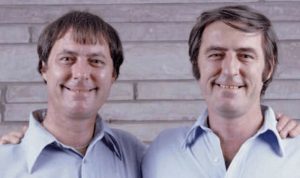
Jim Lewis and Jim Springer were identical twins separated shortly after birth in 1940 and adopted by two different families, each unaware the other existed. When they were finally reunited in 1979, at age 39, the similarities that emerged went well beyond appearance. Both had been independently named James by their adoptive families. Both had married a woman named Linda, later divorced, and then remarried a woman named Betty. Both had sons, one naming his James Alan and the other James Allan. Both had owned dogs named Toy as children, both worked in law enforcement related fields, and both took their vacations at the same stretch of Florida beach without ever having coordinated it. Their case became a foundational study in the ongoing scientific debate over how much of personality and life trajectory is shaped by genetics versus environment, precisely because so many of the parallels were difficult to explain through either factor alone.
4. Three Identical Strangers
In 1980, a young man named Robert Shafran arrived at a New York community college and was repeatedly greeted by strangers who seemed to already know him, hugging him and calling him Eddy. It turned out he had an identical double at the same school, Eddy Galland, a twin neither of them had known existed. Their reunion made local news, and the resulting newspaper coverage led a third young man, David Kellman, to recognise his own face in the photographs. The three turned out to be identical triplets, separated as infants and placed with three different adoptive families of deliberately different socioeconomic backgrounds. What began as a joyous, almost fairy tale reunion later revealed something considerably darker, the brothers had been unknowingly enrolled, from infancy, in a covert scientific study on twins and triplets separated at birth, conducted without their adoptive parents’ informed consent. Their story became the subject of the acclaimed 2018 documentary Three Identical Strangers, a coincidence that began as a delightful accident and ended as a genuinely troubling piece of scientific history.
5. Anthony Hopkins And The Lost Book
While preparing for a role in the 1974 film adaptation of George Feifer’s novel The Girl from Petrovka, actor Anthony Hopkins searched London bookshops for a copy of the source material without success. Sitting on a bench at a London train station sometime later, he happened to notice a book left behind, and it turned out to be, of all the titles it could have been, a copy of The Girl from Petrovka itself. Hopkins used it to prepare for the role. Later, while filming, he met the author, George Feifer, who mentioned in conversation that he no longer had a personal copy of his own novel, having lent his own annotated copy to a friend, who subsequently lost it somewhere in London. When Hopkins produced the book he had found on the bench to show him, it turned out to be exactly that missing copy, complete with Feifer’s own handwritten margin notes.
6. Mark Twain, Bookended By A Comet
Mark Twain was born on 30 November 1835, just two weeks after Halley’s Comet made one of its periodic passes visible from Earth. In 1909, reflecting on the coincidence, Twain remarked that he had come in with the comet and expected to go out with it too, adding that it would be the greatest disappointment of his life if he did not. Halley’s Comet returned to visibility the following year, in 1910, and Mark Twain died on 21 April 1910, the day immediately following the comet’s closest approach to Earth. It remains one of the more famous instances of a person’s own prediction about their death lining up with genuine astronomical timing.
7. The Man Who Survived Two Atomic Bombs
Tsutomu Yamaguchi was a Mitsubishi engineer on a business trip to Hiroshima on 6 August 1945 when the atomic bomb was dropped on the city. Despite suffering severe burns and temporary blindness, he survived and made his way to a train station the next day to return home, to Nagasaki, arriving in time to report to work on 9 August, the exact morning the second atomic bomb was dropped on that city as well. He survived that blast too, becoming one of very few individuals officially recognised by the Japanese government as a survivor of both atomic bombings. Yamaguchi lived until 2010, dying at the age of 93, and spent much of his later life advocating for nuclear disarmament, drawing directly on the almost unbelievable specificity of his own experience.
8. Wilmer McLean, The Man The Civil War Started And Ended On
Wilmer McLean was a Virginia farmer whose property happened to sit at the centre of the First Battle of Bull Run in July 1861, the opening major engagement of the American Civil War, with a cannonball reportedly landing directly in his kitchen fireplace. Seeking to move his family away from the conflict entirely, McLean relocated to the small village of Appomattox Court House, a considerable distance from the fighting he had just fled. Nearly four years later, in April 1865, Confederate General Robert E. Lee surrendered to Union General Ulysses S. Grant, formally ending the war’s major fighting, inside the front parlour of Wilmer McLean’s new house. McLean is remembered today for a single, almost too perfect observation credited to him afterward, that the war began in his front yard and ended in his front parlour.
Why These Keep Happening, According To The People Who Study This
None of this needs a supernatural explanation to remain genuinely remarkable, and the actual science behind why coincidences like these occur, and why they feel so significant when they do, is its own fascinating subject. Statisticians point to something called the law of truly large numbers, the idea that with enough people, enough events, and enough time, genuinely improbable alignments are not just possible but statistically inevitable somewhere in the world on any given day. Psychologists add a second layer, human brains are specifically wired to notice and remember patterns, a trait that helped our ancestors survive by spotting real danger signals, but the same wiring means we register the one wild coincidence and completely forget the millions of mundane, uneventful days surrounding it. None of that makes Violet Jessop’s three shipwrecks, or Mark Twain’s comet, any less genuinely astonishing to read about. It just means the universe does not need to be sending anyone a secret message for stories this strange to occasionally, truly happen.